
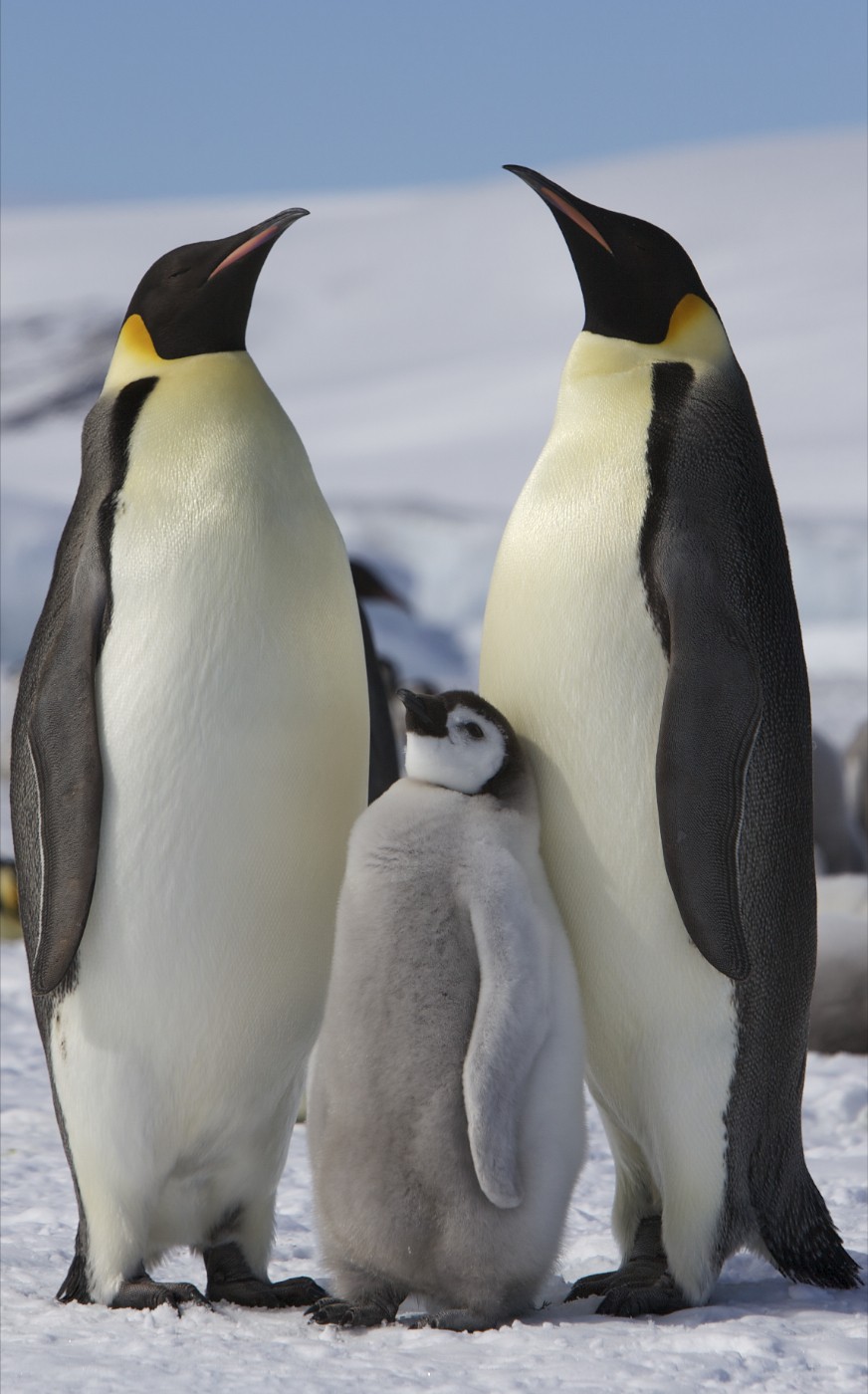
The emperor penguin (Aptenodytes forsteri) is a large flightless seabird endemic to Antarctica. Its most striking physiological feat is its dive: emperor penguins can reach about 1,850 feet (roughly 565 metres) below the surface, deeper than any other bird on record, and stay submerged for more than 20 minutes on a single breath. As of April 2026, the species was listed as Endangered on the IUCN Red List, upgraded from Near Threatened, based on projections that climate-driven sea-ice loss will reduce its population by half before the 2080s. Around 595,000 adults were estimated to remain as of April 2026, between 10 and 22 percent fewer than in 2009.
Key facts
- Scientific name: Aptenodytes forsteri
- Kingdom: Animalia
- Phylum: Chordata
- Class: Aves
- Order: Sphenisciformes
- Family: Spheniscidae
- Genus: Aptenodytes
- Taxonomic rank: species
- Mass: 425 g
Taxonomy and closest relatives
Aptenodytes forsteri sits within the family Spheniscidae and the order Sphenisciformes, under the class Aves. The genus name Aptenodytes comes from Greek for “featherless diver”. The king penguin is the only other member of the genus and is therefore the emperor penguin’s closest living relative. Genetic marker studies place their divergence in the early Miocene, during a period of global cooling that produced permanent Antarctic ice sheets.
The species name forsteri honours Johann Reinhold Forster, the naturalist aboard Captain James Cook’s second voyage of 1772 to 1775. The naming was done by Gray, though a historical survey published in the 2010s in Polar Record concludes Gray was almost certainly mistaken about who first observed the bird: Thaddeus von Bellingshausen in 1820 was probably the actual first observer, not Forster. The first breeding colony was located and studied by Edward Wilson and colleagues during Robert F. Scott’s expeditions of 1902 to 1903 and 1911.
Breeding biology
Emperor penguins reach reproductive maturity between 4 and 6 years old and breed once per year, with the cycle running from April to December during the Antarctic winter. Courtship can last up to six weeks and accounts for about 16 percent of the total breeding cycle. Among birds arriving at breeding grounds, 82 percent of males and 56 percent of females pair with a mate within 24 hours.
The female lays a single egg, pear-shaped and pale greenish-white, measuring almost 5 inches long and 3 inches wide (12 by 8 cm). The male incubates and protects the egg in a brood pouch, a skin fold on his lower abdomen, for roughly 65 days until the female returns.
Newly hatched chicks weigh just 11 ounces (312 grams). They carry only a thin layer of down at hatching and are completely dependent on the father for warmth and protection.
Diving physiology
On foraging trips at sea, emperor penguins routinely dive to about 1,850 feet, with one individual recorded at 565 metres, the deepest confirmed dive of any bird. Submersion can last more than 20 minutes. To sustain that duration, the bird’s heart rate drops to as low as 15 to 20 beats per minute during the deepest phases of a dive, while non-essential organs reduce activity to preserve the available oxygen supply.
Population and conservation status
On April 9, 2026, the IUCN moved the emperor penguin from Near Threatened to Endangered. The uplisting rests on modelling showing the global population will halve by the 2080s if sea-ice trends continue at projected rates. As of April 2026, the estimated adult population stood at around 595,000, a decline of 10 to 22 percent compared with 2009 figures.
Colony-level data sharpen that picture. Seven colonies in the Ross Sea declined by 32 percent between 2020 and 2024, a loss of approximately 23,000 birds in five years. In 2020, scientists reported finding 11 new or rediscovered colonies via satellite, a 20 percent increase in known breeding locations; those sites added only five to ten percent more birds to the overall population estimate, so the new colonies did not substantially change the conservation picture.
A 2026 BAS study identified moulting groups of emperor penguins in satellite imagery for the first time. The images showed that in the 2022 to 2024 period, sea ice broke up before adults had finished moulting, forcing birds into the ocean before their new waterproof feathers had grown in, exposing them to hypothermia and increased predation risk. Satellite surveys locate colonies in part by detecting the pinkish-brown discolouration that large concentrations of penguin guano leave on white Antarctic ice.
Did you know
- One emperor penguin has been recorded diving to a depth of 565 metres, deeper than any other bird. (wwf.org.uk)
- Satellite surveys identify colonies by spotting the tell-tale pinkish-brown stains of penguin guano on the white Antarctic ice. (wwf.org.uk)
- In 2020, scientists reported discovering 11 new or rediscovered emperor penguin colonies via satellite, a 20 percent increase in known breeding locations, though they added only five to 10 percent more birds to the overall population estimate. (sciencealert.com)
- During deep dives the emperor penguin’s heart rate can slow to as low as 15–20 beats per minute while non-essential organs shut down to conserve oxygen. (solarspell-dls.sfis.asu.edu)
Data sources
Data updated: 2026-11-18