
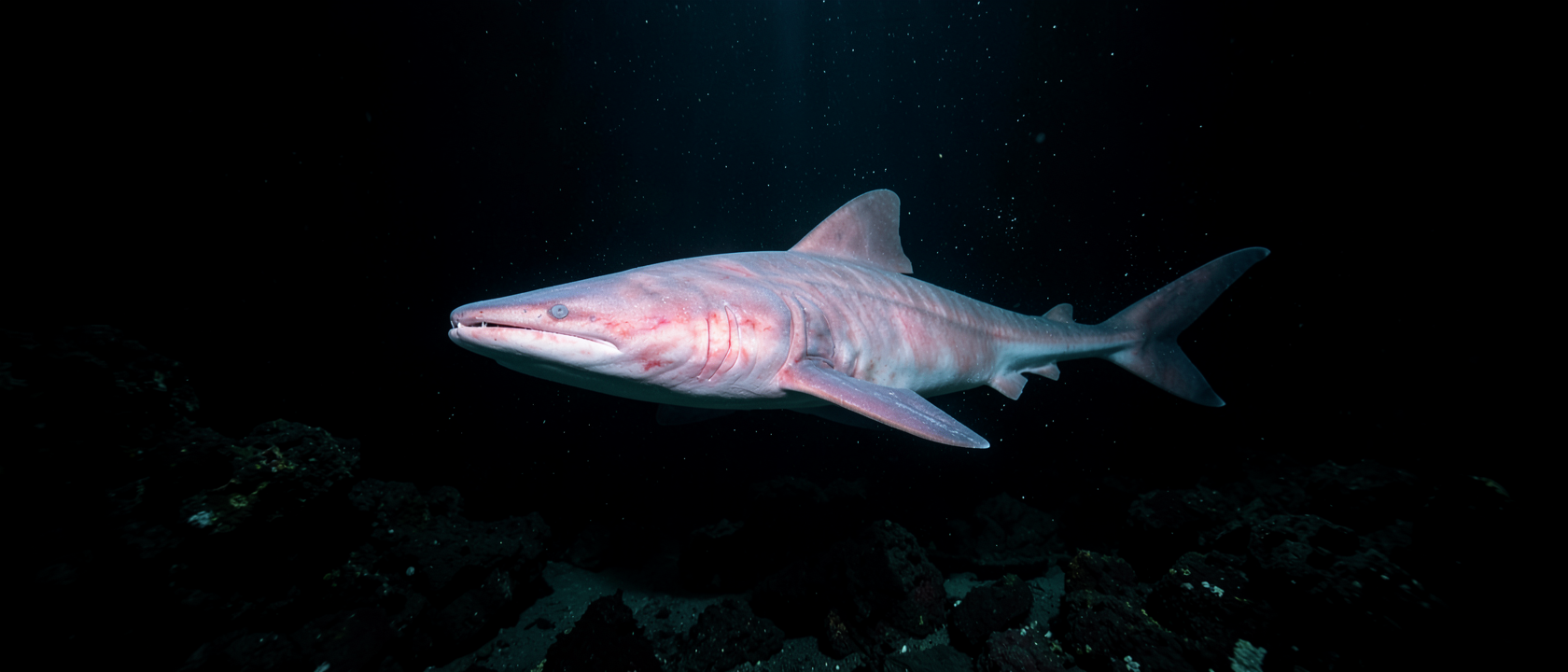
Every goblin shark video that ever existed was a death scene. A pink, soft-bodied shark with a blade-like snout would come up tangled in a longline, hauled through hundreds of feet of collapsing pressure, and the camera only ever found it dying on a boat deck. That changed when a team led by University of Hawaiʻi at Mānoa doctoral candidate Aaron Judah published, in the Journal of Fish Biology, the first confirmed footage of a living goblin shark (Mitsukurina owstoni) simply moving through its own deep-sea habitat. The goblin shark is the only surviving member of a shark family, Mitsukurinidae, that has existed for roughly 125 million years. Nobody had ever filmed one just being a shark.
The two new sightings sit an ocean apart and five years apart. The first was filmed in 2019 by the remotely operated vehicle Hercules, during an Ocean Exploration Trust expedition aboard the E/V Nautilus, near an unnamed seamount northwest of Jarvis Island, at 4,059 feet (1,237 meters) down. The second was filmed in 2024 on the slope of the Tonga Trench, by a baited camera on a bottom lander deployed from the R/V Dagon during the Inkfish Open Ocean Expedition, run by the Minderoo-UWA Deep-Sea Research Center.
How two teams filmed a living goblin shark
Goblin sharks live on outer continental shelves, upper slopes, and seamounts, at depths down to 4,265 feet (1,300 meters), though most records cluster between 886 feet and 3,150 feet (270 and 960 meters). That water is hard to reach and even harder to film without disturbing what lives there. Almost every past encounter with a live goblin shark came from bycatch, a shark caught by accident on a fishing line, dragged up through a huge pressure change, and filmed only as it lay dying. Neither new sighting worked that way. The Jarvis Island footage had been sitting in a public dive archive, unreviewed, since 2019. Judah found it in 2025 after colleagues mentioned a possible goblin shark sighting, then combed through the old Nautilus tape until he located it himself. The Tonga Trench footage came from a different kind of tool: a baited lander, a rig that sinks to the seafloor, sets out bait, and simply waits, with no vehicle moving in to risk spooking the animal and no boat hauling it up into water it was never built to survive. Both methods did the same job: they let a goblin shark behave normally, alive, with nobody chasing it.
A new depth record for an entire shark order
The Tonga Trench shark was filmed nearly 2,300 feet (700 meters) deeper than any goblin shark had ever been confirmed alive before. The paper reports that the same observation also extends the maximum confirmed depth for the order Lamniformes, the mackerel sharks that include the white shark, the basking shark, and the mako, by 354 feet (108 meters). The finding means a slow-moving bottom specialist now holds the depth record for an order otherwise known for fast, open-water hunters. The paper reads this as evidence of a real tolerance for cold, crushing, lightless water, a tolerance that had simply never been tested by a camera able to reach that far down.
A region with no prior goblin shark records
Goblin shark range maps have long shown a handful of narrow bands: waters off the western United States, around Japan, around Australia, with scattered records from the Atlantic and Indian Oceans. Both new sightings sit in the Central Pacific, a stretch of ocean with zero prior confirmed goblin shark records. The paper reads that gap as a survey gap, not an absence. A map built mostly from fishing bycatch reflects where boats worked their longlines; it says little about where the sharks actually live. Two animals, five years apart and recorded on opposite sides of the Central Pacific, cannot settle whether the region holds an established group of goblin sharks or whether these were simply wanderers that happened to pass a camera. That question stays open.
An independent discovery in Hawaiʻi and Tonga
Aaron Judah says he was “shocked” when colleagues at the University of Hawaiʻi’s Deep-Sea Fish Ecology Lab first mentioned a possible goblin shark sighting in the Central Pacific, while he was reviewing the old Nautilus archive in 2025. The species had never been recorded anywhere near Jarvis Island. Alan Jamieson had already lived through his own version of that shock in 2024, when his baited lander came back from the Tonga Trench slope with a goblin shark on it, a species he said he never expected to film alive. Neither team knew about the other’s footage until they compared notes and realized they were holding video of the same elusive species from opposite ends of the same ocean. Jamieson called it “incredible.”