
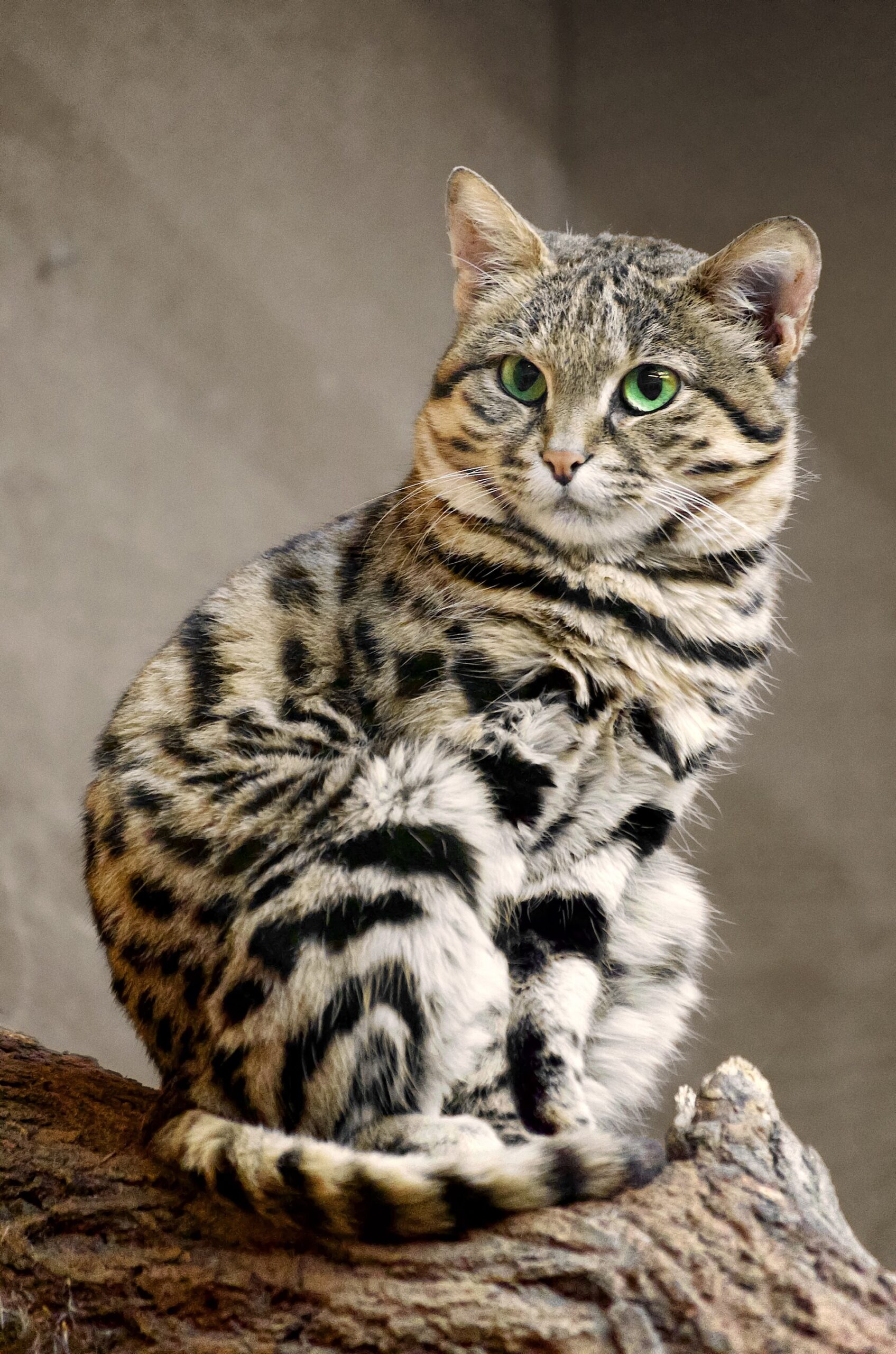
The black-footed cat (Felis nigripes) is the smallest wild cat in Africa and one of the smallest in the world, yet it holds the highest hunting success rate of any cat species on record, completing a successful hunt roughly every 30 to 50 minutes during its nightly forays. Its estimated mature wild population stands at approximately 9,707 individuals, with the trend running downward. Confined mainly to the arid and semi-arid zones of southern Africa, most of its range falls outside formally protected areas, which makes the species unusually dependent on private landowners for its long-term survival.
Key facts
- Scientific name: Felis nigripes
- Kingdom: Animalia
- Phylum: Chordata
- Class: Mammalia
- Order: Carnivora
- Family: Felidae
- Genus: Felis
- Taxonomic rank: species
- Mass: 74 g
- Gestation period: 65 days
Physical characteristics
With a recorded mass of 74 g, the species is among the lightest members of the family Felidae. The cat’s ears are rounded and sit low on the skull, an arrangement that sharpens hearing considerably. During a hunt, those ears flatten tight against the head, reducing the cat’s profile in areas with limited ground cover and making the approach harder for prey to detect.
A metabolism calibrated for constant activity drives the cat to cover up to 10 miles on a single night. That pace demands continuous refuelling: the roughly 60% hunting success rate, documented across the species, is the highest figure recorded for any cat.
Behaviour and reproduction
The black-footed cat is nocturnal. In the wild, mating occurs between August and March; in captivity, breeding can happen at any time of year. After a gestation period of 65 days, litters average 1.78 kittens, based on 164 recorded captive-born litters. Kittens are somewhat more mature at birth than domestic cat kittens and develop at a noticeably faster rate.
A mother returns to her full nocturnal hunting routine within four days of giving birth, hunting for only two hours on the first night after the kittens arrive. The brevity of that transition reflects how tightly the species’ fast metabolism constrains even maternal behaviour.
Size does not map onto timidity. Black-footed cats have been documented defending themselves against jackals eight times their own body weight. One observer recorded a female weighing 1.5 kg spending thirty minutes stalking an 80 kg male ostrich on its nest, a pursuit that illustrates what the species will attempt when hungry.
Temperament in captivity
Zookeepers describe black-footed cats as notoriously untamable. That assessment holds even for newborn kittens, in which the same ferocity is present from the first days of life. The species does not follow the domestic cat’s historical trajectory of tolerance toward humans, and captive management remains demanding for that reason.
Health and genetics
A genetic condition called AA-amyloidosis is prevalent in Felis nigripes. The condition causes amyloid protein to accumulate in organs, eventually leading to organ failure. It complicates wild survival and has significantly hampered captive breeding programmes, limiting the usefulness of captive populations as a genetic reserve.
Conservation status and threats
The estimated mature population of approximately 9,707 individuals is declining. Much of that pressure comes from outside the species’ own biology. In South Africa, black-footed cats are killed by blanket predator-control operations aimed at other animals: poisoned baits, night shooting, trapping, and hunting with dogs claim individuals that happen to be within the target zone.
Because the majority of the species’ range sits on private land rather than inside game reserves or national parks, formal protection mechanisms reach only a fraction of occupied habitat. Conservationists working with the species have therefore concentrated on building direct relationships with private landowners, encouraging judicious predator management and healthy prey populations rather than relying on park boundaries.
Small cats as a group represent 33 of the world’s 40 wild cat species but receive less than 1% of global wild cat conservation funding by some estimates. That funding gap means that many threats to Felis nigripes are documented long before resources exist to address them.
Research
The Black-footed Cat Working Group (BFCWG) has carried out more than two decades of field research into the species’ ecology, health, and distribution. Their work produced much of the baseline data on population size, nightly movement distances, and reproductive biology that informs current conservation planning.
In 2018, Panthera launched its Small Cats Program, naming the black-footed cat one of its focal African species alongside the sand cat and the African golden cat. The programme directs research and advocacy resources toward species that have historically received little institutional attention relative to larger cats.
Did you know
- A Bushman legend holds that the black-footed cat can kill a giraffe. Ecologists dismiss this as an exaggeration, but the story persisted because the cat’s reputation for ferocity among animals many times its size gave it a believable shape. (animalinfo.org)
- One observer watched a female black-footed cat weighing 1.5 kg spend half an hour in careful pursuit of an 80 kg male ostrich that was sitting on its nest. (animalinfo.org)
- The calls that black-footed cats produce during the breeding period are deeper and louder than the cat’s body size would lead most people to expect. They are repeated at intervals and carry far enough to help animals locate potential mates across open terrain. (wildcatconservation.org)
- Zookeepers describe the black-footed cat as notoriously untamable. The same fierce disposition is present in newborn kittens, before the animals have had any significant contact with humans. (baike.baidu.com)
- Black-footed cat kittens are more developmentally advanced at birth than domestic cat kittens and reach subsequent milestones at a faster rate. (wildcatconservation.org)
Data sources
Where it appears
- Palm-sized wild cat prowled a cave full of archaic humans, hunting rats November 25, 2026
Data updated: 2026-11-15