
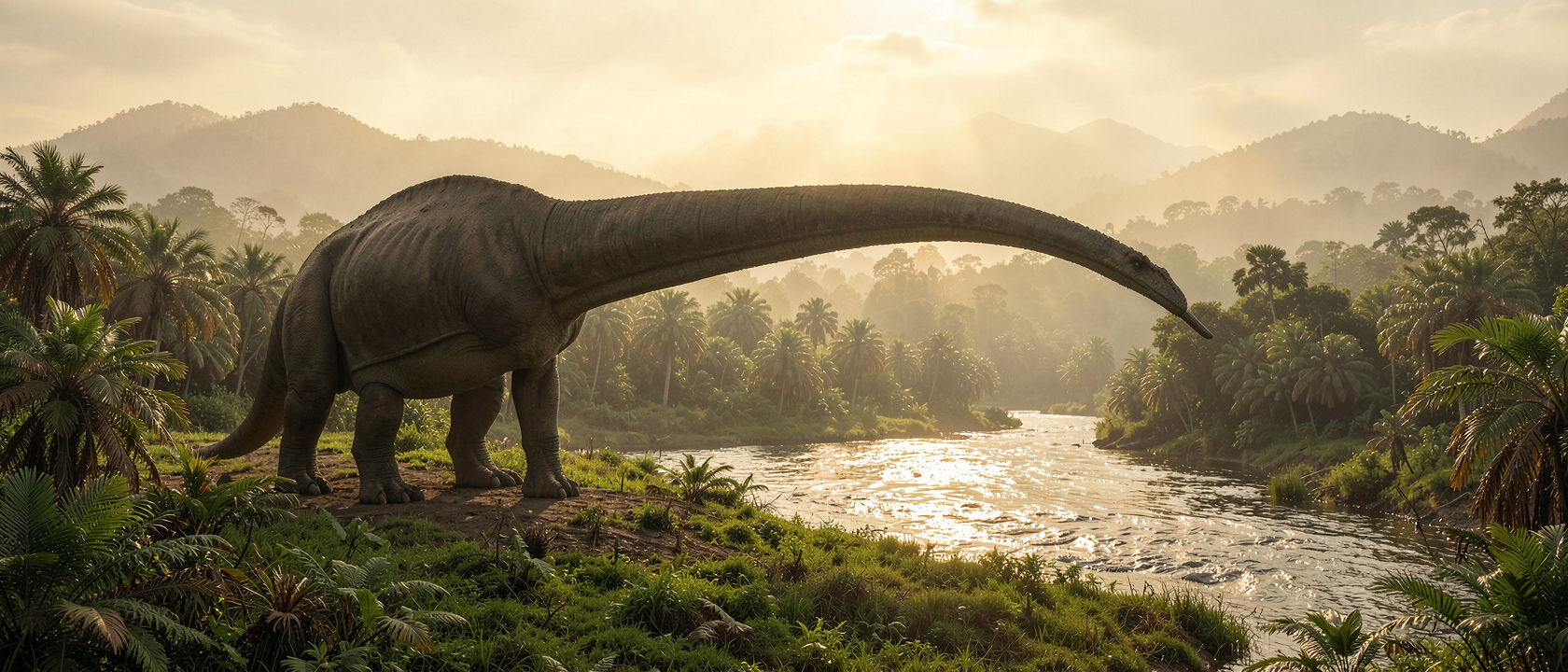
One Bone, One New Dinosaur
One fossilized vertebra was enough to name an entirely new species of giant, long-necked dinosaur. In a paper published in Scientific Reports on July 8, 2026, Apirut Nilpanapan of Mahasarakham University, together with Sita Manitkoon, Varavudh Suteethorn, and Komsorn Lauprasert, described Uragasaurus kalasinensis from a single anterior dorsal vertebra dug out of the Phu Kradung Formation at the Phu Noi Locality in Kalasin Province, northeastern Thailand.
That vertebra, cataloged as PRC 460 and held at the Palaeontological Research and Education Centre at Mahasarakham University, is not a scrap of some already-known animal filed under a new label. It is the holotype: the single physical specimen that anchors the species name and everything scientists will ever be able to say about it. The bone places the animal inside Mamenchisauridae, a family of sauropods built around some of the longest necks any land animal ever evolved.
How a Vertebra Talks
Naming a species from one bone sounds reckless until you see what that bone actually holds. Nilpanapan’s team examined the vertebra by eye and then ran it through a CT scanner, the same imaging technology that lets a doctor see inside a body without opening it, to map what was hidden beneath the fossil’s surface.
Two things turned up that match nothing else on record. On the outside, the bone carries a Y-shaped configuration of bony ridges, called laminae, formed where the intraprezygapophyseal laminae meet. On the inside, the scan revealed small hollow chambers: pneumatic cavities left by air sacs that, in life, extended out from the dinosaur’s lungs into its own skeleton, the same system that hollows and lightens the bones of birds today. In Uragasaurus, that architecture would have taken weight off a spine built to carry a very long neck.
The team checked both features directly against vertebrae from two Chinese relatives, Mamenchisaurus hochuanensis and Mamenchisaurus anyuensis, and found no match. Neither the ridge pattern nor the internal cavity layout lines up with anything already named. A phylogenetic analysis, a statistical test of evolutionary relationships run against a published dataset, placed Uragasaurus as an early-branching member of Mamenchisauridae. Nilpanapan later told the BBC, in an interview from July 2026, that it was the vertebra’s internal structure specifically that convinced him he was looking at a mamenchisaurid.
China Wasn’t the Whole Map
Mamenchisauridae has, until now, read almost like a regional dinosaur family rather than a global one. Its members have turned up overwhelmingly in China, in basins like Junggar, Turpan, and Sichuan, consistently enough that the family’s known range looked settled. Uragasaurus kalasinensis is the first formally named mamenchisaurid from Thailand, and the authors argue it pulls the family’s confirmed territory into mainland Southeast Asia for the first time.
Pinning down exactly when this animal lived is harder than naming it. The Phu Kradung Formation has no layer that can be dated radiometrically, so there is no single confirmed number, only a window. Regional stratigraphy and detrital zircon data point to a Late Jurassic origin for most of the formation, possibly running into the earliest Cretaceous near the top. The authors read the vertebra’s anatomical affinities with those Chinese basins, Junggar, Turpan, and Sichuan, as consistent with a placement somewhere near that Jurassic-Cretaceous transition, not as proof of an exact date. That shared ancestry, they argue, points to faunal connections across the East Asian landmass at the time.
None of that changes what the animal looked like. It changes where a lineage of some of the longest-necked animals that ever lived gets to count as home.
Nobody Found a Skeleton
The popular image of a dinosaur discovery is a brush, a pit, and a complete animal rising out of the rock bone by bone, the kind that ends up wired together under a museum ceiling. Most dinosaur species are not named that way, and this one certainly was not. Uragasaurus kalasinensis exists, as a scientific entity, as exactly one vertebra. No skull, no limb, no tail, no skin impression. Nothing else is confirmed to belong to this animal.
That is not a lesser kind of discovery. A single bone, read closely enough, carries enough detail, in its ridge pattern and its internal air-sac architecture, to separate one species from every other one on record. The museum skeleton is the exception in paleontology, not the rule.
The Bones Next Door
The Phu Noi site did not give up just one bone. Within a few yards of the vertebra, the team also recovered a fibula, a coracoid, several cervical vertebrae, and additional vertebrae, all consistent with a sauropod of roughly the right kind. It would be easy to assume all of it came from one animal.
The researchers declined to make that call. The bones were not found articulated, meaning not connected the way they would have been in a living skeleton, and their anatomy is not distinctive enough to tie them specifically to Uragasaurus kalasinensis rather than some other sauropod sharing the same floodplain. The team labels them “associated sauropod materials,” a deliberately noncommittal name for evidence that is real but not diagnostic.
That is where it stands: one named species, one holotype vertebra, and a handful of other bones sitting a few yards away that may or may not belong to it. Nobody is sitting on the answer. There isn’t one yet.