
The Fact That Shouldn’t Be Possible
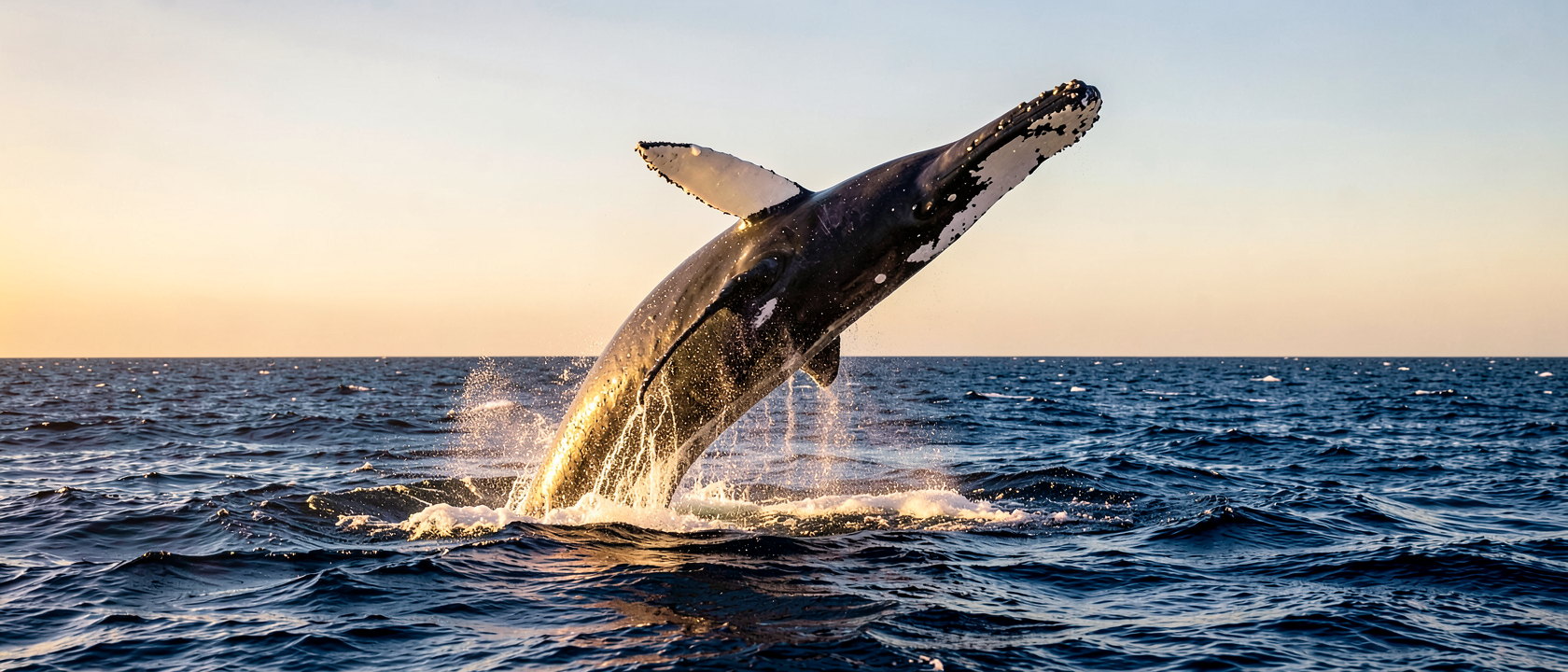
A humpback whale (Megaptera novaeangliae) photographed at Abrolhos Bank, Brazil, in 2003 turned up again off Hervey Bay, Queensland, in September 2025. Alone. Roughly 9,383 miles (15,100 km) from where it had last been seen. That is the longest gap ever recorded between two sightings of a single humpback whale, and it links two breeding populations that researchers have long treated as separate. This whale did not drift off course by a few hundred miles. It crossed an entire ocean basin and surfaced in another country’s nursery.
How You Recognize One Whale Among 20,000
Dr. Cristina Castro Ayala of the Pacific Whale Foundation and Stephanie Stack, a PhD candidate at Griffith University, led a team that compared 19,283 fluke photographs collected between 1984 and 2025, pulled from the citizen-science platform Happywhale. A humpback’s tail fluke carries a black-and-white pigment pattern on its underside that barely changes over the animal’s lifetime, plus scars and a trailing-edge shape as individual as a fingerprint. An image-recognition algorithm flags possible matches first; a person then checks the same two photographs by eye, sometimes decades and continents apart. No tags, no tracking collars, no satellites. Just photographs contributed by scientists and whale-watchers worldwide, and a pattern that doesn’t lie.
Why a Whale Would Ever Switch Breeding Grounds
The leading explanation is called the Southern Ocean Exchange hypothesis. Humpbacks from different breeding populations, Australia, Brazil, and others, all converge on the same Antarctic feeding grounds each year to gorge on krill. Most swim home to the exact population they were born into, loyal to one coastline for life. But occasionally, the idea goes, a whale falls in with a different group at the feeding grounds and simply follows them home instead, possibly settling into the new breeding region permanently. If that’s right, this is how distant breeding populations stay connected, not only genetically, but culturally too. Humpback song is already known to spread between populations that mix, so a whale carrying a new tune home is not a stretch.
The Closed-Population Myth This Breaks, and the Number That Keeps It Honest
The study, titled “First Evidence of Bidirectional Exchange Between Distant Humpback Whale Breeding Populations in Eastern Australia and Brazil” and published in Royal Society Open Science in 2026, names two confirmed cross-ocean individuals. The first was photographed in Hervey Bay in 2007, seen there again in 2013, then photographed off São Paulo, Brazil, in 2019, a straight-line distance of about 8,823 miles (14,200 km). The second is the Abrolhos-to-Hervey-Bay whale, the record holder. The widespread assumption, repeated in documentaries and textbooks, is that eastern Australian and Brazilian humpbacks are closed populations that never mix. This finding contradicts that outright: researchers note humpbacks are generally very loyal to their breeding grounds, yet here are two that weren’t. The honesty check matters just as much. Out of 19,283 photographs covering nearly 20,000 individual whales across four decades, only these two crossings turned up, about 0.01 percent of identified animals. That isn’t “populations mix all the time.” That’s “it happens, rarely, and we finally caught it on camera.”
What Nobody Knows Yet
Whether this is a one-off fluke or something becoming more common is genuinely unresolved. Researchers propose that Antarctic krill distribution is shifting as the Southern Ocean warms, which could be reshuffling feeding grounds, and with them, the whales that use them, into new configurations more often than before. That link is a hypothesis, not an established fact. Nobody has the historical photo density to say whether cross-population swaps were always this rare or are only now starting to show up because there are finally enough cameras pointed at enough tails. And the route itself is a blank: researchers documented a starting photograph and an ending photograph, not the path in between, so 15,100 km is a straight-line distance, not a confirmed swim. Answering any of this needs another decade, at minimum, of fluke photographs.
Nine Friends, Then None
The last time anyone photographed this particular whale before 2025, it was in 2003, one of what researchers described as a large, boisterous group of nine adults at Abrolhos Bank. Twenty-two years later, it surfaced on the opposite side of the planet, photographed completely alone in Hervey Bay. Nobody knows the route it took, the company it kept along the way, or why it left. Just two photographs, decades apart, of what is very likely the same animal living two entirely different lives.