
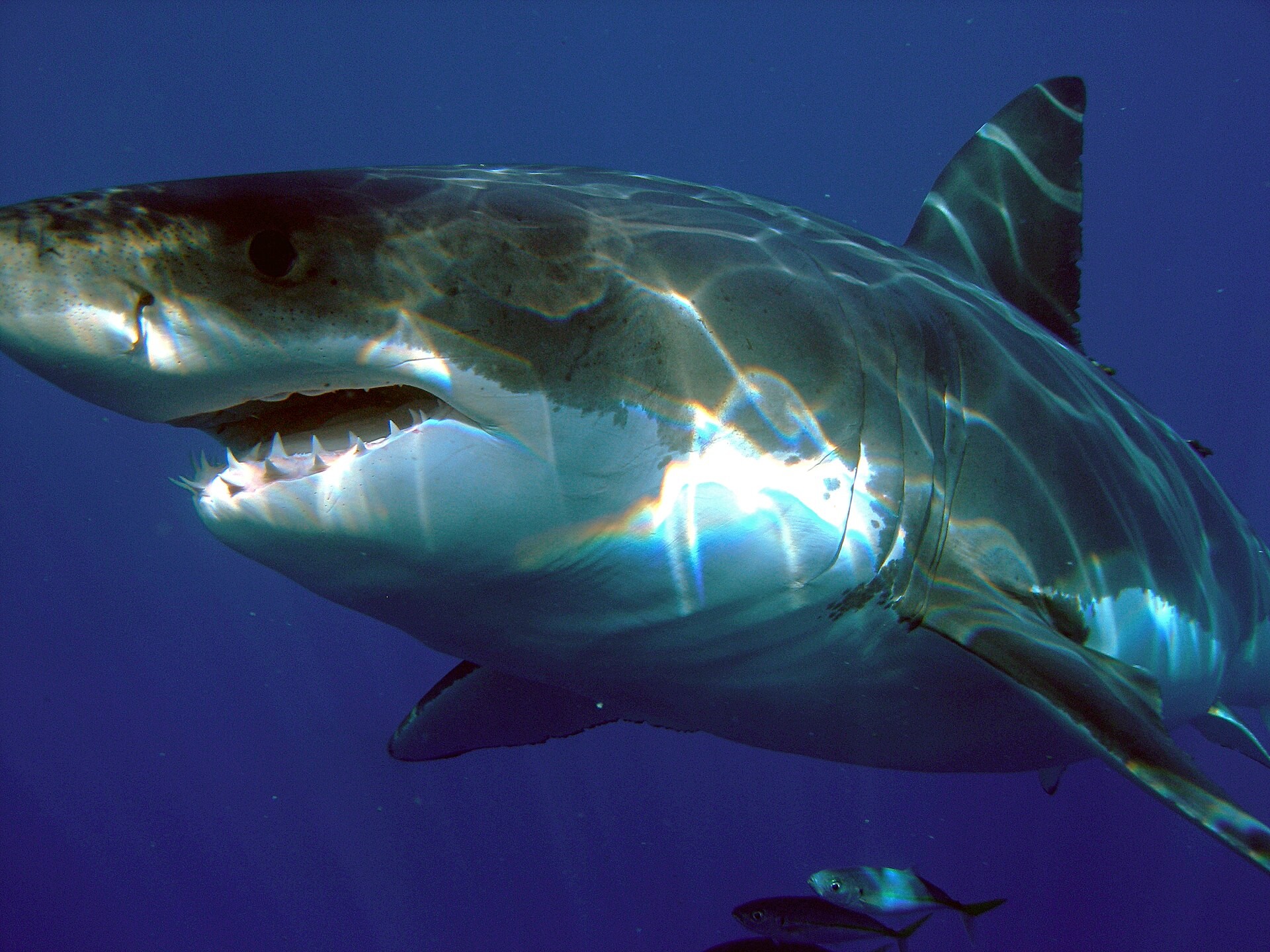
Carcharodon carcharias, the great white shark, is a large lamniform shark found in every ocean on Earth, from temperate to subtropical seas. It is the largest member of the mackerel shark family, Lamnidae, capable of weighing over 1,088.6 kg and living up to 73 years. Classified by the IUCN as Vulnerable with a decreasing global population trend, the species sits at the intersection of ecological importance and genuine conservation pressure. A single individual tracked from South Africa completed a 20,000 km roundtrip to Australia and back in under nine months, illustrating both the species’ mobility and the scale at which it operates.
Key facts
- Scientific name: Carcharodon carcharias
- Kingdom: Animalia
- Phylum: Chordata
- Class: Elasmobranchii
- Order: Lamniformes
- Family: Lamnidae
- Genus: Carcharodon
- Taxonomic rank: species
- Mass: 1,088.6 kg
- Life expectancy: 73 years
- Gestation period: 547.9 days
- Main food: fish; Teuthida; seabird; sea turtle
Physical characteristics
The great white’s teeth are broad, triangular and distinctly serrated, well suited to the range of prey it takes: fish, squid (Teuthida), seabirds and sea turtles. Those teeth sit in a body built for speed and endurance. NOAA has documented great whites reaching over 56 km/h (35 mph) at the surface and diving to depths of 1,200 m (3,900 ft), a performance range that lets a single animal move through radically different pressure and temperature environments in the same journey.
The species is endothermic. Unlike most sharks, it maintains a body temperature slightly above that of the surrounding water, which is what allows it to function across oceans with very different climates. This metabolic investment also supports its sensory systems. A great white’s olfactory organs can detect a drop of blood from half a kilometre away. Its electroreceptive pores, the ampullae of Lorenzini distributed across its snout, can number well over a thousand, a count far higher than the few hundred found in a small catshark.
Growth is slow. The great white is classified as a K-selected species, meaning it invests heavily in each offspring rather than producing large numbers. The gestation period runs to roughly 547.9 days, and fecundity is low. The combination of slow maturation, long lifespan and infrequent reproduction makes population recovery after decline an extremely slow process.
Evolutionary origins
The question of where the great white sits in shark evolutionary history was complicated for over a century by a taxonomic decision made in 1843. When megalodon was first formally described from giant fossil teeth, it was placed in the genus Carcharodon alongside the great white, creating an apparent close kinship that became widely accepted. The genus assignment was later revised, but the idea of a direct lineage persisted in popular accounts.
A 2009 study of a 4- to 5-million-year-old fossil jaw recovered in Peru challenged that lineage directly. The specimen contained 222 intact teeth and 45 vertebrae, providing enough material to support the view that the great white evolved from the broad-toothed mako shark lineage rather than from megalodon. That fossil evidence contradicts the long-held notion of a direct megalodon-to-great-white lineage.
Global distribution and population genetics
Great white sharks occur in every ocean, concentrated in temperate and subtropical zones, but population boundaries are not simply geographic. Nord University researchers found that the global white shark population split into three distinct genetic types roughly 100,000 to 200,000 years ago. Those genetic lines are relevant to conservation: a population decline in one region does not represent a loss that can be replenished from another.
The Mediterranean population carries the most acute risk. The IUCN lists Mediterranean great white sharks as Critically Endangered, a designation far more severe than the global Vulnerable status. In the North Atlantic more broadly, the population has been estimated to have declined by more than 90%, though there are signs of partial recovery following legal protections. In the east Australasian region, a 2018 estimate put the total great white population at around 5,500 individuals, with fewer than 1,000 in New Zealand waters. A 2023 study by Kanive et al. estimated the central California population at around 300 individuals, mostly adults and subadults, while a NOAA Fisheries status review concluded the northeastern Pacific population appears to be increasing and is not considered at risk of becoming endangered in U.S. waters.
Conservation status and legal protections
The IUCN Red List classified the great white shark as Vulnerable in its 2018 assessment, with a decreasing global population trend. The species is listed under CITES Appendix II and CMS Appendix II and receives additional coverage under UNCLOS. National protections are in place in South Africa, Namibia, Australia, New Zealand, Israel and Malta.
In U.S. waters the great white is a prohibited species across all federal fisheries: no commercial retention is permitted. The species is occasionally caught as bycatch, but cannot be landed. That framework means any population data for the region relies on research surveys and tagged individuals rather than harvest records.
Did you know
- Great white sharks rank first among shark species by documented human attack records. (fisheries.noaa.gov)
- Nord University researchers found that the global white shark population split into three distinct genetic types roughly 100,000 to 200,000 years ago. (divemagazine.com)
- The Mediterranean population of great white sharks is listed as Critically Endangered by the IUCN, a status far more severe than the global Vulnerable classification. (divemagazine.com)
- When megalodon was first scientifically described in 1843 from giant fossil teeth, it was placed in the same genus, Carcharodon, as the great white shark, fueling a long-held myth of close kinship between the two species. (fossilera.com)
- A great white shark’s electroreceptive pores can number well over a thousand, far more than the few hundred found in a small catshark. (sharksider.com)
- Corroding metal in seawater, such as a submarine cable, can generate electric fields that mimic a living animal to a shark’s electroreceptors. (sharksider.com)
Data sources
- GBIF
- Wikidata
- fisheries.noaa.gov
- sos.noaa.gov
- sharks.cms.int
- ifaw.org
- sciencedaily.com
- doc.govt.nz
- sharkstewards.org
Where it appears
Data updated: 2026-11-05