
HEADLINE:
Starving polar bear moms linger 12 days outside the den before hunting
ARTICLE:
The Fact That Shouldn’t Add Up
A nursing polar bear (Ursus maritimus) mother denning in Svalbard, Norway, can lose up to 43% of her body mass over a single winter, living entirely off stored fat while she produces rich milk for cubs she never leaves. By any sensible math, the moment she can walk again, she should be sprinting for open water and the nearest seal. She doesn’t. GPS collars and time-lapse cameras set up at 13 den sites by Louise Archer and colleagues from Polar Bears International and the Norwegian Polar Institute, published in the Journal of Wildlife Management in 2025, show families lingering near the den for an average of 12.1 days after they first break out, before heading toward the sea ice. That’s nearly two more weeks of voluntary fasting, stacked on top of a fast that already cost her close to half her body weight.
Inside the Den: What the Collars Actually Detect
Nobody can watch a bear through snow, so the collars read denning indirectly: long stretches with almost no movement, and a temperature signal running about 36°F warmer (20°C) than the air outside, insulated by snow and heated by the mother’s own body. It’s a self-made igloo. To check that the readings meant what they thought, the researchers compared years of camera footage against matching collar data and built a statistical model that can now estimate what’s happening underground from GPS and temperature alone. What’s happening underground is this: a blind, nearly hairless 1.3-pound (600-gram) newborn grows to roughly 20 times that weight within three to four months, entirely on milk, while its mother eats nothing at all. She is not just feeding her cubs. She is converting herself into them.
Why Linger While Starving Further
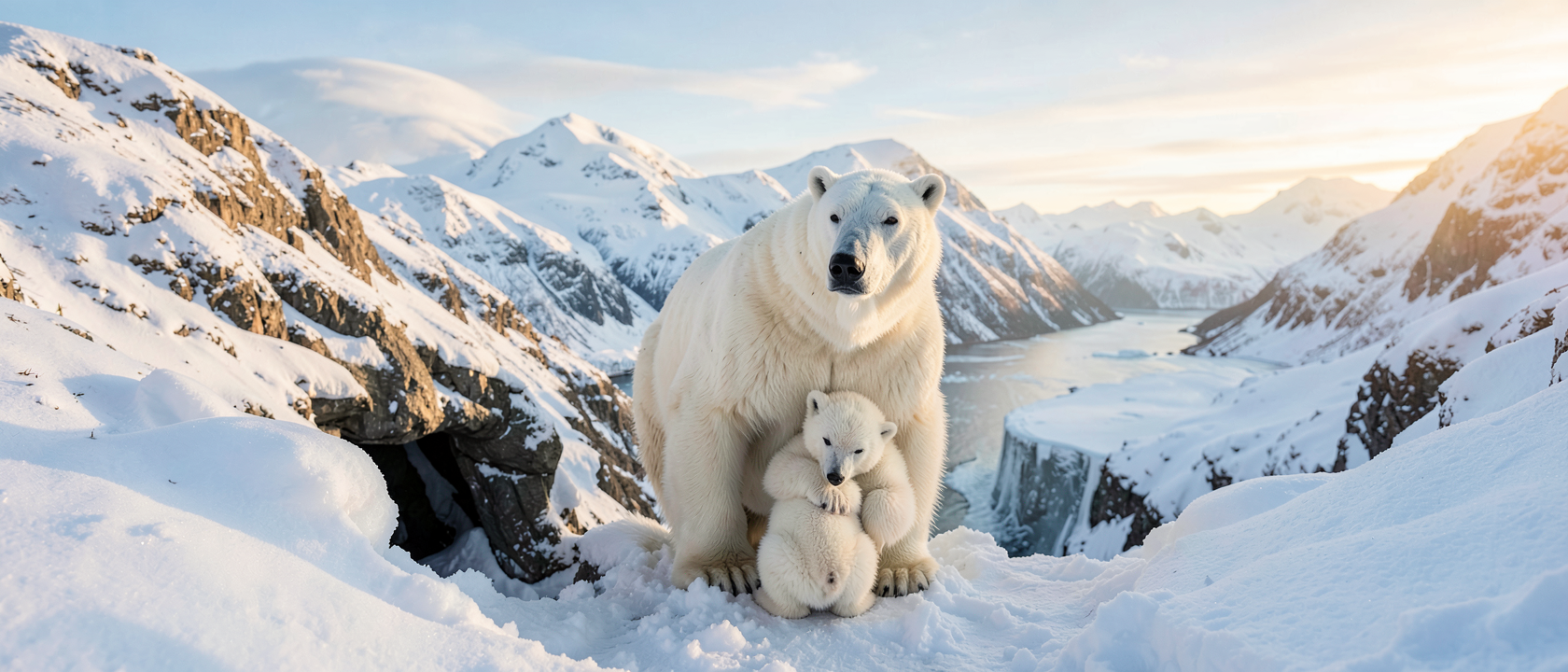
So why extend a fast that’s already stripped away nearly half her weight? The researchers’ working explanation turns on what comes next: a mother and her cubs are about to set off across sea ice on a partnership that can last up to two and a half years, and a cub that has only just opened its eyes to daylight isn’t built for that yet. The extra days spent near the den, while the cold is easing and the ground underfoot is familiar, likely let cubs practice walking, sharpen coordination, and build tolerance to real Arctic cold before committing to moving ice. A mother who rushes a wobbly cub onto that ice risks losing it outright. A few more unfed days is the cheaper bet.
The Myth: “They Bolt the Moment They Emerge”
The assumption is that a den works like a holding cell, and the second the door opens, the family is gone, done with the dark and done with hunger. The tracking data contradict that, and they refuse to simplify into one neat rule. Cubs were seen outside without their mother in just 5% of camera observations; she keeps them close almost the entire time. Timing between families was wildly inconsistent: one left the area within a couple of days of first emerging, another stayed put for a full month. There’s no shared emergence calendar. Each mother appears to be making her own call, on her own cubs, on her own schedule.
The Mothers Who Just… Moved
Two of the thirteen tracked mothers skipped the lingering entirely. After first breaking out, they packed up their cubs and relocated the whole family to a brand-new den site, settling there before eventually striking out for the ice. Archer’s team has no explanation for it yet. Maybe the original den had been compromised. Maybe it was something specific to those cubs. Maybe it was nothing more than restlessness. It’s one detail from one dataset, not a pattern: most of the thirteen families stayed close to where they first emerged.
What’s Still Unknown
The same dataset turned up something else worth sitting with: on average, these Svalbard bears broke out of their dens roughly a week earlier than historical records from the region suggest. Nobody yet knows whether that’s a genuine, ongoing shift, possibly tied to a warming Arctic reshaping snow cover and sea ice timing, or simply noise from a sample of 13 dens in one part of the world. The researchers are clear that only longer-term monitoring across more sites can tell a real trend from a coincidence, and that the stakes aren’t trivial: cubs given less time at the den before heading for the ice are cubs with less time to get ready for it.