
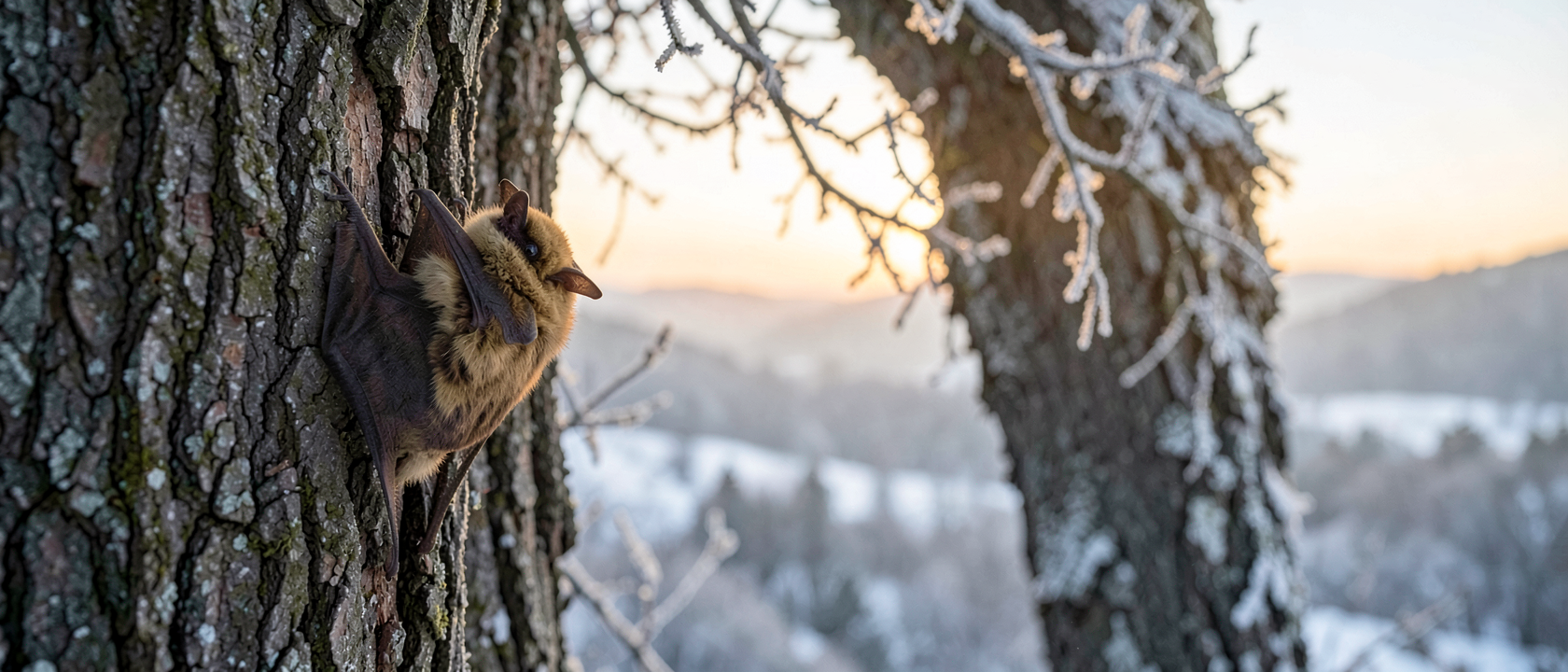
A Bat the Weight of a Slice of Bread Is Rewriting the Map
The common noctule bat (Nyctalus noctula) has already shifted its European hibernation range about 162 miles (260 km) to the northeast since 1901. A new model, published by researchers studying the species, projects up to another 454 miles (730 km) of shift by 2100 under the harshest of four climate scenarios tested, one in which winters warm by roughly 4.2°F (2.35°C) and shrink by 41 days. Put the historical and projected pieces together and the total move comes to about 615 miles (990 km) over two centuries. That is a bat weighing around 1 ounce (30 g) relocating its winter grounds farther than the length of most European countries. The work is by Kseniia Kravchenko, Christian Voigt, Jan Volkholz, Alexandre Courtiol and Shannon Currie at the Leibniz Institute for Zoo and Wildlife Research, published in Ecology Letters on May 4, 2025.
How Two Numbers Predict Where a Bat Can Sleep
Hibernation looks complicated from the outside. A bat does not simply go cold and wait: it drops into torpor, a state of lowered body temperature and slowed metabolism, then periodically rewarms and goes active again, burning fat reserves each time it does. To get a handle on that back-and-forth, the researchers measured two things directly in live noctules. First, skin temperature, used as a stand-in for how much time each bat spent in torpor at a given ambient temperature. Second, carbon dioxide output, a proxy for how much energy the bat was burning at that same temperature. Those two physiological readings were then run against daily temperature records and projections for more than 12,000 sites across Europe, spanning 1901 through 2100. The whole system reduces to two numbers per location: the average winter temperature there and how long the hibernation season lasts. Feed those in, and the model tells you whether a noctule could survive the winter at that spot.
The Researchers’ Simple Model Matched Reality
The test of any model is whether it gets the present right before anyone trusts it with the future. Here, the two-variable version reconstructed the bats’ current wintering range closely, matching where common noctules are actually known to hibernate. That result matters because hibernation has long been treated as too messy a behavior to model this way, with animals flipping between active and torpid states on their own unpredictable schedule. The researchers found otherwise: the hibernation niche of this species is adequately explained by just mean winter temperature and season length, and they note the same stripped-down approach could potentially map hibernation niches in other species, too. Common noctules are also known from earlier work by Kravchenko and colleagues to be fast movers, capable of shifting their range by several hundred kilometers within just a few decades, which is part of why a 615-mile (990 km) total shift over two centuries is plausible rather than fanciful.
Warm Enough Doesn’t Mean Welcome
A thermally survivable site is not automatically a livable one. Common noctules hibernate in hibernacula, shelters such as buildings, rock crevices and tree hollows, that sit above ground and stay poorly insulated, exposed to whatever the winter air outside is doing. A patch of northeastern Europe might warm into the bat’s survivable range on paper by 2100 and still have no such shelters nearby, or no food source for bats to fatten up on before winter sets in. The study’s authors flag this directly: thermal suitability is necessary but not sufficient, and whether the newly modeled range will actually have roosts and pre-winter food to match is left as an open question, not answered either way.
Why Hibernators Keep Getting Left Out of the Model
Hibernating animals are routinely excluded from climate-impact models, the study’s authors point out, because the switch between active and torpid states was assumed to make their physiology too complicated to handle. Their result argues otherwise. A bat that cycles through two metabolic states turned out to be predictable from just two numbers: how cold its winters are, and how long they last. The authors add a caution of their own, though: a habitat is more than its temperature, and tracking where an animal could physically survive winter is not the same as tracking where it will actually find shelter and food to make it there. If the same two-number approach holds for other hibernating species, a group that modelers have been setting aside as too complicated to include may turn out to be easier to track into a warmer future than anyone assumed.