
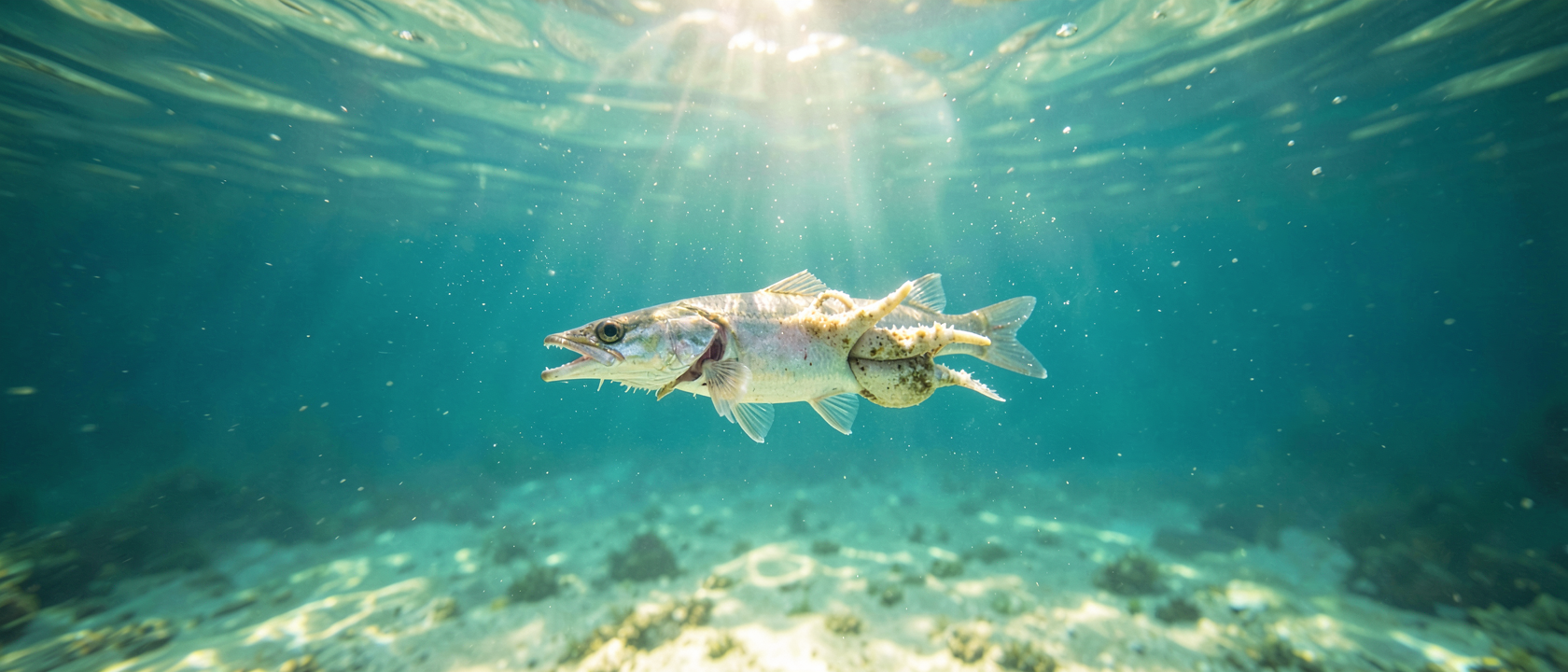
Several fossils of the Jurassic fish Tharsis, pulled from the limestone beds of Germany’s Solnhofen Plattenkalk, show the exact same cause of death. A dead belemnite’s internal shell went in nose-first, punched straight through the fish’s gills, and left its wider end jammed in the mouth.
A 150-Million-Year-Old Crime Scene with a Repeat MO
Paleontologists Martin Ebert and Martina Kölbl-Ebert, both at Ludwig Maximilian University of Munich, lay out the pattern in a 2025 paper in the journal Scientific Reports titled “Jurassic fish choking on floating belemnites.” Tharsis was a small ray-finned fish (a member of the extinct family Ascalaboidae) that swam the open lagoon waters above the Solnhofen Archipelago seafloor around 152 million years ago, in what is now Bavaria, Germany. Across several specimens from the Eichstätt and Solnhofen basins, plus material in private hands, the researchers found the same geometry: the pointed rostrum, the solid, bullet-shaped tip of a belemnite’s internal shell, driven backward through the fish’s gill apparatus, while the broader phragmocone, the chambered rear section of that same shell, stayed lodged in the mouth opening.
Why It Couldn’t Just Spit It Out
Tharsis had tiny teeth and made its living as a micro-carnivore, a visual zooplanktivore that fed by suction, gulping mouthfuls of water loaded with larvae, plankton, and the decaying organic film that collects on anything floating in open water. That feeding style works for soft, shapeless food. It has no reverse gear. Once a streamlined, hard object got pulled in point-first, the fish could not push it back out through the mouth, and it could not pass through the gills either. The belemnites found in these fossils belong to the genus Hibolithes, with a rostrum about 2.4 inches (6 cm) long attached to a phragmocone of another 2.4 inches (6 cm), nearly half the length of the roughly 3.9-inch (10 cm) subadult Tharsis documented choking on one. The rostrum went straight through gill tissue instead, and the fish suffocated with it wedged in place.
The Belemnite Was Already Dead
The belemnites in these fossils were not fresh kills. Belemnite shells from the Eichstätt and Solnhofen basins often turn up overgrown with bivalves, meaning the shell had drifted long enough to collect hitchhikers. In one example cited by the researchers, a specimen from Museum Bergér near Eichstätt, catalog number MBH20252251, has an oyster cemented directly onto the phragmocone, the kind of overgrowth that only forms once a shell has drifted for a while, kept buoyant by its own gas-filled chambers, soft tissue already gone, while other scavengers worked over what remained. Among Late Jurassic fish, only large sharks are documented as predators of belemnites. Tharsis, topping out at around 10.6 inches (27 cm) and usually much smaller, was never built to hunt one down. It was doing what it always did: skimming rot and biofilm off a floating object. That object just happened to still have its former owner’s skeleton attached.
How Often Did This Happen?
Ebert and Kölbl-Ebert describe only “several” fossils showing this exact death, without giving a single final count, drawn from museum holdings in Eichstätt and Solnhofen plus a fourth roughly 3.9-inch (10 cm) specimen recorded in a private collection from the Eichstätt Basin. Kölbl-Ebert examined around 4,200 Tharsis fossils over the course of the study, and a rough survey of the major collections turned up only about 120 belemnites against some 15,000 fish, so this was never a common prey item. Tharsis itself makes up roughly 26% of the entire fish fauna known from the Solnhofen Archipelago, which makes the real rate of this kind of death, a rare fluke or a routine hazard of feeding near a floating belemnite, impossible to pin down from the numbers published so far. Whether the fish were drawn in by visible algae or bacterial growth on the shell, or simply misjudged a solid object while filtering the water around it, is the authors’ working idea. Nobody has it on film.
From the Fish’s Side
Somewhere in a Late Jurassic lagoon: a promising smear of green on something bobbing near the surface, a mouth opening wide for the biofilm special, and no warning at all that the squid relative who used to live in that shell left a parting gift, pointed the wrong way. No bite required. No struggle. Just gills, full stop.