
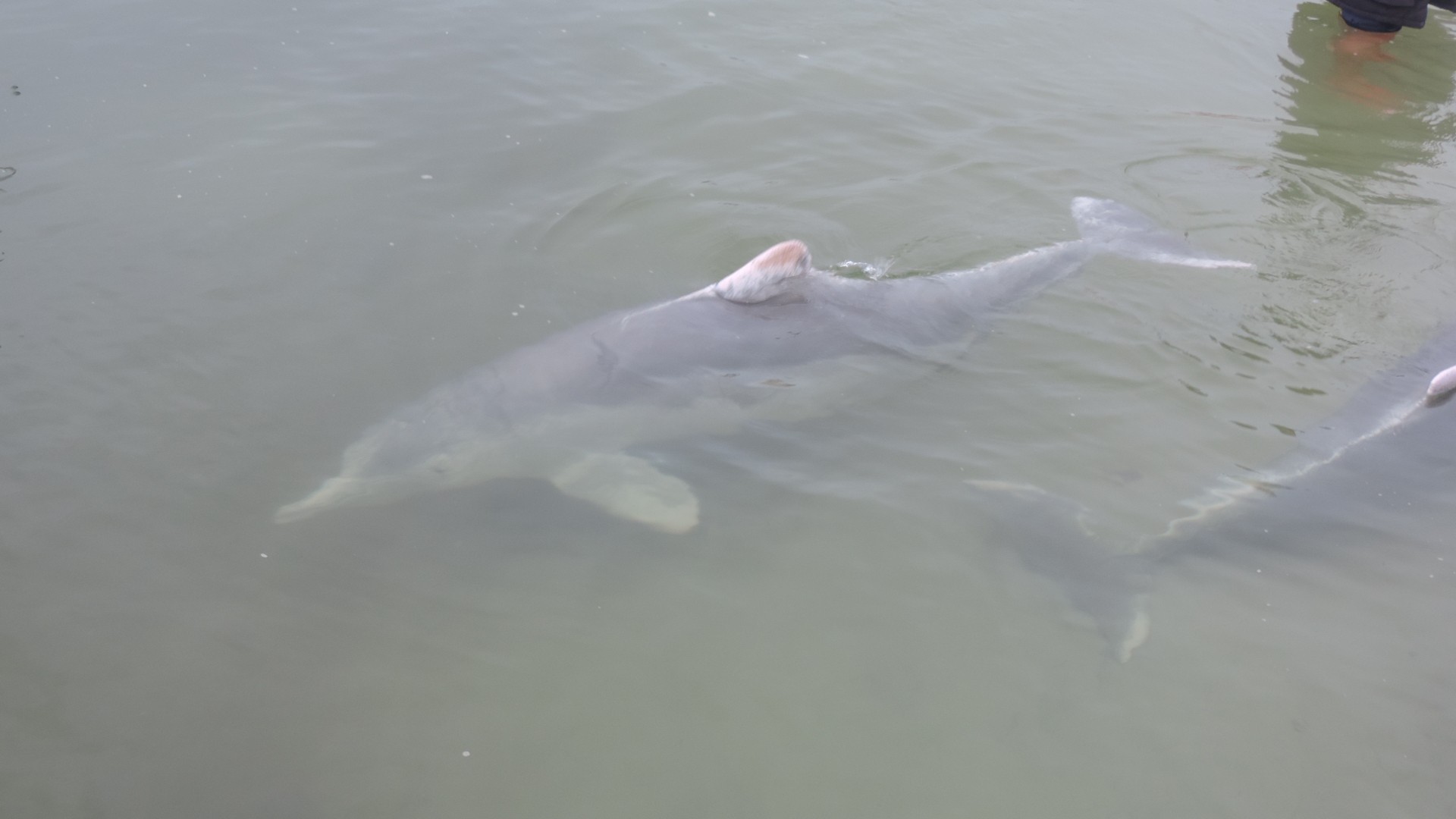
The Australian humpback dolphin, Sousa sahulensis, is a coastal cetacean formally described by T. A. Jefferson and H. C. Rosenbaum in 2014 in Marine Mammal Science (volume 30, issue 4, pages 1494–1541). It is confined to the shallow, often turbid inshore waters of the Sahul Shelf, from Exmouth in Western Australia east to the Queensland–New South Wales border and north into the waters of Papua New Guinea. Subpopulation abundance estimates studied to date range from just 14 to 207 individuals, and no single studied population has been estimated to contain more than 104 mature individuals. Those numbers, combined with concentrated threats in the very coastal zone the species depends on, placed it on Australia’s threatened-species list effective 5 March 2025.
Key facts
- Scientific name: Sousa sahulensis
- Kingdom: Animalia
- Phylum: Chordata
- Class: Mammalia
- Order: Cetacea
- Family: Delphinidae
- Genus: Sousa
- Taxonomic rank: species
Taxonomy and description history
Sousa sahulensis belongs to the family Delphinidae, order Cetacea, class Mammalia, phylum Chordata, kingdom Animalia. The genus Sousa groups the humpback dolphins, a lineage characterised by their preference for nearshore and estuarine waters across the Indo-Pacific region.
The species waited a long time for a valid name. An earlier attempt — Sousa queenslandensis, proposed by Gaskin in 1972 — was never validly published and therefore constitutes a nomen nudum, a name with no standing in formal taxonomy. The gap that created persisted until Jefferson and Rosenbaum published their 2014 description in Marine Mammal Science, settling the species’ identity more than four decades after Gaskin’s failed attempt.
Range and habitat
Australian humpback dolphins occupy tropical and subtropical coastal waters of the Sahul Shelf. On the Australian mainland their range runs from Exmouth, Western Australia, along the northern coast through the Northern Territory and Queensland to the Queensland–New South Wales border, and extends north into the waters surrounding southern New Guinea, including those of Papua New Guinea.
The species is an inshore specialist. It uses waters generally no deeper than 25 metres and is strongly associated with river mouths, mangroves, tidal channels, estuaries, seagrass meadows, inshore reefs, and sheltered bays. The species does not appear to undertake large-scale seasonal migrations, though seasonal shifts in local abundance have been observed within individual areas.
Social structure and group size
Groups are small. Typical school size ranges from 1 to 12 individuals, and travelling groups ordinarily consist of around 4–5 animals. Along the east coast of Queensland, feeding aggregations can number up to 30 individuals, the largest groupings documented for the species.
Research combining photo-identification with capture-recapture models has demonstrated high site fidelity across multiple populations. A study at North West Cape, Western Australia, found that 63% of identified individuals showed high levels of site fidelity. In Moreton Bay, the population is structured into five separate social communities that occupy largely non-overlapping areas of the bay.
Feeding
The diet centres on fishes associated with coastal-estuarine waters. The species is an opportunistic predator and also takes crustaceans, squid, and rays, though fish form the bulk of prey.
One of the more unusual foraging strategies recorded for this species is strand-feeding. Individuals chase fish out of the water and deliberately beach themselves on mudflats or shores to secure prey, then work their way back into the water. Strand-feeding has been observed in Queensland, the Northern Territory, and Western Australia, indicating it is a widespread rather than locally isolated behaviour.
Acoustics and communication
Because the shallow, coastal, and often estuarine habitats this species uses are frequently turbid, vision is limited and sound carries most of the load for navigation and social contact. The acoustic repertoire includes high-frequency echolocation clicks, whistles, and screams of varying length.
Echolocation click parameters have been measured in detail: mean source level 199 dB re 1 μPa peak-peak, mean centroid frequency 106 kHz, and mean interclick intervals of 79 ms. These values are comparable to those recorded from other delphinids of similar body size.
Whistles are not uniform across the species’ range. Whistle parameters recorded from Australian humpback dolphin populations differ significantly from those of Indo-Pacific humpback dolphin populations, and the pattern of difference matches population-, regional-, and species-level distinctions already established through morphological, genetic, and geographic data.
Conservation status and threats
Sousa sahulensis was listed as Vulnerable under Australia’s Environment Protection and Biodiversity Conservation Act 1999, with that listing taking effect on 5 March 2025. It is also listed as Migratory under the same Act. At the international level, the species was added to Appendix II of the Convention on the Conservation of Migratory Species of Wild Animals, with the listing effective from 2024.
The threats pressing on this species are concentrated precisely in the shallow coastal zone it cannot leave. Incidental capture in gill nets and in shark nets set under the Queensland Shark Control Program is among the most direct. Habitat loss and degradation, vessel strikes, marine pollution, and climate change compound that pressure across the full range.
The small size of individual populations turns each local threat into a potentially irreversible event. With no single studied subpopulation estimated to hold more than 104 mature individuals, and studied estimates ranging as low as 14, local extirpation requires far fewer mortalities than would be needed to destabilise the populations of most other coastal cetaceans.
Did you know
- A synonym proposed in 1972, Sousa queenslandensis (Gaskin), was never validly published and remains a nomen nudum, leaving the species without a valid species-level name for over four decades until Jefferson and Rosenbaum formalised Sousa sahulensis in 2014. (bie.ala.org.au)
- Echolocation clicks of Sousa sahulensis reach a mean source level of 199 dB re 1 μPa, roughly equivalent in intensity to the clicks of other delphinids of similar body size, suggesting biosonar power scales primarily with body size rather than ecological niche. (pubmed.ncbi.nlm.nih.gov)
Data sources
- GBIF
- Wikidata
- mammaldiversity.org
- environment.gov.au
- marinewaters.fish.wa.gov.au
- marinewise.com.au
- pubmed.ncbi.nlm.nih.gov
- link.springer.com
- cms.int
- research-repository.uwa.edu.au
Data updated: 2026-11-02