
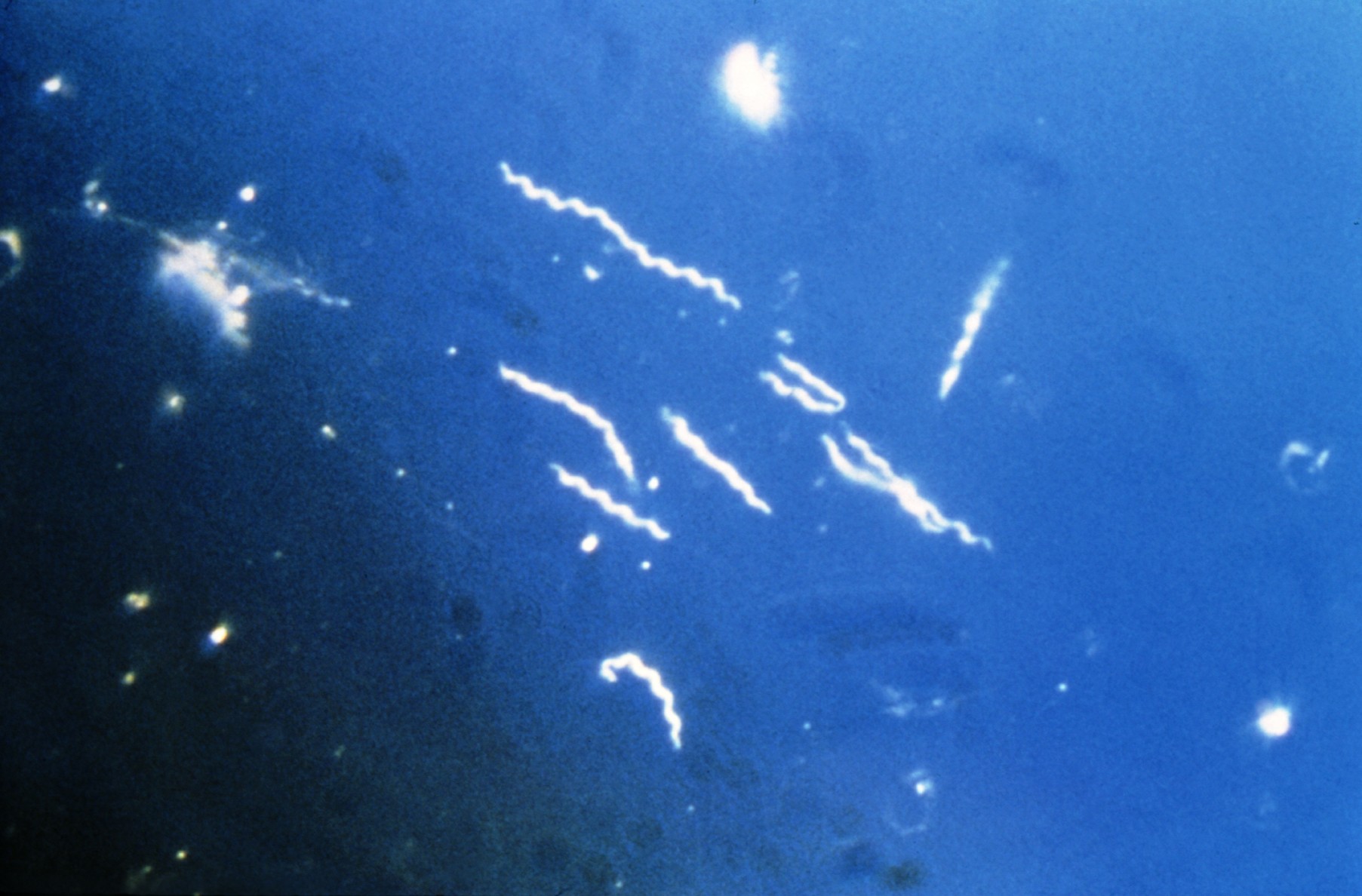
Borrelia burgdorferi is a Gram-negative spirochete bacterium and the causative agent of Lyme disease, the most prevalent tick-transmitted infection in temperate areas of Europe, North America, and Asia. Its cells measure approximately 0.3 micrometers wide and 10 to 30 micrometers in length, placing it among the longer bacterial cells relative to its width. The species circulates between Ixodes ticks and vertebrate reservoirs, cycling through two radically different host environments across its life and switching its surface proteins in response to each. Its genome, fully sequenced in December 1997, is one of the more architecturally complex among bacteria, spread across a linear chromosome and at least 17 additional plasmids.
Key facts
- Scientific name: Borreliella burgdorferi
- Kingdom: Bacteria
- Phylum: Spirochaetota
- Class: Spirochaetia
- Order: Borreliales
- Family: Borreliaceae
- Genus: Borreliella
- Taxonomic rank: species
Structure and cellular organization
The cell body of B. burgdorferi has a flat-wave morphology with 3 to 10 waves along its length. Motility is driven by 7 to 11 periplasmic flagella, called endoflagella, inserted at each end of the cell and running within the space between the inner membrane and the outer membrane. This internal placement of the flagella, rather than on the outside of the cell as in most motile bacteria, gives the organism its characteristic corkscrew movement.
One structural feature sets B. burgdorferi apart from most Gram-negative bacteria: its outer membrane contains no lipopolysaccharide. In its place, the outer membrane carries abundant lipoproteins, most notably OspA and OspC. These proteins are not structural decoration; they mediate direct interactions with both tick and mammalian hosts at each stage of the transmission cycle.
Genome
The complete genome sequence of the type strain B31 was published on December 11, 1997 in the journal Nature by Claire M. Fraser, Sherwood Casjens, and colleagues, placing B. burgdorferi among the first bacterial species to have its genome fully sequenced. The linear chromosome is 910,725 base pairs in length with an average G+C content of 28.6%. Complementing the chromosome are at least 17 linear and circular plasmids whose combined size exceeds 533,000 base pairs.
During growth, B. burgdorferi is polyploid: each cell carries multiple copies of its chromosome rather than a single copy as in most bacteria. A 2022 study published in Nature Communications showed that these chromosome copies are regularly spaced along the spirochete’s length, a spatial arrangement observed both in laboratory cultures and inside fed ticks.
Life cycle and transmission
B. burgdorferi maintains itself in nature through an enzootic cycle between Ixodes ticks and vertebrate reservoir hosts. In the northeastern and midwestern United States, the primary reservoir is the white-footed mouse, Peromyscus leucopus. The primary tick vector in the northeastern and north-central United States is Ixodes scapularis, the blacklegged deer tick; on the Pacific coast the role is filled by Ixodes pacificus, the western black-legged tick.
Transmission to a human from an attached tick does not occur immediately on attachment. The spirochetes reside in the tick’s midgut and must migrate to the salivary glands before entering the host. That migration takes time: transmission typically does not occur until the tick has been attached for at least 36 hours.
The journey from midgut to host is accompanied by a precisely regulated surface protein switch. OspA is expressed in the tick midgut, where it aids the spirochete in attaching to midgut tissue. When the tick takes a blood meal, OspA is downregulated and OspC is upregulated, preparing the spirochete to infect a mammalian host. The two proteins serve opposite ends of the transmission chain.
Immune evasion
Once inside a mammalian host, B. burgdorferi faces an adaptive immune system capable of generating antibodies against its surface proteins. The bacterium counters this with a system called VlsE, encoded on linear plasmid lp28-1. VlsE (variable major protein-like sequence E) undergoes continuous gene-conversion recombination with 15 adjacent silent cassettes, generating thousands of distinct surface variants within the host. The result is a moving target that outpaces antibody responses directed at any single surface configuration.
This antigenic variation system is one reason B. burgdorferi can persist in mammalian tissue over extended periods, contributing to the chronic and relapsing features sometimes observed in Lyme disease.
Disease in humans
The hallmark early sign of B. burgdorferi infection is erythema migrans, an expanding red rash that appears in approximately 70 to 80 percent of infected individuals, typically 7 to 14 days after the tick bite. The rash’s appearance correlates closely enough with confirmed exposure that its presence is treated as a clinical indicator even without laboratory confirmation.
B. burgdorferi sensu stricto is not the only genospecies capable of causing disease. The B. burgdorferi sensu lato complex comprises over 20 distinct genospecies. In Europe, Borrelia afzelii is associated primarily with skin complications, while Borrelia garinii is associated with neurological ones.
Laboratory cultivation
In laboratory settings, B. burgdorferi is grown in Barbour-Stoenner-Kelly II (BSK-II) liquid medium under microaerophilic conditions: 3 percent oxygen and 5 percent carbon dioxide, at temperatures of 33 to 34 degrees Celsius. Under these conditions, generation time ranges from 8 to 24 hours, and culture-adapted strains reach densities of about 10^8 spirochetes per milliliter. The slow generation time, compared with organisms such as Escherichia coli, reflects the challenges the pathogen poses for rapid laboratory work.
Discovery
The identification of B. burgdorferi as a pathogen is tied to two moments separated by six years. In 1975, a cluster of cases in three Connecticut towns, including Lyme and Old Lyme, was recognized as a distinct condition after being initially misdiagnosed as an epidemic of juvenile rheumatoid arthritis. That recognition established Lyme disease as a clinical entity in the United States, but the causative organism remained unknown.
In November 1981, Swiss-American scientist Wilhelm Burgdorfer, working at the NIAID Rocky Mountain Laboratories in Hamilton, Montana, identified spirochetes as the cause while examining the midgut tissues of Ixodes dammini ticks from Shelter Island, New York. The species was subsequently named in his honor. Burgdorfer had been studying Rocky Mountain Spotted Fever in the same tick specimens when he noticed structures he recognized as spirochetes, organisms that no one had previously associated with deer ticks.
Current research
A 2025 study published in Science Translational Medicine by scientists at Northwestern University identified piperacillin, a beta-lactam antibiotic, as capable of eliminating B. burgdorferi in mice at 100 times less than the effective dose of doxycycline, which is the current standard treatment. The study also found that piperacillin had virtually no impact on gut microbiota, a property that distinguishes it from broad-spectrum antibiotics that disrupt the intestinal bacterial community. The finding represents a potential direction for Lyme disease treatment, though the study was conducted in mice.
Did you know
- Willy Burgdorfer almost missed his landmark 1981 discovery. He was originally examining tick specimens for Rocky Mountain Spotted Fever when he noticed what he described as “long, snake-like organisms” and recognized them as spirochetes — the bacteria no one had previously linked to deer ticks. (irp.nih.gov)
- Lyme disease was not recognized as a clinical entity in the United States until 1975, when a cluster of cases appeared in three Connecticut towns, including Lyme and Old Lyme. Physicians initially attributed the outbreak to an epidemic of juvenile rheumatoid arthritis before the pattern of cases prompted further investigation. (wikidoc.org)
Data sources
- GBIF
- Wikidata
- scienceinsights.org
- vetbact.org
- biologyinsights.com
- nature.com
- ecdc.europa.eu
- doverma.gov
- ldh.la.gov
- aldf.com
- dermnetnz.org
- irp.nih.gov
- lymerick.net
- grantome.com
- ncbi.nlm.nih.gov
- news.northwestern.edu
Data updated: 2026-10-30