
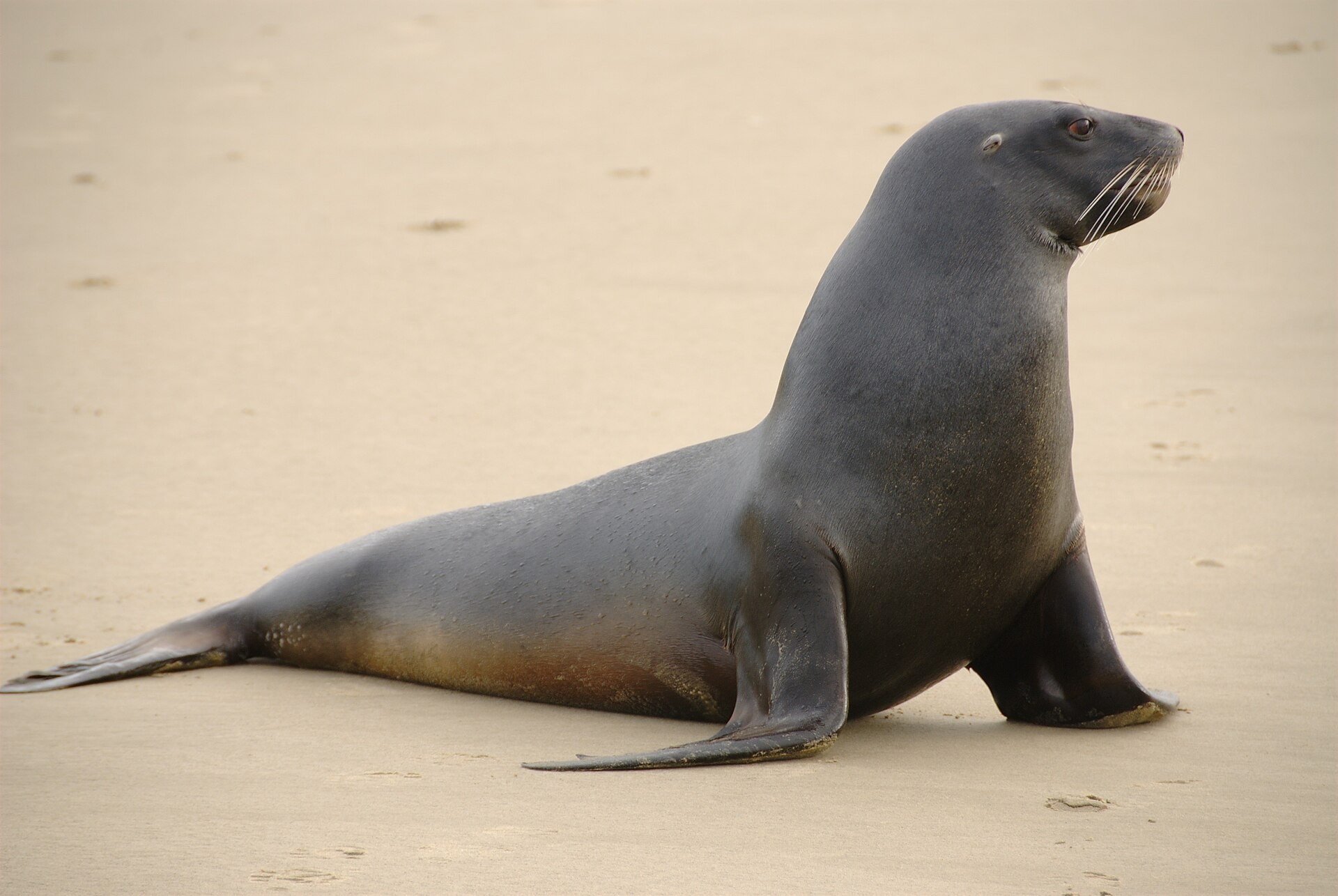
The New Zealand sea lion, Phocarctos hookeri, is the sole member of its genus and one of the rarest sea lions on Earth. Endemic to New Zealand, it breeds almost entirely in subantarctic waters: approximately 93% of all pups are born on the Auckland Islands and Campbell Island. As of 2025, the New Zealand Department of Conservation classified the adult population as below 5,000 individuals, with a projected decline of 50–70% over the next three decades. The species sits at the intersection of deep evolutionary history and an acute conservation crisis.
Key facts
- Scientific name: Phocarctos hookeri
- Kingdom: Animalia
- Phylum: Chordata
- Class: Mammalia
- Order: Carnivora
- Family: Otariidae
- Genus: Phocarctos
- Taxonomic rank: species
- Endemic to: New Zealand
Physical characteristics
Phocarctos hookeri is immediately recognisable by its skull shape. The head is very short and blunt, with a skull length-to-width ratio of 2:1, against the 3:1 ratio typical of other fur seals and sea lions. That compression gives the animal a distinctly broad-faced profile compared with its relatives.
To hunt in dark or turbid water, the species relies on two sensory systems. Its large eyes gather available light at depth, while its vibrissae (whiskers) detect the pressure waves and movement of prey through the water.
Taxonomy and evolutionary history
John Edward Gray first described the species in 1844, placing it in Arctocephalus under the name Arctocephalus hookeri, in ‘The Zoology of the Voyage of H.M.S. Erebus and Terror.’ Gray assigned the type locality as ‘Falkland Islands and Cape Horn,’ an error corrected by Clark in 1873 to the Auckland Islands. The species is named after Sir Joseph Hooker, the botanist with the British Antarctic Expedition of 1839–43, which first brought specimens back for scientific study.
The genus Phocarctos was established by Peters in 1866. Later taxonomists Sivertsen (1954) and Scheffer (1958) argued that Phocarctos should be merged with Neophoca, but subsequent morphological and molecular work retained it as a distinct genus. Molecular studies place all southern sea lions — Otaria, Neophoca, and Phocarctos — in a monophyletic group alongside Arctocephalus fur seals, confirming that the grouping reflects genuine shared ancestry rather than geographic convenience.
Diet
On the subantarctic islands, adults of both sexes take a varied diet. Yellow octopus, arrow squid, hoki, hake, rattail, small-scale cod, opalfish, and red cod are all recorded prey items. Some individuals go further: there are documented cases of New Zealand sea lions feeding on seabirds and on fur seals, making certain individuals notably broader in their foraging than the species description alone suggests.
Reproduction and life history
The breeding system is polygynous and territorial. A dominant male occupies a beach in late November. Harems of up to 25 females gather in December, and bulls disperse by late January. Females arrive at the breeding site and give birth roughly two days after arrival, then come into oestrus 6–7 days after giving birth. Gestation lasts approximately 11 months, so the cycle is tightly compressed into the austral summer calendar.
Females reach sexual maturity at 3–4 years. Males reach sexual maturity at 5 years but do not begin breeding until at least 8 years of age. Females typically produce a single pup every one to two years rather than annually, and the maximum recorded lifespan in the wild is approximately 23 years.
Pup survival in the first weeks of life is precarious. Research on ivermectin treatment has demonstrated that deworming pups with ivermectin at around one week of age reduces the risk of mortality from hypervirulent Klebsiella pneumoniae. The mechanism involves hookworm: intestinal damage from hookworm infestation likely creates a pathway for bacterial dissemination, and preventing that damage reduces the risk of death from the bacterial infection.
Conservation status and legal protection
Commercial killing of the species was made illegal in New Zealand in 1893. More than a century later, in August 1997, the species was formally designated a Threatened Species under New Zealand’s Marine Mammals Protection Act. As of 2025, the New Zealand Department of Conservation elevated that assessment to ‘Nationally Endangered,’ with high confidence that the adult population has fallen below 5,000 and is projected to decline a further 50–70% over the next three decades if present trends continue.
Protection of the core breeding habitat has taken several forms. A 20 km Marine Mammal Sanctuary was established around the Auckland Islands. In 1998, New Zealand’s subantarctic islands as a group were granted UNESCO World Heritage status.
Taxonomic and nomenclatural notes
The species is classified under Kingdom Animalia, Phylum Chordata, Class Mammalia, Order Carnivora, Family Otariidae, Genus Phocarctos. As the only species in Phocarctos, it has no congener to compare with in the living fauna. The common name ‘Hooker’s sea lion,’ still used in some literature, derives from the same eponym as the specific epithet hookeri.
Did you know
- The Chatham Islands once held a population of more than 50,000 sea lions. The genetically distinct Chatham Island lineage was hunted to extinction within approximately 200 years of Moriori settlement around 1450 AD, at a harvest rate of fewer than one sea lion per person per year — a low offtake that nonetheless proved unsustainable for a slow-reproducing population. (rnz.co.nz)
- New Zealand sea lion pups lose weight at an average of 48 g per day during their first week of life. The trajectory reverses sharply: over the following three months, pups gain an average of 151 g per day. (pinnipeds.org)
- A 20 km Marine Mammal Sanctuary encircles the Auckland Islands, the primary breeding site for the species. In 1998, New Zealand’s subantarctic islands received UNESCO World Heritage status. (marinebio.org)
Data sources
- GBIF
- Wikidata
- animaldiversity.org
- doc.govt.nz
- pinnipeds.org
- marinebio.org
- seahistory.org
- coastalpaleo.blogspot.com
- zenodo.org
- newsroom.co.nz
- ncbi.nlm.nih.gov
Data updated: 2026-10-29