
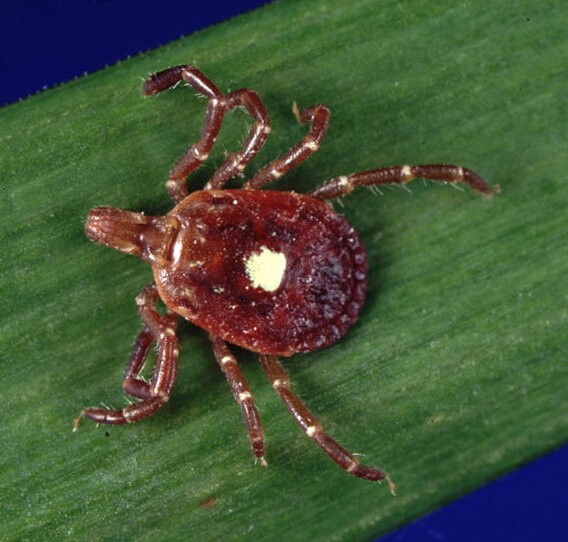
Amblyomma americanum, the lone star tick, is a hard tick (family Ixodidae) native to North America and now established across counties in the Northeast, South, and Midwest of the United States. The adult female carries a single silvery-white spot on her dorsal scutum — the feature that names the species. Beyond the discomfort of a bite, the tick is the primary vector of two Ehrlichia bacteria that cause distinct ehrlichiosis syndromes in humans and dogs, and its saliva can trigger a red, expanding rash that mimics Lyme disease yet remains without a confirmed cause. An unfed adult female is roughly the size of a sesame seed; fully engorged, she can reach about 12 mm wide.
Key facts
- Scientific name: Amblyomma americanum
- Kingdom: Animalia
- Phylum: Arthropoda
- Class: Arachnida
- Order: Ixodida
- Family: Ixodidae
- Genus: Amblyomma
- Taxonomic rank: species
Morphology and Identification
The adult female lone star tick is reddish-brown. Near the center of the posterior portion of her dorsal scutum sits a single silvery-white spot, the defining mark of the species and the origin of its common name. Unfed adults measure approximately 3 to 4 mm in length; blood-feeding expands the body to about 12 mm in width.
Larval lone star ticks measure less than 1 mm wide and carry only six legs, which is why they are commonly called seed ticks. Nymphs range from approximately 1 to 2.5 mm wide and possess eight legs. Both nymphs and adults bear festoons, small rectangular blocks arranged along the rear margin of the body, along with distinctively long, projecting mouthparts formed by a long capitulum.
Habitat and Range
Amblyomma americanum is a habitat generalist. It reaches highest densities in deciduous, pine, and mixed forested habitats with dense underbrush, but populations also occur in open grasslands, prairies, and suburban landscapes that border woodlands.
As of 2025, the CDC maps established populations across counties in the Northeast, South, and Midwest of the United States. The range has continued to expand northward and westward since the mid-20th century, carrying the tick into regions where it was historically absent.
Disease Transmission
Amblyomma americanum is the primary vector of Ehrlichia chaffeensis, the bacterium responsible for human monocytic ehrlichiosis, and of Ehrlichia ewingii, which causes granulocytic ehrlichiosis in both humans and dogs.
Southern tick-associated rash illness (STARI) develops following an Amblyomma americanum bite. It produces a red, expanding rash within seven days of the bite, reaching 8 to 30 centimeters in diameter — a presentation that closely resembles the Lyme disease rash. The exact cause of STARI remains unknown, though Borrelia lonestari has been proposed as the agent.
A 30-year review published in the Journal of Medical Entomology confirmed that Amblyomma americanum does not transmit Borrelia burgdorferi, the bacterium that causes Lyme disease. The rash STARI produces is therefore not evidence of Lyme infection, despite the visual similarity. The claim that lone star tick bites cause Lyme disease is a myth the long-term record does not support.
Saliva and Feeding Biology
To sustain extended blood-meal feeding, the saliva of Amblyomma americanum contains anticoagulant proteins that interfere with both the extrinsic and intrinsic coagulation pathways, including inhibition of factor Xa and thrombin.
The saliva also carries immunomodulatory proteins that suppress the host’s defenses. One of these, the serpin protein AAS27, is injected into the host within the first 24 hours of feeding and blocks the host’s inflammatory response by inhibiting plasmin and trypsin. Both mechanisms together allow the tick to remain attached and feeding without triggering the rapid immune clearance that would otherwise dislodge it.
Evolutionary History
The genus Amblyomma originated approximately 47.8 million years ago and began to diversify approximately 36.8 million years ago. The main theater of that diversification was the southern hemisphere.
Genomics and Current Research
In February 2024, Arcadia Science published predictions of 28,319 genes from a draft genome assembly of Amblyomma americanum. The dataset is intended to support functional characterization of tick proteins and comparative genomics research across the genus.
Did you know
- In a 2025 case reported by the CDC’s Emerging Infectious Diseases journal, STARI caused by an Amblyomma americanum bite was documented in a child in New York State. The case illustrates how the tick’s expanding northern range is bringing its associated diseases into regions where they were previously unknown. (wwwnc.cdc.gov)
Data sources
- GBIF
- Wikidata
- pestworld.org
- lsuagcenter.com
- lonestarmap.com
- pmc.ncbi.nlm.nih.gov
- cdc.gov
- web.uri.edu
- pubmed.ncbi.nlm.nih.gov
- ncbi.nlm.nih.gov
- journals.plos.org
- research.arcadiascience.com
Data updated: 2026-10-29