
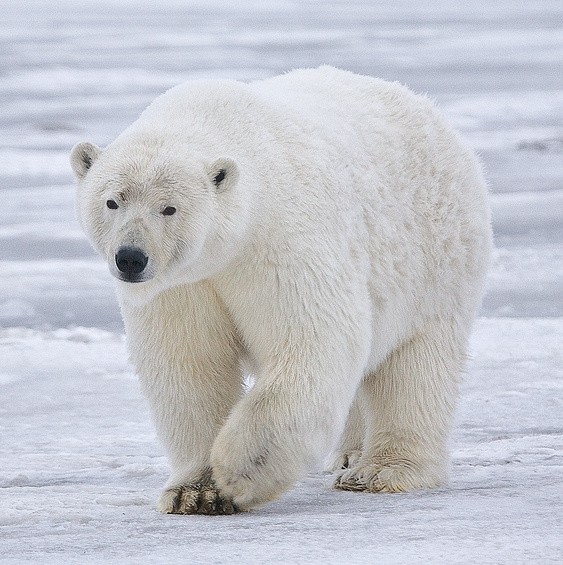
Ursus maritimus, the polar bear, is a species of bear native largely within the Arctic Circle and is classified as a marine mammal because it spends most of its life on sea ice. Adult males weigh between 300 and 800 kg and reach up to 2.5 m in length, making the polar bear the largest extant species of bear and the largest land carnivore on Earth by body mass. The species occurs in 19 subpopulations across the seasonally and permanently ice-covered marine waters of the United States, Canada, Greenland, Norway, and Russia, with its southernmost occurrence at James Bay in Canada. Its primary prey are ringed seals, grey seals, harp seals, and beluga whales, hunted almost entirely from sea ice.
Key facts
- Scientific name: Ursus maritimus
- Kingdom: Animalia
- Phylum: Chordata
- Class: Mammalia
- Order: Carnivora
- Family: Ursidae
- Genus: Ursus
- Taxonomic rank: species
- Mass: 450 kg
- Life expectancy: 50 years
- Gestation period: 258.7 days
- Main food: Ringed Seal; Grey Seal; Harp Seal; beluga whale
Taxonomy and Classification
Carl Linnaeus encountered the polar bear in the 1758 edition of Systema Naturae and labelled it Ursus maritimus albus-major, arcticus, treating it as a variety of brown bear rather than a distinct species. The formal species description as Ursus maritimus, credited to Phipps, established the name that remains in use. Some taxonomists, including Theodore Knottnerus-Meyer, later placed the polar bear in its own genus, Thalarctos, on the grounds of its extreme morphological specialisation. Evidence of hybridization with brown bears and of recent evolutionary divergence led researchers to abandon that designation and return the species to Ursus; the name Thalarctos maritimus is now listed as a synonym.
The species belongs to the kingdom Animalia, phylum Chordata, class Mammalia, order Carnivora, and family Ursidae. It shares the genus Ursus with the brown bear, American black bear, and Asian black bear.
Size and Sexual Dimorphism
Adult male polar bears weigh between 300 and 800 kg and measure up to 2.5 m from nose to tail. Adult females weigh between 150 and 450 kg and measure between 1.9 and 2.1 m, roughly half the mass of males. This degree of size difference makes Ursus maritimus the most sexually dimorphic of all extant bear species.
The gestation period is approximately 258.7 days, and pregnant females give birth in December or January to one to three cubs weighing approximately 500 grams each, which is about 1/400th of the mother’s mass.
Coat, Skin, and Thermoregulation
The polar bear’s skin is black, which improves the absorption of solar energy. The fur consists of hollow, translucent guard hairs that make the pelage appear white; oxidation can turn it yellowish in summer, and lighting conditions can cause it to appear grey or brown.
A widespread belief holds that the guard hairs act as fibre-optic cables that channel solar energy directly to the black skin below. The black skin absorbs, but the hairs deliver warmth through insulation and scattering, not through directed conduction.
The same insulation that keeps polar bears warm in Arctic water becomes a liability on land. Polar bears tend to overheat above 10°C and must move slowly and rest frequently during exertion to avoid hyperthermia. On land they commonly adopt an energy-conserving gait for this reason, even though they are capable of sprinting at over 40 km/h for short distances and walking up to 70 km per day.
Anatomy and Sensory Systems
The polar bear’s skull is longer than the brown bear’s, accommodating a large olfactory bulb. A network of nasal bones called turbinates serves two functions: warming inhaled Arctic air and concentrating odour molecules for detection. The result is a detection range that reaches a seal’s snow-covered breathing hole at one kilometre and probably reaches carrion from 30 kilometres.
Polar bears also possess a Jacobson’s organ in the roof of the mouth. This structure detects pheromones from potential mates, rivals, and prey. When a polar bear uses it, the bear typically holds its head high, curls back its lips, and inhales deeply for several seconds.
The cheek teeth are more serrated than those of the brown bear, an adaptation to a highly carnivorous diet. The claws are smaller and sharper than the brown bear’s, suited for grasping and dispatching prey rather than digging. In water, the bear uses only its forepaws as paddles while the hind legs are held flat as rudders; it can swim at up to 9.6 km/h, remain submerged for up to two minutes, close its nostrils during a dive, and keep its eyes open underwater.
Habitat and Distribution
The preferred habitat is the pack ice of the Arctic Ocean, particularly ice edges and pressure ridges where fractures and refreezing create the best conditions for hunting seals. The species has a circumpolar distribution and is found in 19 subpopulations across the marine waters of Alaska, Canada, Greenland, Norway, and Russia.
Canada holds approximately two-thirds of the world’s polar bear population. The southernmost regular occurrence of the species is at James Bay in Canada.
In June 2024, at the IUCN Polar Bear Specialist Group’s 20th Working Meeting, a group of polar bears in southeast Greenland was formally recognised as a distinct subpopulation. The Government of Greenland had recognised the group in 2023.
Hunting Behaviour and Diet
The most common hunting method is still-hunting. The bear waits motionlessly beside a seal’s breathing hole, sometimes for 10 to 15 hours, until the seal surfaces for air. It then crushes the seal’s skull with a single blow and pulls the animal up through the hole. The primary prey species are ringed seals, grey seals, harp seals, and beluga whales.
Polar bears leave individual scent signatures from glands in their paws as they move across the sea ice. Scientists found that this marking system enables bears to identify one another and track potential mates or rivals across the Hudson Bay icepack, which covers approximately 474,900 square miles.
Reproduction and Denning
Mating occurs in spring, but the species employs embryonic diapause: fertilised eggs remain dormant for approximately six months before implanting in the uterine wall in autumn. Implantation occurs only if the female has accumulated sufficient fat reserves. Pregnant females enter maternity dens around late October.
Cubs are born in December or January, weighing approximately 500 grams each, and litters contain one to three cubs. The mother does not eat, drink, or defecate throughout the entire denning period. Females emerge with their cubs around mid-March. The life expectancy of the species reaches 50 years.
Conservation Status and Management
The International Agreement on the Conservation of Polar Bears and Their Habitat was signed in Oslo on November 15, 1973, by the five range states: Canada, Denmark and Greenland, Norway, Russia, and the United States. It entered into force on May 26, 1976. Since ratification, the threat from overharvest has largely been eliminated.
Under Canada’s Species at Risk Act, the polar bear is listed as Special Concern. Canadian populations are co-managed by federal, provincial, and territorial governments together with Indigenous rights holders. Canada is home to approximately two-thirds of the global population.
A 2025 study published in Nature Scientific Reports examined the Svalbard polar bear population (Barents Sea subpopulation) and found that body condition index scores measured across 770 adult bears in 1,188 captures from 1995 to 2019 remained relatively good, despite the Barents Sea experiencing the fastest loss of sea ice among all polar bear subpopulations.
Did you know
- Polar bears are so thoroughly insulated that they tend to overheat at temperatures above 10°C (50°F). To manage heat during exertion, they move slowly and rest often — a constraint that runs directly counter to their reputation as cold-water endurance athletes. (voyagers.travel)
- Glands in a polar bear’s paws leave individual scent signatures on the sea ice as the animal walks. Scientists found that this system allows bears to identify one another and follow the tracks of potential mates or rivals across the Hudson Bay icepack, which covers approximately 474,900 square miles. (nathab.com)
- On land, polar bears can sprint at over 40 km/h for short distances and cover up to 70 km in a single day. Their insulation makes sustained effort costly, however, and bears on land frequently adopt a slow, energy-conserving gait specifically to avoid overheating. (tiergarten.nuernberg.de)
Data sources
- GBIF
- Wikidata
- canada.ca
- polarbearscience.com
- bearbiology.org
- animaldiversity.org
- fws.gov
- tiergarten.nuernberg.de
- goldstarcanada.com
- arcticwildlifetours.com
- polarbearsinternational.org
- indigenousclimatehub.ca
- nature.com
Data updated: 2026-10-29