
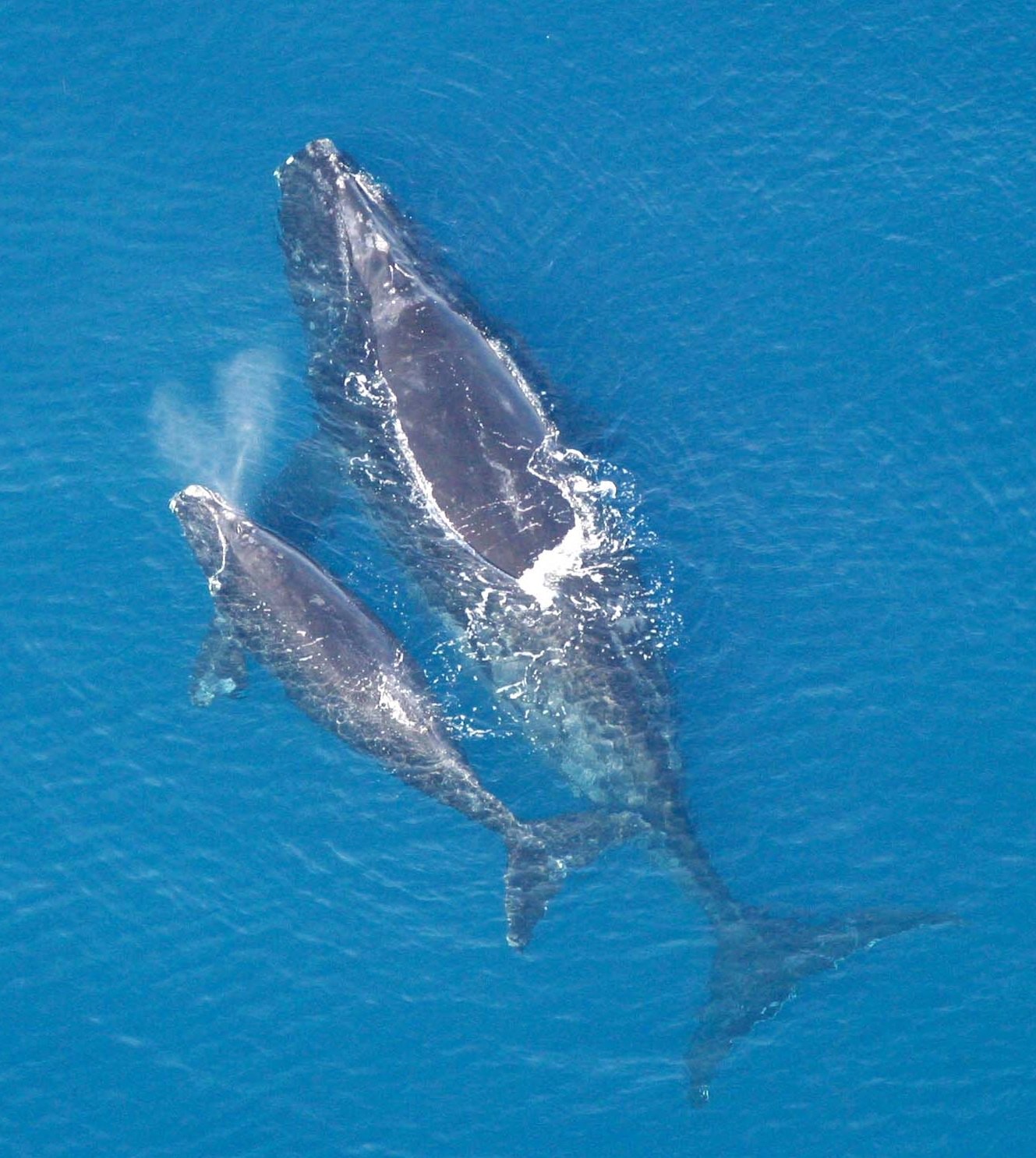
O. F. Müller formally described the species in 1776 under the name Balaena glacialis, in his Zoologiae Danicae Prodromus published in Copenhagen. Recovery of the population has been severely hampered by entanglement in fishing gear and collisions with vessels. The Balaenidae lineage to which it belongs has a fossil record stretching back approximately 20 million years, placing this whale among the oldest surviving groups of baleen whales.
Key facts
- Scientific name: Eubalaena glacialis
- Kingdom: Animalia
- Phylum: Chordata
- Class: Mammalia
- Order: Cetacea
- Family: Balaenidae
- Genus: Eubalaena
- Taxonomic rank: species
- Gestation period: 365.2 days
Classification and Relatives
Eubalaena glacialis belongs to the kingdom Animalia, phylum Chordata, class Mammalia, and order Cetacea. Within the family Balaenidae, its closest living relatives are the North Pacific right whale (Eubalaena japonica) and the Southern right whale (Eubalaena australis). All three were formerly classified as a single species before 2000. The molecular divergence between Balaena (the bowhead whale) and Eubalaena is estimated at approximately 17 million years ago.
Physical Characteristics
The species is a ram filter-feeder equipped with 200 to 270 baleen plates on each side of the jaw, each plate growing up to 3 metres long. Those plates act as a sieve: the whale swims slowly through dense patches of zooplankton with its mouth open, straining prey from the water. A right whale can consume more than a tonne of copepods in a single day, feeding anywhere from the surface down to the seafloor.
Calves are 4 to 5 metres long at birth and grow rapidly, reaching 8 to 9 metres by the end of their first year. Lactation lasts 10 to 12 months on average, occasionally extending to 17 months. Females reach sexual maturity at approximately age 10 and, after a gestation period of 365.2 days, give birth to a single calf.
Male right whales within the genus Eubalaena possess the largest testes of any animal species. Each testis may weigh as much as 500 kg (1,100 lb), and together they can produce as much as 4.5 litres (1.2 US gallons) of sperm. This is understood as an adaptation to sperm competition, consistent with the species’ mating system.
Behaviour and Reproduction
Right whales engage in what researchers call surface-active groups (SAGs), in which multiple males simultaneously court a single female. These interactions are observed in all seasons and all habitats, and the pattern is consistent with a sperm-competition mating system rather than one based on male-male combat.
Under healthy conditions, females calve every three to four years. As of the mid-2020s, the average calving interval has stretched to between seven and ten years, partly due to chronic stress from entanglement in fishing gear. That extended interval significantly slows potential population recovery.
Migration and Habitat
The species migrates seasonally along the Atlantic seaboard. From spring through fall, many whales feed in waters off New England and northward into Canadian waters, including the Bay of Fundy, Scotian Shelf, and Gulf of St. Lawrence. Each fall, some individuals travel more than 1,000 miles to shallow coastal waters in the southeastern United States to give birth.
The coastal zone stretching from Cape Fear, North Carolina, south to below Cape Canaveral, Florida, is the only known calving ground for the western North Atlantic population. NOAA Fisheries first designated this area as critical habitat in 1994.
Individual Identification
Each right whale carries a unique pattern of callosities, roughened patches of skin on the head. Researchers use these patterns as the primary means of photo-identification. The North Atlantic Right Whale Catalog, managed by the New England Aquarium, holds more than two million photographs and has recorded over 800 individuals across the history of the population.
Population Status and Threats
As of October 2025, the North Atlantic Right Whale Consortium estimated approximately 384 individuals alive at the start of 2024, a 2.1 percent increase over the recalculated 2023 estimate of 376 and the third consecutive year of slight population growth. The total remains critically low.
NOAA Fisheries estimates that over 85 percent of right whales have been entangled in fishing gear at least once, and that only about one-third of right whale deaths are documented. An Unusual Mortality Event declared in 2017 had, as of 2026, recorded 176 affected individuals: 43 dead, 41 seriously injured, and 92 sublethally injured or ill. The primary causes recorded in that event are entanglement in fishing gear and vessel strikes.
A study published in January 2025 found that the species should naturally survive well past 100 years, possibly to 130, yet the average lifespan has been reduced to approximately 22 years because of vessel strikes, entanglements, and climate-related stress on prey availability.
Research and Conservation Technology
In February 2025, a Cornell University-led study published in Endangered Species Research demonstrated that passive acoustic monitoring combined with machine-learning tools can estimate North Atlantic right whale numbers in Cape Cod Bay. The approach is described as a potentially safer and more cost-effective supplement to traditional aerial surveys.
Engineers at the Woods Hole Oceanographic Institution have developed on-demand, ropeless fishing technology in which traps are retrieved by sending an acoustic signal that releases a bottom-stowed buoy.
Did you know
- A study published in January 2025 found that North Atlantic right whales should naturally live well past 100 years, possibly to 130. Because of vessel strikes, entanglements, and climate stress, the species’ average lifespan has been cut to approximately 22 years. (cbc.ca)
- In 2015, NOAA hosted a Kaggle artificial-intelligence competition to automate identification of individual North Atlantic right whales from photographs. The winning algorithm, developed by Deepsense.ai, identified individuals with 87 percent accuracy using convolutional neural networks. (repository.library.noaa.gov)
- Basque whalers called the North Atlantic right whale sardako, meaning “whales living in groups.” By the mid-1500s they had established summer shore bases at harbors such as Red Bay, Labrador, sailing over 3,000 miles (4,800 km) from their Pyrenean home each year to hunt them. (narwc.org)
- The 2026 calving season produced 23 calves, the highest calf count since 2009, even as the total population remained below 400 individuals. (lovewhales.org)
Data sources
- GBIF
- Wikidata
- mammaldiversity.org
- neaq.org
- narwc.org
- fisheries.noaa.gov
- mammal.org.uk
- guinnessworldrecords.com
- ncbi.nlm.nih.gov
- ospar.org
- ifaw.org
- news.cornell.edu
- whoi.edu
Data updated: 2026-10-28