
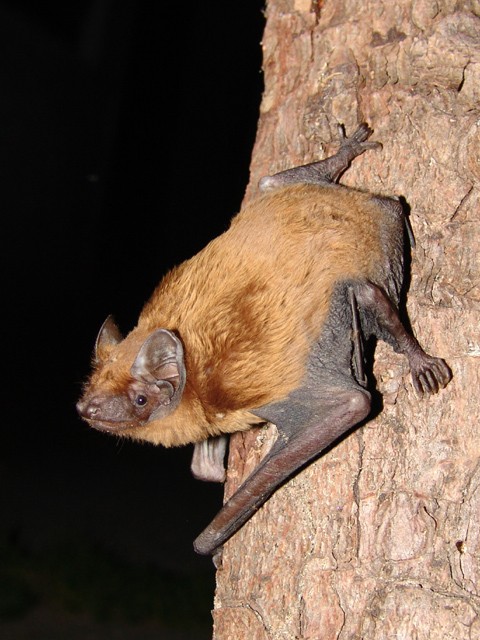
Nyctalus noctula, the noctule bat, is a medium-sized, tree-roosting bat distributed across the Palaearctic and a member of the family Vespertilionidae. With a wingspan of 34.4 cm and a maximum recorded flight speed of 20 m/s (roughly 50 km/h), it is one of the swiftest bats on the continent. A confirmed long-distance migrant, one ringed individual holds a banding record of 1,546 km, and French monitoring data from the Vigie-Chiro programme recorded a statistically significant population decline of 52.5% between 2006 and 2023. The species sits at the intersection of several active conservation concerns: wind-energy infrastructure, artificial light pollution, and a northward shift of its hibernation range already under way over the past 50 years.
Key facts
- Scientific name: Nyctalus noctula
- Kingdom: Animalia
- Phylum: Chordata
- Class: Mammalia
- Order: Chiroptera
- Family: Vespertilionidae
- Genus: Nyctalus
- Taxonomic rank: species
- Wingspan: 34.4 cm
- Habitat: forest
Physical description
The noctule’s fur is golden-brown and uniformly coloured across both the dorsal and ventral surfaces. The skin on the face, ears and wing membranes is dark brown. Adult body length falls between 60 and 85 mm, forearm length between 46 and 58 mm, and tail length between 40 and 60 mm; weight in normal condition ranges from 21 to 30 g.
The ears are short, measuring 15 to 21 mm, and rounded, with a mushroom-shaped tragus. That tragus form is shared by every member of genus Nyctalus and is one of the characters used to place an unfamiliar specimen in the group. The wings are long and narrow, a shape associated with fast, direct, open-air flight rather than the manoeuvring flight used by species that forage inside woodland canopy.
Taxonomy and discovery
Johann Christian Daniel von Schreber formally described the species in 1774, naming it Vespertilio noctula and citing France as the type locality. The name was later transferred to the genus Nyctalus as that genus was erected and refined. Three subspecies of Nyctalus noctula are currently recognised.
Phylogenetically, Nyctalus noctula is sister to the clade that contains the greater noctule (N. lasiopterus) and the birdlike noctule (N. aviator). Among all Palaearctic bat species, N. noctula produces the most variable social calls: 11 distinct call types have already been described, a repertoire breadth that has no parallel in the region.
Roosting and habitat
The species is strongly associated with forests. For summer roosting it favours woodpecker holes and natural tree cavities, typically at heights between 4 and 30 metres, with an average of approximately 19 metres. Breeding maternity colonies of 20 to 60 females form in the northern portion of the range, with females returning to those roosts during early pregnancy in late April.
Hibernation roosts differ in character.
Reproduction and mating
Mating takes place in late summer and early autumn. Males occupy mating roosts from early August and sing at the roost entrance to attract harems. A typical harem holds 4 to 5 females, though clusters of up to 20 have been recorded.
The species uses delayed fertilisation. After autumn mating, viable spermatozoa are stored in the uterine horns throughout hibernation. Ovulation does not occur until after the female arouses from torpor, from late March to mid-April. A 2022 study found that females can actively influence litter size: 65% give birth to a single pup, while others produce twins, with the outcome tied to the female’s energetic condition after hibernation.
Diet and foraging
The diet consists mainly of medium and small-sized Diptera, Hemiptera, Trichoptera, beetles and moths. The species also takes mayflies, winged ants and hoverflies, particularly when foraging over water bodies. The narrow-winged flight morphology suits pursuit of these insects in open airspace rather than within dense vegetation.
Echolocation calls around 20 to 25 kHz are low enough to be audible to the unaided human ear. The calls are audible as a ‘chip-chop’ sound, and colonies roosting in buildings have been detected from 200 to 300 metres away on warm days.
Migration
Nyctalus noctula is one of the few European bat species confirmed as a long-distance migrant. Populations from northeastern Europe move southwest in autumn, typically covering up to 1,000 km, with the single banding record standing at 1,546 km.
A European community-science project compiled over 500 sightings of at least 15,000 individual noctule bats flying during daylight hours.
Urban environment and artificial light
A 2020 study using GPS loggers tracked 20 noctule bats commuting through the Berlin metropolitan area. The data showed that the bats altered their movement paths in response to artificial light at night (ALAN), demonstrating a direct behavioural effect of urban light pollution on a species that habitually commutes over long stretches of open ground.
Conservation status and threats
The Vigie-Chiro monitoring programme in France recorded a statistically significant decline of 52.5% in common noctule numbers between 2006 and 2023. The noctule is simultaneously one of the bat species most frequently found dead under wind turbines in Central Europe. A 2025 study confirmed that wind-turbine casualties in France draw on breeding populations from across the whole of Europe, meaning that a mortality source concentrated in one country removes individuals from a continent-wide breeding pool.
Climate change adds a further dimension. A 2025 study published in Ecology Letters modelled that the noctule’s hibernation area will shift 78 to 732 km north-eastward and expand by 5.8% to 14% by 2100, depending on the emissions scenario applied. The model is consistent with observed data: the species has already shifted its hibernation range northward over the past 50 years. BatLife Europe designated Nyctalus noctula as Bat Species of the Year for both 2016 and 2017, specifically to raise the profile of the species’ conservation needs at the European scale.
Did you know
- In a European community-science project, researchers compiled over 500 sightings of at least 15,000 individual noctule bats flying during daylight hours, with directional autumn movements suggesting this unusual behaviour is linked to migration rather than foraging. (batcon.org)
- Although the noctule is normally nocturnal, during the mating season harem-holding males actively avoid entering torpor, remaining awake and mobile in their roosts to defend access to females from rival males. (jungledragon.com)
- A 2022 study found that female noctule bats can actively manipulate their litter size, with 65% giving birth to a single pup while others produce twins depending on their energetic condition after hibernation. (ncbi.nlm.nih.gov)
- The noctule’s echolocation calls around 20–25 kHz are low enough to be audible to the unaided human ear as a ‘chip-chop’ sound, and colonies in buildings can be heard from 200–300 m away on warm days. (bats.org.uk)
Data sources
- GBIF
- Wikidata
- batmonitoring.org
- mammaldiversity.org
- researchsquare.com
- ceson.org
- treatment.plazi.org
- croemer3.wixsite.com
- pmc.ncbi.nlm.nih.gov
- ncbi.nlm.nih.gov
- zenodo.org
- jungledragon.com
Data updated: 2026-10-28