
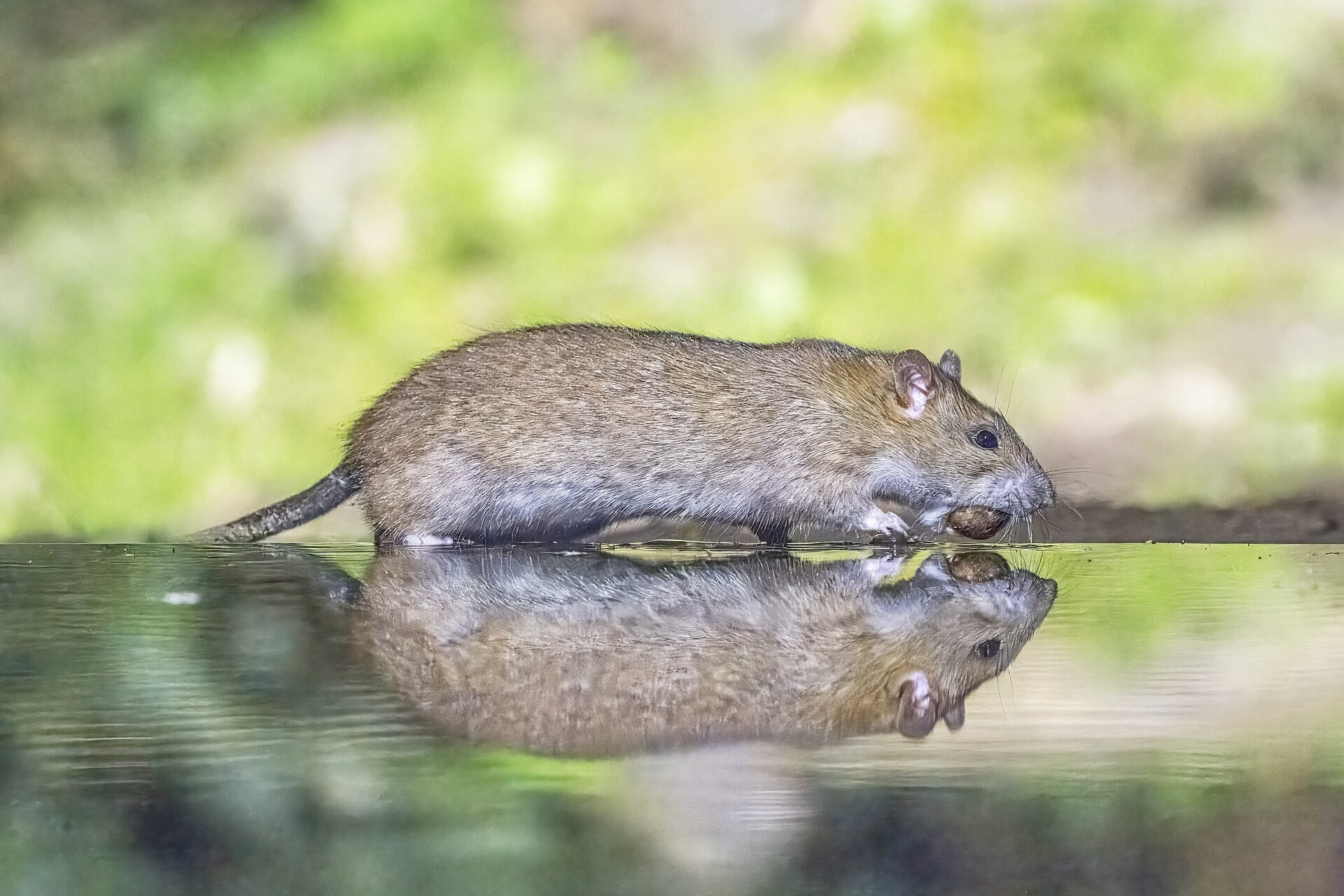
Rattus norvegicus, the brown rat, is a medium-sized rodent in the family Muridae. Originally native to northern China and Mongolia, it reached Europe by the early 18th century and North America by the 1750s, carried on ships along trade routes, and has since spread to every continent except Antarctica. Its dual identity as urban pest and laboratory model has made it central to more than 1.5 million research publications spanning cardiovascular disease, diabetes, cancer, and neuroscience.
Key facts
- Scientific name: Rattus norvegicus
- Kingdom: Animalia
- Phylum: Chordata
- Class: Mammalia
- Order: Rodentia
- Family: Muridae
- Genus: Rattus
- Taxonomic rank: species
- Habitat: landmass; shrubland
Appearance and Physical Characteristics
The brown rat has coarse fur that is typically brown or dark grey across the back, lightening to grey or tan on the underside. Natural populations can include individuals with scattered black or white hairs. Head and body length runs from 15 to 28 cm, while the tail measures between 10.5 and 24 cm, making it consistently shorter than the head and body combined.
The ears are shorter than those of related species and, when pulled forward, do not reach or cover the eyes. This distinguishes Rattus norvegicus from the black rat (Rattus rattus), whose temporal ridges are curved rather than straight. Vision is poor: pigmented individuals test at roughly 20/600, and the species is a dichromat whose colour perception resembles that of a human with red-green colour blindness. Hearing, by contrast, is acute, extending into ultrasound, and the olfactory system is highly developed.
Origins, Range, and Naming
The common name ‘Norway rat’ is a misnomer. Genetic studies show the species most likely migrated from southern East Asia to the Middle East roughly 3,600 years ago and reached Europe only around 1,800 years ago. The scientific name itself has a complicated history: John Berkenhout’s 1769 description is the accepted first valid scientific account, but the Norwegian naturalist Erxleben independently named the rat Mus norvegicus in 1777 using Norwegian specimens, which led to a period of confusion before Berkenhout’s priority was formally recognised.
From its East Asian origin, the species spread globally via human shipping and trade. By the early 18th century it had established itself in Europe, and by the 1750s it was documented in North America. It is now the dominant rat across Europe and much of North America, and the IUCN Red List assesses it as Least Concern with a stable global population trend, though no overall global population estimate is available.
Habitat and Diet
In environments without human presence or human food, brown rats favour damp terrain: river banks, coastlines, and wetlands. In practice, the majority of the global population lives in association with human infrastructure, including warehouses, ships, and sewage or stormwater systems.
The species is an opportunistic omnivore. Its diet spans grains, seeds, fruit, insects, eggs, fish, small mammals, and carrion, with cereals forming a large part of its natural intake. An adult consumes approximately 25 g of food per day and, on a dry diet, requires around 25 ml of water per day, equating to roughly 10% of body weight per day in dry grain.
Brown rats are proficient swimmers, capable of holding their breath for up to three minutes and covering more than half a mile through open water.
Reproduction and Lifespan
Gestation lasts 21 to 23 days. Litter size ranges from 2 to 14 offspring, with an average of 7 to 8. Newborns are born blind and hairless, open their eyes at 14 days, and are weaned at 3 to 4 weeks of age.
Wild brown rats typically live less than one year, with predation accounting for most mortality. The maximum longevity recorded in captivity is 3.8 years.
Behaviour and Social Structure
Brown rats live in large hierarchical groups. Laboratory studies have documented problem-solving, complex task learning, and maze navigation. A 2011 study published in Science by University of Chicago neuroscientists found that free rats repeatedly opened containers to release trapped cagemates with no food reward involved, which the researchers identified as the first experimental evidence of empathy-driven helping behaviour in rodents.
Neuroscientist Jaak Panksepp reported in the late 1990s that rats emit ultrasonic chirps at around 50 kilohertz when tickled, a frequency outside the range of human hearing. Those vocalisations are considered analogous to laughter and are associated with positive affective states.
Physiology reinforces how different the rat’s internal tempo is from a human’s. The resting heart rate averages 300 to 400 beats per minute, and the resting respiratory rate is around 100 breaths per minute, roughly five to six times the equivalent human rates.
Role as an Invasive Species
On islands, where native fauna evolved without generalist predators, the brown rat is a major driver of wildlife decline. It preys on the eggs and juveniles of ground-nesting birds, and invasive rodents have been documented as key contributors to the extinction of at least 50 island species.
Agricultural losses are also substantial. Rats have been estimated to damage more than 1% of the world’s cereal crops annually, with losses of 3 to 5% commonly reported in developing countries.
Laboratory Model and Scientific Significance
Rattus norvegicus was the first mammal domesticated specifically for scientific research. Its earliest documented laboratory use dates to 1828, in a fasting study. Controlled breeding for research purposes accelerated with the development of the Wistar strain at the Wistar Institute in Philadelphia under Dr. Helen Dean King in the early 20th century.
The species has served as a model for complex human diseases, including cardiovascular disease, diabetes, cancer, and neurological disorders, for over 150 years, generating more than 1.5 million research publications. The Rat Genome Database, established in 1999, curates genetic, genomic, phenotypic, and disease-related data produced by that body of work.
Genome assembly quality has continued to advance. In 2024, the Genome Reference Consortium adopted a new reference genome assembly designated GRCr8, constructed using 40x Pacific Biosciences HiFi sequencing coverage and scaffolded with optical mapping and Hi-C data. It supersedes the previous mRatBN7.2 assembly and provides a more complete foundation for genomic research.
Did you know
- In a 2011 study published in Science, University of Chicago neuroscientists found that free rats repeatedly opened containers to release trapped cagemates without any food reward on offer. It was the first experimental evidence of empathy-driven helping behaviour in rodents. (uchicagomedicine.org)
- Neuroscientist Jaak Panksepp discovered in the late 1990s that rats emit ultrasonic chirps at approximately 50 kilohertz when tickled, a frequency far above the range of human hearing. Those vocalisations are considered analogous to laughter and are associated with positive emotional states. (ncbi.nlm.nih.gov)
- The name Rattus norvegicus means ‘Norwegian rat’, but the species is not native to Norway. Genetic studies indicate it most likely migrated from southern East Asia to the Middle East approximately 3,600 years ago and reached Europe only around 1,800 years ago. (biorxiv.org)
- During a female brown rat’s six-hour oestrus period, she may mate with as many as 500 competing males. That reproductive intensity can theoretically yield up to 60 young per female per year. (animaldiversity.org)
- Rats have been estimated to damage more than 1% of the world’s cereal crops every year, with losses of 3 to 5% commonly reported in developing countries. (knowledgebank.irri.org)
- A brown rat’s heart beats 300 to 400 times per minute at rest, and its resting respiratory rate is around 100 breaths per minute, roughly five to six times faster than the human equivalents. (bionity.com)
Data sources
- GBIF
- Wikidata
- animaldiversity.org
- faculty.ucr.edu
- adfg.alaska.gov
- biorxiv.org
- worldanimalrescuenetwork.org
- iucngisd.org
- canalrivertrust.org.uk
- depts.ttu.edu
- genomics.senescence.info
- nfrs.org
- ncbi.nlm.nih.gov
- understandinganimalresearch.org.uk
- genome.cshlp.org
Data updated: 2026-10-28