
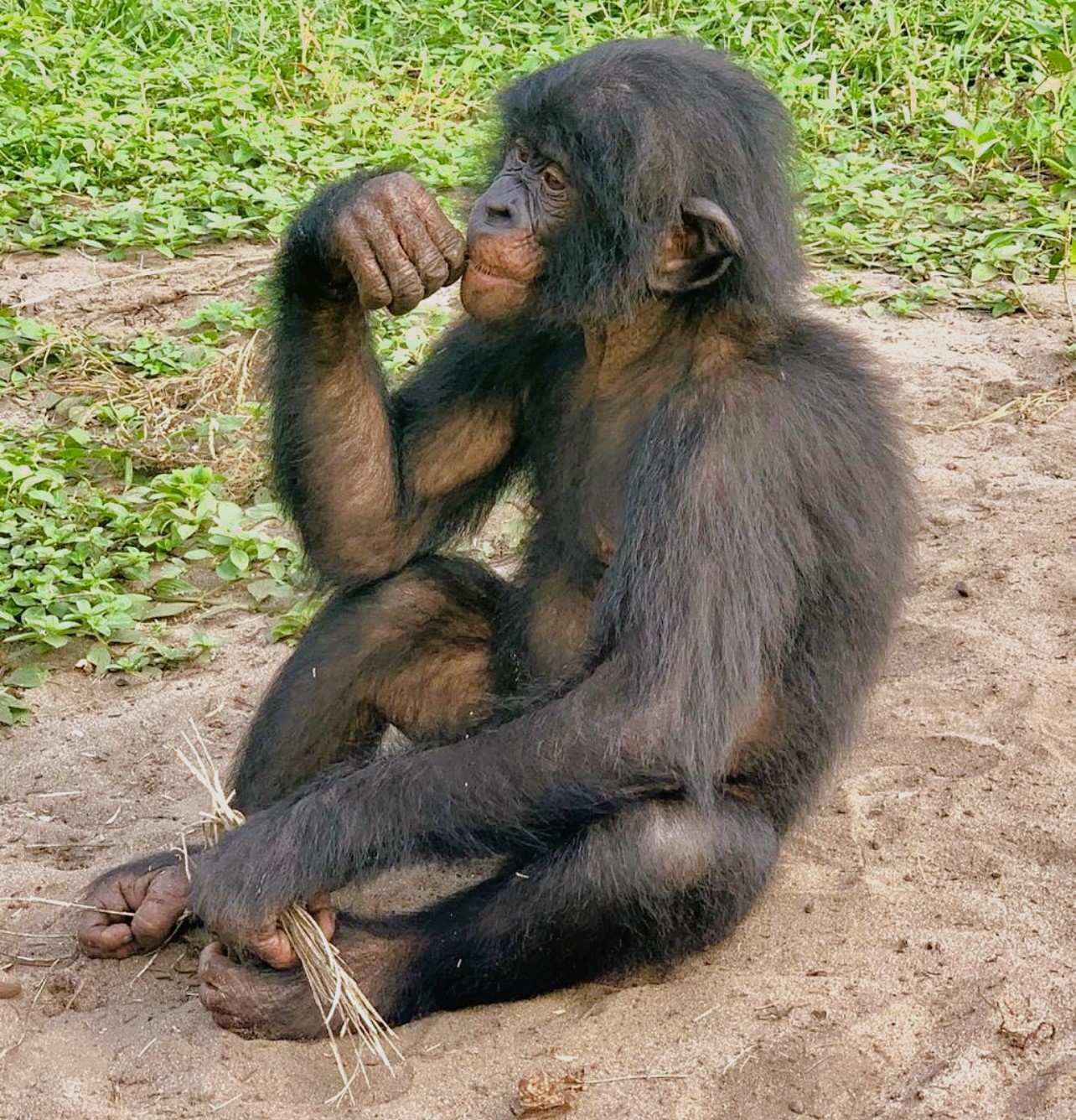
The bonobo, Pan paniscus, is one of two living species in the genus Pan, alongside the common chimpanzee. Its genome is 98.7 percent identical to the human genome and 99.6 percent identical to the chimpanzee genome, placing it among the closest living relatives of Homo sapiens. Confined entirely to the rainforests south of the Congo River in the Democratic Republic of Congo, it is listed as Endangered on the IUCN Red List (2016 assessment), with an estimated minimum of 15,000 to 20,000 individuals remaining in surveyed areas and a population trend that continues to decline. Only about 30 percent of the species’ historic range has been surveyed, so the true figure is unknown.
Key facts
- Scientific name: Pan paniscus
- Kingdom: Animalia
- Phylum: Chordata
- Class: Mammalia
- Order: Primates
- Family: Hominidae
- Genus: Pan
- Taxonomic rank: species
- Mass: 43 kg
- Gestation period: 243.5 days
Physical characteristics
The bonobo has black facial skin, prominently pink lips, and hair that parts naturally along the top of the head. Two or three toes on each foot are partially webbed. Adults weigh around 43 kg.
Compared with other great apes, bonobos show a greater predisposition for bipedal movement. Anatomical features that support this include a more centrally positioned foramen magnum, longer thigh bones, longer feet, and a differential distribution of body weight. On the ground they travel by knuckle-walking, bearing weight on the dorsal surface of the knuckles in a quadrupedal gait. In the trees they brachiate, scramble quadrupedally along branches, and occasionally move upright.
The species occupies primary and secondary tropical rainforests, swamp forests, and forest-savanna mosaics at elevations from approximately 300 to 700 meters (984 to 2,297 feet).
Society and behavior
Bonobos live in fission-fusion societies: larger groups split into smaller subgroups to forage and then reassemble. Leadership within these groups falls to older females, who typically have first access to food and determine where the group moves. Bonobo society is female-dominated and matriarchal; unrelated females form strong alliances and act collectively to control or repel aggressive males.
Socio-sexual contact is used across many pairings, including same-sex and mixed-age combinations, to reduce tension, resolve conflicts, and reinforce social bonds. This pattern has been described in the literature as substituting sex for aggression. The behavior is not confined to reproductive contexts and is not analogous to any single human social institution.
Bonobos do not have a fixed breeding season. Wild females first give birth at 13 to 14 years of age and reach full adult size at about 15 years. A single infant is born every five to six years; the average interbirth interval recorded from field data is 4.6 years (4.8 years when counting only live births). Lifespans in the wild range from 20 to 45 years; captive individuals have been recorded living between 50 and 58 years.
Discovery and classification
The bonobo was formally described in 1929 by German zoologist Ernst Schwarz, based on a skull held at the Tervuren Museum in Belgium. The skull had been catalogued as a juvenile chimpanzee; Schwarz recognized it as belonging to an adult of a previously undescribed taxon. Schwarz initially classified the animal as a subspecies, Pan satyrus paniscus, and it was only subsequently elevated to full species status as Pan paniscus.
Unlike the common chimpanzee, the bonobo is not divided into subspecies. The single population across the Congo Basin is treated as a uniform taxon under current taxonomy.
The complete bonobo genome was sequenced for the first time in research published in Nature in 2012, using a female bonobo named Ulindi from Leipzig Zoo. That work revealed that more than 3 percent of the human genome is more closely related to either the bonobo or chimpanzee genome than those two genomes are to each other, a result with implications for understanding the divergence of the Pan lineage from the ancestors of modern humans.
Conservation status and legal protections
The IUCN Red List assessed the bonobo as Endangered in 2016, with a declining population trend. Field surveys covering approximately 30 percent of the species’ historic range yield a minimum estimate of 15,000 to 20,000 individuals. Because most of the range remains unsurveyed, any global population figure carries substantial uncertainty.
The species is listed on Appendix I of CITES and classified as Class A under the African Convention on the Conservation of Nature and Natural Resources, giving it the highest level of legal protection in international trade law.
In April 2022, the organization Friends of Bonobos (Les Amis des Bonobos du Congo) announced the reintroduction of 14 bonobos into the Ekolo ya Bonobo Community Reserve. Combined with earlier reintroductions carried out in 2009, the total number of rewilded bonobos reached 30 animals.
Did you know
- The bonobo is one of the last large mammals to be identified by science. Ernst Schwarz recognized it in 1929 not during a field expedition in Africa but while examining a mislabeled skull stored in a Belgian colonial museum in Tervuren. (scientificamerican.com)
- Bonobos are the only great ape species not divided into subspecies, meaning the single population across the Congo Basin is treated as a uniform taxon. (awf.org)
- Other females have been observed gathering around a pregnant bonobo and assisting during birth, a behavior likened to midwifery and recorded as unique among non-human great apes. (ifaw.org)
- In April 2022, Friends of Bonobos (Les Amis des Bonobos du Congo) announced the reintroduction of 14 bonobos into the Ekolo ya Bonobo Community Reserve, following earlier reintroductions in 2009, bringing the total of rewilded bonobos to 30 animals. (projetogap.org)
Data sources
- GBIF
- Wikidata
- awf.org
- facts-about.info
- ifaw.org
- neprimateconservancy.org
- animaldiversity.org
- scientificamerican.com
- dimensions.com
- ielc.libguides.com
- primate.wisc.edu
- populartimelines.com
- livescience.com
- nature.com
- theanimalmap.com
- link.springer.com
Data updated: 2026-10-28