
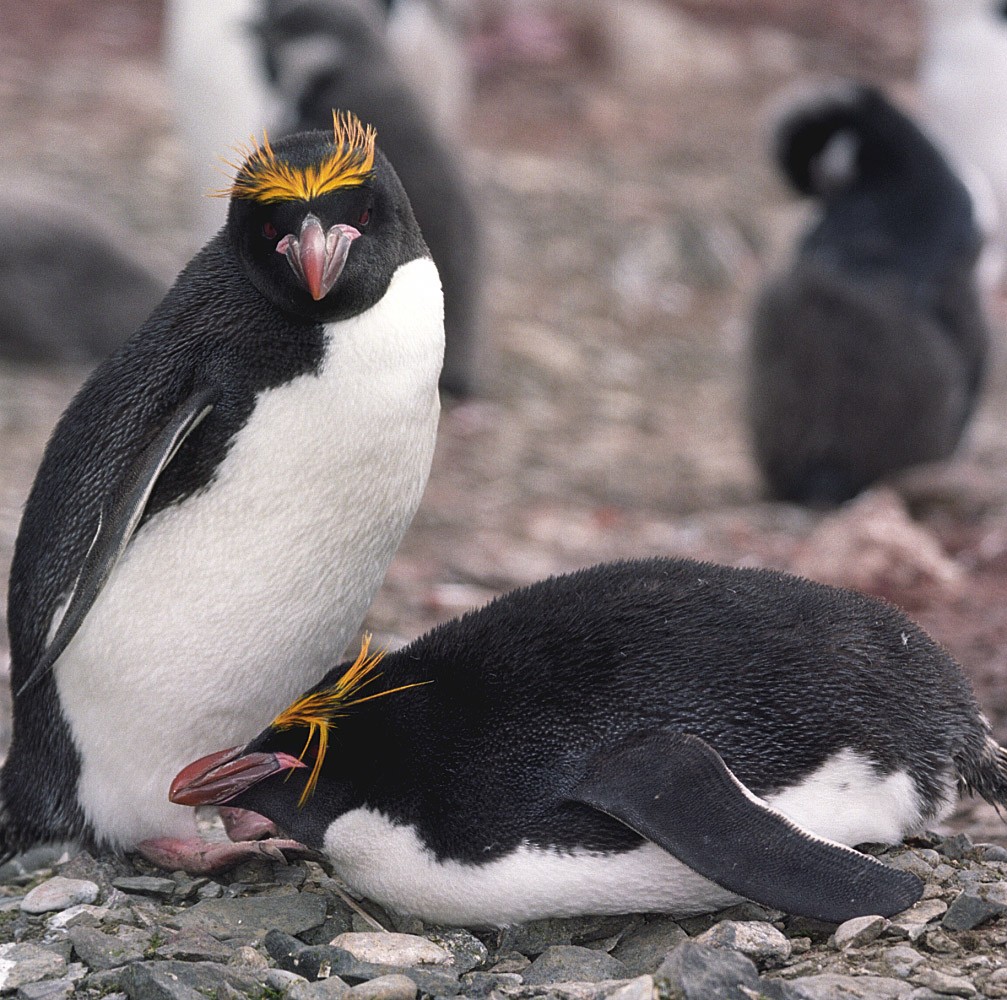
The Macaroni Penguin (Eudyptes chrysolophus) is a crested penguin of the sub-Antarctic, breeding at more than 50 known sites scattered across islands in the South Atlantic and southern Indian Oceans, with one site recorded on the Antarctic Peninsula. Once cited as the most numerous penguin species on Earth, with roughly 18 million individuals, the species has declined sharply since the mid-1970s and now carries a Vulnerable classification on the IUCN Red List. Its genus name, from the Ancient Greek eu (“good”) and dyptes (“diver”), was earned honestly: solid bones, salt-excreting glands, and eyes tuned for underwater clarity all point to a bird built primarily for the sea.
Key facts
- Scientific name: Eudyptes chrysolophus
- Kingdom: Animalia
- Phylum: Chordata
- Class: Aves
- Order: Sphenisciformes
- Family: Spheniscidae
- Genus: Eudyptes
- Taxonomic rank: species
- Mass: 142 g
- Wingspan: 70 cm
Taxonomy and Naming
German naturalist Johann Friedrich von Brandt formally described the species in 1837 from specimens collected at the Falkland Islands, placing it under the original protonym Catarhactes chrysolophus. The specific epithet chrysolophus draws on the Greek chryse (“golden”) and lophos (“crest”), a direct reference to the bird’s conspicuous orange-yellow plume. The species now sits in the genus Eudyptes, family Spheniscidae, order Sphenisciformes.
Molecular clock analysis using DNA evidence indicates that the Macaroni Penguin diverged from its closest relative, the Royal Penguin (Eudyptes schlegeli), approximately 1.5 million years ago. The two birds are so similar that some authorities treat them as a single species, a debate the genetics has not yet settled conclusively. In March 2021, Jong-U Kim and Jeong-Hoon Kim at the Korea Polar Research Institute published the first complete mitochondrial genome of Eudyptes chrysolophus, determining that the circular mitogenome is 17,059 base pairs long and contains 13 protein-coding genes, 22 tRNA genes, and two rRNA genes. Their phylogenetic analysis confirmed the close relationship between E. chrysolophus and E. schlegeli. The genome was sequenced from a blood sample collected at Narebski Point, Antarctica, on 10 January 2010, and deposited in GenBank under accession number MW074963.
Range and Breeding Colonies
The Macaroni Penguin has a circumpolar range centred on the sub-Antarctic, with major breeding colonies on South Georgia, the South Sandwich Islands, the South Orkney Islands, the South Shetland Islands, Bouvet Island, the Prince Edward and Marion Islands, the Crozet Islands, the Kerguelen Islands, Heard Island, the Falkland Islands, and coastal sites in Chile and Argentina. The two largest population strongholds are the Crozet Islands, holding approximately 2.2 million breeding pairs, and the Kerguelen Islands, with approximately 1.8 million breeding pairs; both archipelagos form part of the French Southern Territories.
The scale of those colonies makes clear why the Macaroni Penguin was long considered the most numerous penguin on Earth. Yet numbers at several sites have fallen substantially. The South Georgia population dropped by roughly half between the mid-1970s and mid-1990s. At Marion Island, breeding pairs declined from approximately 416,000 to 278,000 between 1994 and 2013, a loss of more than one third in under two decades.
Anatomy and Physiology
Adult Macaroni Penguins have a wingspan of 70 cm. The bones are solid rather than hollow, a reversal of the arrangement in flying birds; that extra density reduces buoyancy, which helps the bird maintain depth during dives rather than fighting to stay submerged. The eyes are adapted for sharp vision underwater, while vision on land is comparatively poor.
A supraorbital salt gland handles the osmotic cost of swallowing seawater during foraging. The gland excretes excess salt, keeping the bird’s internal water balance stable across extended marine foraging bouts. The Macaroni Penguin also deliberately swallows small stones measuring 10 to 30 mm in diameter, a behaviour thought to aid deep-sea diving by adding ballast and to help grind the hard exoskeletons of crustaceans in their diet.
Foraging and Diet
The diet consists primarily of krill, which during the breeding season constitutes over 90 percent of food intake, supplemented by cephalopods and small fish, particularly myctophids. Individual dives follow a V-shaped profile, with no time spent at the sea bottom, and typically last about two minutes. Per dive, the bird catches between 4 and 16 krill, or between 40 and 50 amphipods.
Reproduction
The Macaroni Penguin lays two eggs per breeding season, but the pair almost invariably raises only one chick. The first egg, weighing approximately 93 g, is smaller, takes longer to incubate, and is almost always discarded before or shortly after the second egg is laid. The second egg weighs approximately 150 g and is the one that proceeds to hatching. The outcome is that, despite producing two eggs, the species functions as a one-chick-per-season breeder.
Did you know
- Although the Macaroni Penguin has historically been cited as the most numerous of all penguin species, with about 18 million individuals, widespread population declines recorded since the mid-1970s have reduced numbers substantially enough for the IUCN to classify the species as Vulnerable. (theanimalmap.com)
- Macaroni Penguins deliberately swallow small stones measuring 10 to 30 mm in diameter, a behaviour thought to aid deep-sea diving by adding ballast and to help grind the hard exoskeletons of crustaceans in their diet. (animalcorner.org)
- The first egg a Macaroni Penguin lays weighs only about 93 g while the second weighs about 150 g. The smaller first egg is almost always lost, either discarded before the second is laid or failing to hatch, so the species effectively functions as a one-chick-per-season breeder despite laying two eggs. (penguins.cl)
- The complete mitochondrial genome sequenced by the Korea Polar Research Institute in 2021 from a blood sample taken at Narebski Point, Antarctica, on 10 January 2010, was deposited in GenBank under accession number MW074963, providing the first full mitogenomic reference for this species. (ncbi.nlm.nih.gov)
Data sources
- GBIF
- Wikidata
- marinebio.org
- penguins.cl
- theanimalmap.com
- polar-latitudes.com
- animalcorner.org
- animaldiversity.org
- a-z-animals.com
- ncbi.nlm.nih.gov
Data updated: 2026-10-28