
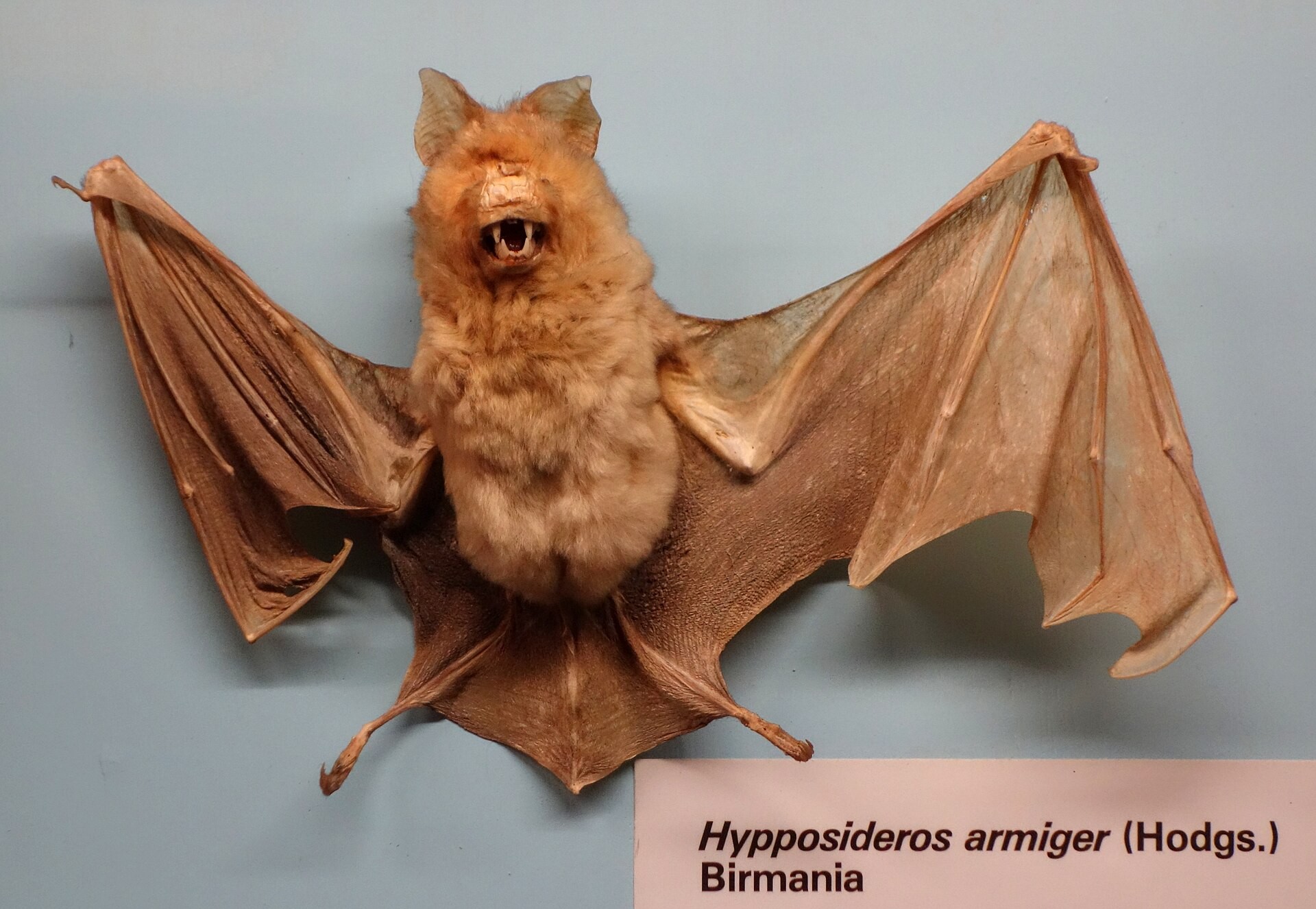
Hipposideros armiger, known as the Great Himalayan Leaf-nosed Bat, is the largest bat of the genus Hipposideros found in Southeast Asia and among the largest hipposiderid bats across its entire range, which stretches from Nepal and northeastern India east through southern China and south to Peninsular Malaysia. First formally described by Brian Houghton Hodgson in 1835 and originally placed in the genus Rhinolophus, it has since been established as the namesake of the armiger species group within Hipposideridae. In December 2024, a published study confirmed its presence in Bangladesh for the first time, extending the known range by one country.
Key facts
- Scientific name: Hipposideros armiger
- Kingdom: Animalia
- Phylum: Chordata
- Class: Mammalia
- Order: Chiroptera
- Family: Hipposideridae
- Genus: Hipposideros
- Taxonomic rank: species
- Habitat: forest
Description and appearance
The fur of Hipposideros armiger is thick and woolly. The upperparts range from dark brown to reddish brown, while the ears, wings, and flight membranes are dark brown, creating a visible contrast against a grey-brown body. The species is notably large for its family: it holds the record as the largest Hipposideros bat in Southeast Asia and ranks among the largest hipposiderids wherever it occurs.
Its echolocation call consists of a short constant-frequency signal with brief frequency-modulated components at the start and tail. The constant-frequency portion ranges from 65 to 75 kHz. A study of Chinese populations published in 2022 recorded a maximum variation of about 6 kHz across those populations, with calls spanning 66.80 to 72.51 kHz. That same research identified three distinct acoustic clusters within China: Eastern and Western China, Hainan, and Southern Yunnan.
Range and habitat
The species occupies a broad but discontinuous range. In the west it reaches northern and northeastern India and Nepal; to the north it extends through southern China south of the Yangtze River, including Hainan and Taiwan; to the south it reaches Peninsular Malaysia, passing through Myanmar, Thailand, Laos, Vietnam, and Cambodia. Recorded elevations span 100 to 2,031 metres above sea level, from montane and bamboo forests in South Asia to low-elevation limestone cave systems in Southeast Asia.
A colony of approximately 75 to 80 individuals discovered during field surveys conducted between July and December 2023 in a cave in the Chittagong Hill Tracts was reported in December 2024 as the first confirmed record of the species in Bangladesh.
Roosting and social structure
Hipposideros armiger forms colonies that range from small groups to aggregations of thousands. Each individual keeps a roosting gap of roughly 10 to 20 cm from its neighbours. One roost recorded in a tunnel over a waterway in Sichuan, China, contained thousands of bats. During winter, large numbers gather at hibernacula, with hibernation typically running from late December to February depending on local temperature.
During the breeding season, the sexes largely separate. Colonies consisting mainly of females and their offspring occupy breeding roosts, while non-breeding colonies are composed primarily of males. Females in mainland China were recorded as pregnant from January to early May, with birth of a single offspring occurring between May and early June. Young were observed attached to females in the roost from February to June, reaching approximately the size and weight of adult females and becoming capable of independent flight around seven weeks after birth. Male bats require one year to reach sexual maturity; females require two years.
Diet and foraging
The species is insectivorous. Diet studies conducted in Meghalaya, India, found Coleoptera (beetles) comprising between 56.3% and 100% of prey items from December to April, with Diptera accounting for up to 27.5% and Lepidoptera up to 16.2% during that period. In Malaysia, recorded diet composition shifts toward a broader mix: Coleoptera at 36.7% and Hymenoptera at 28.8%.
Foraging takes place around trees and in adjacent open areas. The bat has been observed clinging to tree trunks to consume prey and has been recorded foraging around street lights in Sichuan, China.
Echolocation mechanics
The precision of Doppler shift compensation in this species has been measured in detail. During free flight, the average frequency of returning echoes was kept constant with a standard deviation of only 110 Hz, independent of flight speed, with the resting and reference frequency coupled with an offset of 80 Hz.
Research published in 2022 added a thermal dimension to this picture: the resting echolocation frequency changes with body temperature.
Taxonomy and classification
Brian Houghton Hodgson formally described the species in 1835 from a type locality of Nepal. His original description appeared in the Journal of the Asiatic Society of Bengal, volume 4, page 699, where he placed it in the genus Rhinolophus under the name Rhinolophus armiger. Later reclassification moved it to Hipposideros, where it now lends its name to the armiger species group. That group includes Hipposideros pendleburyi from peninsular Thailand and Hipposideros alongensis from northern Vietnam, both closely related but more geographically isolated.
Genomics and biomedical research
In 2017, the genome of Hipposideros armiger was assembled de novo using next-generation sequencing technology.
A 2014 study published in PLOS ONE identified a potential biomedical role for the species in obesity research. After exposing bats to 10 degrees Celsius for seven days, researchers found that expression of the thermogenic genes Ucp1 and Pgc1a in abdominal fat was upregulated by 729-fold and 23-fold respectively. The study proposed Hipposideros armiger as a potentially useful animal model for research on cold-induced browning of intra-abdominal white adipose tissue, a pathway relevant to human obesity therapy.
Threats and conservation
Localized threats vary by region. In South Asia, deforestation, agriculture, mining, and roost disturbance are the primary pressures. In Laos, Vietnam, and Thailand, roost disturbance and subsistence hunting are the recorded concerns.
In Meghalaya, India, local hunters have been recorded targeting Hipposideros armiger for consumption using improvised fishing nets placed in front of cave mouths. This practice has led to significant population declines at some roost sites within the state.
Did you know
- Hipposideros armiger serves as host to the land leech Sinospelaeobdella, placing it among the small number of known bat species that act as a food source for a jawed land leech parasite. (thainationalparks.com)
- The echolocation call frequency of Hipposideros armiger varies by up to about 6 kHz across its range in China. A 2022 acoustic study found that populations cluster into three distinct groups by geography: Eastern and Western China, Hainan, and Southern Yunnan. (frontiersin.org)
- A 2022 virology study recovered the first complete genomes of parechoviruses ever isolated from feces of any bat in the genus Hipposideros. The two viruses, named BPeV11 and BPeV20, were found in fecal samples of Hipposideros armiger collected in Mengla County, Yunnan Province, China. (ncbi.nlm.nih.gov)
Data sources
- GBIF
- Wikidata
- zenodo.org
- ecologyasia.com
- thainationalparks.com
- news.mongabay.com
- bio.bris.ac.uk
- hkbatradar.com
- frontiersin.org
- nature.com
- ncbi.nlm.nih.gov
- journals.plos.org
Data updated: 2026-10-28