
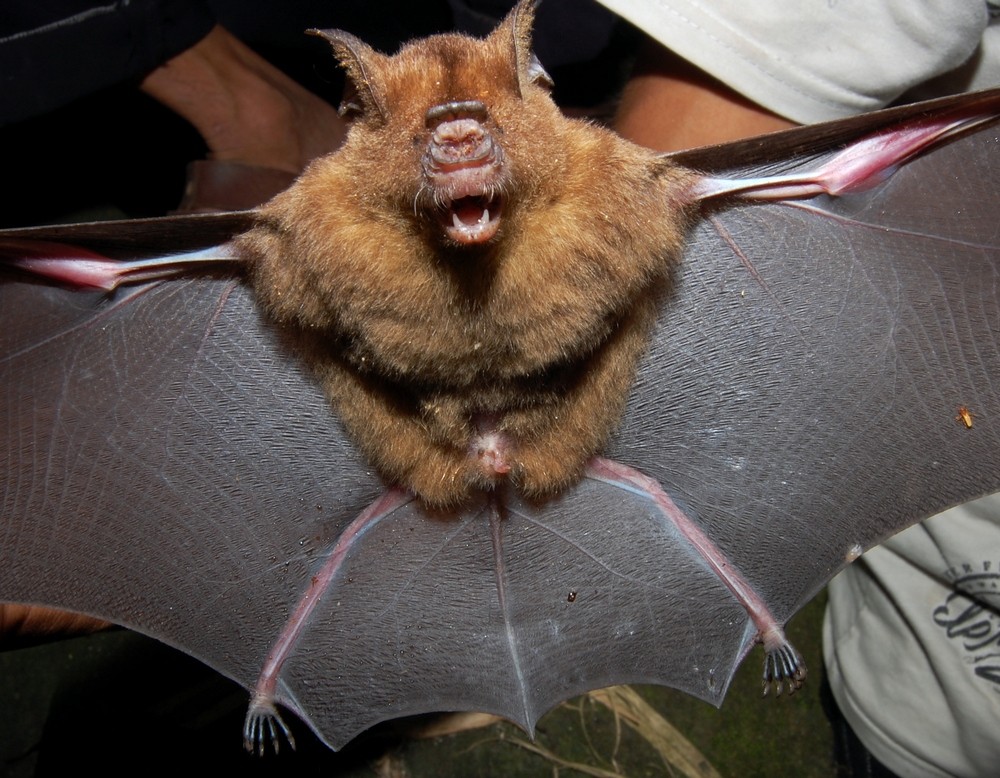
Horsfield’s Leaf-nosed Bat (Hipposideros larvatus) is a medium-sized insectivorous bat of the family Hipposideridae, distributed from northeastern India and Bangladesh east across southern China and mainland Southeast Asia to the islands of Sumatra, Borneo, Java, Bali, and the Kangean Islands. The species weighs between 15 and 23 g and roosts in colonies that can reach 800 individuals in a single cave. Stable isotope analysis has identified it as an important predator of beetles associated with C4 crops including sugar cane and corn, giving the species direct relevance to agricultural pest control. What is classified as a single species may, under ongoing molecular work published in 2022, turn out to be a complex of at least five distinct evolutionary lineages spread across the Indo-Malayan region.
Key facts
- Scientific name: Hipposideros larvatus
- Kingdom: Animalia
- Phylum: Chordata
- Class: Mammalia
- Order: Chiroptera
- Family: Hipposideridae
- Genus: Hipposideros
- Taxonomic rank: species
- Habitat: forest
Physical description
The dorsal fur of Hipposideros larvatus is a uniform cinnamon brown; the ventral fur is lighter and grey. The full range of pelage runs from dark gray-brown to orange-reddish brown depending on population and individual. Juveniles are consistently darker than adults. The ears are rounded and broad, with a sharp tip, and are dark grey or brown in colour, matching the noseleaf.
The noseleaf is the most diagnostic feature of the species. Three lateral accessory leaflets are present on each side of the main noseleaf, a character that in several study areas separates H. larvatus from every sympatric hipposiderid. The posterior noseleaf is as broad as the width of the anterior leaf, and in males a thickened, swollen structure behind the posterior leaf is clearly defined.
Measurements recorded across the full range are: head-body length 52–75 mm, tail 32–35 mm, ear 21–25 mm, hindfoot 7–12 mm, forearm 50–67 mm. Body mass ranges from 15 to 23 g range-wide; Chinese specimens measured in September 2002 and 2003 yielded a mean of 21.04 g for males and 20.12 g for females, with recorded individual masses between 17.4 g and 24.8 g. The chromosomal complement is 2n = 32 with a fundamental number of FN = 60.
Discovery and taxonomic history
Thomas Horsfield, an American-born physician and naturalist, first described the species in 1823 under the name Rhinolophus larvatus, placing it in the horseshoe bat genus Rhinolophus. The type locality he designated was Java, Indonesia. The description appeared in his work ‘Zoological Researches in Java,’ issued in eight parts from 1821 to 1824, a publication that remains a landmark in the natural history of Southeast Asia.
The bat was later transferred to the genus Hipposideros, where it now sits in the larvatus species group alongside the closely related H. grandis and H. poutensis. Within the order Chiroptera, the species belongs to the suborder Yinpterochiroptera. The original placement in Rhinolophus was not unreasonable: both Rhinolophidae and Hipposideridae share elaborate, structurally similar noseleaf anatomy, and the two families are superficially easy to confuse on external examination alone.
A 2022 study by Yuzefovich and colleagues, published in Zootaxa (volume 5200, issue 1, pages 73–95), used mitochondrial data to assess the boundaries of H. larvatus across mainland Asia. The analysis found that H. larvatus sensu lato is paraphyletic, and the paper concluded it constitutes a widespread species complex rather than a single biological species.
Distribution and roosting
The confirmed range of H. larvatus extends from northeastern India and northeastern Bangladesh through southern China, including Hainan Island, across all of mainland Southeast Asia, and into the island archipelagos of Sumatra, Borneo, Java, Bali, and the Kangean Islands, with records from many additional offshore islands. Altitudinal records span from 182 metres to 860 metres according to data compiled by Bates and Harrison in 1997, but a population in Yunnan province, China, was documented at 1,480 metres, extending the known upper limit considerably.
Roosting sites used by this species are varied: limestone and sandstone caves, abandoned mines, rock crevices, mine shafts, pagodas, old buildings, and man-made underground tunnels all appear in the record. The species frequently shares caves with other hipposiderids. In Thailand, documented roost-mates include the Diadem Leaf-nosed Bat (H. diadema), Pendlebury’s Leaf-nosed Bat (H. pendleburyi), and the Great Himalayan Leaf-nosed Bat (H. armiger). Colony sizes range from small groups to assemblages of up to 800 individuals.
A pronounced seasonal pattern has been observed at roost sites: colonies are dramatically reduced or entirely absent from December through April, with bats returning in May or June. The leading interpretation of this pattern is that the absences reflect movement to separate breeding colonies elsewhere, though the full extent of those movements has not been mapped. Local movements have been recorded in Myanmar and Thailand.
Foraging and diet
H. larvatus forages in the forest understory and is recorded in dry and humid forest, at forest edges and gaps, and in degraded agricultural areas. The principal insect prey orders are Coleoptera (beetles), Lepidoptera (moths), and Hymenoptera.
Stable isotope analysis of specimens from a mixed foraging assemblage found that H. larvatus consumed beetles predominantly from C4 food webs. That finding positions the species as a predator of pest insects associated with C4 crops, specifically sugar cane and corn. In Lampung Province on Sumatra, a survey of forests and plantations found H. larvatus to be the most common and abundant insectivorous bat across both land-use types, illustrating how its foraging flexibility enables high local densities even in modified landscapes.
Echolocation
The echolocation call of H. larvatus is a short constant-frequency signal with a brief frequency-modulated start and tail, a call design typical of hipposiderid bats hunting in cluttered environments. In Chinese populations measured at a single study site, the frequency of most energy was 82.64 kHz in males and 82.32 kHz in females. Populations in Peninsular Malaysia emit the highest frequencies recorded for the species, at 100–102 kHz. Across the broader Indo-Malayan region, the frequency of peak energy varies from approximately 82 kHz to 100 kHz, a range wider than might be expected for a single species and consistent with the molecular evidence for a species complex.
Reproduction
Breeding is seasonal and tightly structured. Females are typically pregnant from March through May and lactating from April through July; young have been observed attached to females at roost sites from April through June. A 23-month monitoring study of caves in Cambodia conducted from 2014 to 2016 found that the major birth peak coincides with the period of greatest annual cave visitation, which in Cambodia corresponds to the national new year in April. The temporal overlap between peak parturition and peak human disturbance represents a concrete conservation concern at those sites.
Conservation status and threats
The IUCN Red List classifies H. larvatus as Least Concern (assessment reference IUCN 2024, taxon ID 85646564). Populations in limestone habitats appear generally stable across most of the range. However, cave-bat hunting by local communities puts some populations at local risk, and the species as a whole cannot be fully evaluated until the species-complex question is resolved, since cryptic lineages may have narrower ranges and smaller total populations than the aggregate figures suggest.
Tourism development of caves across Southeast Asia introduces artificial lighting, physical modification of cave interiors, and fluctuations in temperature and humidity. The 2014–2016 Cambodia study documented that these changes can cause roost abandonment by H. larvatus and other cave-dependent bats. Researchers at the University of Bristol have recommended that caves and old buildings used as roosts be formally protected as key habitats for this species.
Did you know
- When Thomas Horsfield described the bat in 1823 he placed it in Rhinolophus, the horseshoe bat genus. It was later moved to Hipposideros. The original assignment was not arbitrary: both Rhinolophidae and Hipposideridae independently evolved similarly elaborate noseleaf structures, making the two families look closely related on external inspection. (zenodo.org)
- A survey across forests and plantations in Lampung Province, Sumatra, found H. larvatus to be the single most common and abundant insectivorous bat recorded across both land-use types. (zenodo.org)
- When DNA barcodes were compared across H. larvatus specimens from throughout the Indo-Malayan region, the sequences sorted into five distinct genetic clusters. The clusters track geography closely, suggesting the bats have been evolving separately in different parts of the region for long enough to qualify as distinct evolutionary lineages — meaning the single species name currently covers at least five biological units. (zenodo.org)
Data sources
- GBIF
- Wikidata
- zenodo.org
- currentconservation.org
- bio.bris.ac.uk
- ecologyasia.com
- bioone.org
- ncbi.nlm.nih.gov
- journals.plos.org
- mammaldiversity.org
Data updated: 2026-10-28