
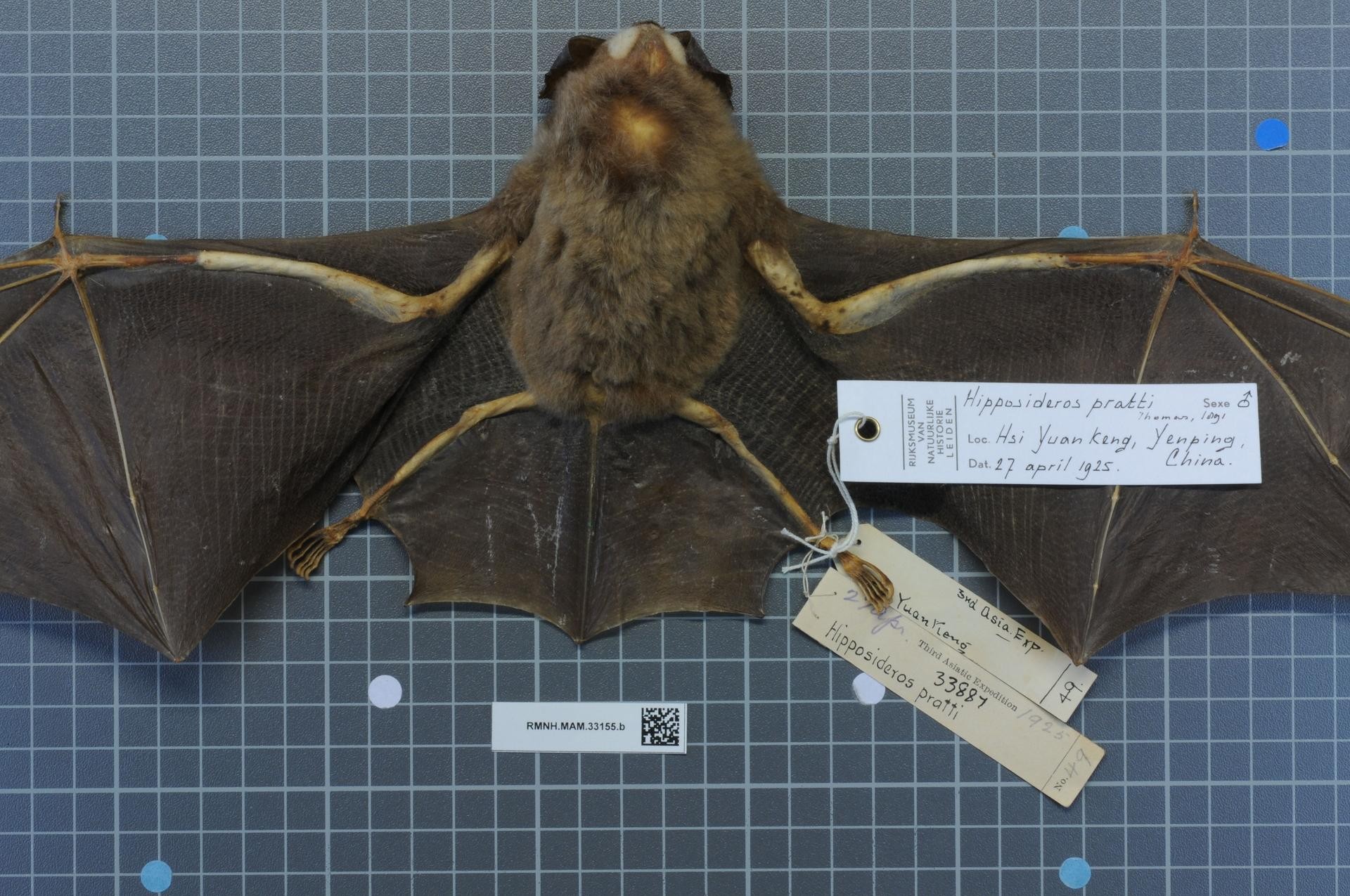
Pratt’s Leaf-nosed Bat (Hipposideros pratti) is a large, cave-roosting chiropteran native to central, eastern, and southern China and northern Vietnam, formally described in 1891 by British zoologist Oldfield Thomas from a specimen collected in what is now Sichuan Province. Within the family Hipposideridae it ranks second in body size only to Hipposideros armiger, with forearm lengths of 79–89 mm and body masses of 53–68.9 g. The species has attracted sustained interest in neuroethology because its constant-frequency echolocation calls, centred near 58–62 kHz, allow researchers to quantify audio-vocal feedback with unusual precision: a 2022 study published in Frontiers in Systems Neuroscience measured its Doppler shift compensation precision at 0.27% during free flight, placing it among bat species with the most accurate audio-vocal control yet recorded.
Key facts
- Scientific name: Hipposideros pratti
- Kingdom: Animalia
- Phylum: Chordata
- Class: Mammalia
- Order: Chiroptera
- Family: Hipposideridae
- Genus: Hipposideros
- Taxonomic rank: species
Description
External measurements place Hipposideros pratti clearly at the larger end of the Hipposideridae. Head-body length runs 91–110 mm, tail 50–62 mm, ear 33–38 mm, hindfoot 15–22 mm, and forearm 79–89 mm, with average forearm length recorded between 83.4 and 90.8 mm. Dorsal pelage is reddish brown, paler on the ventral surface; juveniles carry a noticeably lighter coat than adults.
The species takes its common name from the elaborate noseleaf complex characteristic of the family, but its version has some distinctive features. Two lateral leaflets sit on each cheek, and the posterior and anterior noseleaves are similar in width but remain unjoined. Behind the posterior noseleaf all individuals carry a transverse bilobed shield. In old males this shield develops into a complex fleshy structure; in young males and females it may be no more than a small ridge.
In the skull, the sagittal crest is well developed. The rostral chambers are somewhat flattened and less inflated than those of the Shield-faced Leaf-nosed Bat (H. lylei) and the Shield-nosed Leaf-nosed Bat (H. scutinares), the other members of the pratti species group to which H. pratti belongs.
Taxonomy and Nomenclature
Oldfield Thomas formally described the species in 1891 from material collected at Kia-ting-fu (modern Kiatingfu) in western Sichuan, China. The original description appeared in the Annals and Magazine of Natural History, series 6, volume 7, page 527. Thomas assigned the name Hipposideros pratti, under which the bat remained widely catalogued for well over a century.
A 2014 paper by Sergei V. Kruskop, published in the Russian Journal of Theriology (volume 13, issue 2, pages 105–108), concluded on the basis of re-examination of the type series of Phyllorhina swinhoei held at the Berlin Zoological Museum that the valid senior synonym for this species is Hipposideros swinhoii (Peters, 1871). Whether that synonymy is accepted as standard depends on the taxonomic authority consulted, and the name H. pratti remains the one in common use in field and laboratory literature.
Within the family Hipposideridae, the species is placed in the pratti species group alongside H. lylei (Shield-faced Leaf-nosed Bat) and H. scutinares (Shield-nosed Leaf-nosed Bat).
Distribution and Habitat
The species occurs across central, eastern, and southern China, including Hainan Island, and into northern Vietnam. Confirmed Chinese provinces include Anhui, Fujian, Guangxi, Guizhou, Hunan, Jiangsu, Jiangxi, Shaanxi, Sichuan, Yunnan, and Zhejiang. A record from northern Myanmar has not been confirmed. The Qinling-Funiu Mountain area in central China marks the northernmost boundary of the range, a zone that represents the transition between the Palaearctic and Oriental biogeographic realms.
Hipposideros pratti is a strict cave dweller. It prefers roosts near the entrances of caves that are deep and wide, and those caves often contain underground rivers. Colonies can be large: documented roosts range from hundreds to thousands of individuals, and maternity colonies may hold several hundred bats. In Sichuan, H. pratti has been recorded roosting alongside the Great Himalayan Leaf-nosed Bat (Hipposideros armiger) in mixed-species colonies.
Diet and Foraging
Pratt’s Leaf-nosed Bat forages in the understory of primary and disturbed lowland forest, taking relatively large insects. Beetles make up a substantial portion of the prey. Foraging occurs in both undisturbed primary forest and areas subject to human modification, indicating some tolerance of habitat disturbance at the feeding level.
Reproduction
Documented reproductive data for the species are sparse. Females carrying young were captured in early July in Sichuan, one of the few confirmed data points on the timing of parturition or pup development in H. pratti. Maternity colonies can reach several hundred individuals, suggesting communal roosting during the breeding period.
Echolocation
Hipposideros pratti produces CF/FM (constant frequency/frequency modulated) calls structured across three harmonics. The constant-frequency components sit at approximately 28.9 kHz (first harmonic), 58.9 kHz (second harmonic), and 88.5 kHz (third harmonic). During resting, the dominant CF second harmonic falls in the 58–62 kHz range.
The bat is a Doppler shift compensator: as it flies toward a target, the returning echo arrives at a higher frequency than the emitted call, and the bat lowers its outgoing call to keep the echo within its most sensitive hearing band. A 2022 study published in Frontiers in Systems Neuroscience measured this compensation in H. pratti at a maximum magnitude of 87% and a precision of 0.27% during free flight. The same study found that stationary bats exposed to playback showed little or no consistent compensation, demonstrating that the neural circuits responsible for audio-vocal adjustment produce markedly different outputs depending on whether the bat is flying or sitting still.
Research Significance
Hipposideros pratti has served as a model organism in two distinct research programmes. In neuroethology, its well-defined CF calls and large body size have made it a preferred subject for studies of audio-vocal feedback. Researchers at Central China Normal University and Johns Hopkins University used the species to document the context-dependence of Doppler shift compensation, a finding published in 2022 in Frontiers in Systems Neuroscience.
In developmental biology, a 2010 study by Zhe Wang and colleagues, published in BMC Developmental Biology, used H. pratti embryos to extend a bat embryonic staging system into the Rhinolophoidea superfamily for the first time. No prior post-implantation staging study had included any member of that superfamily, so the embryos of this species filled a gap that spanned a major chiropteran lineage.
In July 2024, the complete mitochondrial genome of H. pratti was sequenced and published. The genome contains 13 protein-coding genes, 22 transfer RNA genes, 2 ribosomal RNA genes, and 1 non-coding control region, with all elements showing a pronounced AT bias in base composition.
Did you know
- When the complete mitochondrial genome of H. pratti was first sequenced and published in July 2024, researchers found the genome contained 13 protein-coding genes, 22 tRNA genes, 2 rRNA genes, and 1 non-coding region, all exhibiting a significant AT bias. (pmc.ncbi.nlm.nih.gov)
- H. pratti achieves Doppler shift compensation precision of 0.27% in free-flight experiments, meaning it can adjust its call frequency with extraordinary accuracy to keep returning echoes locked within its hearing sensitivity band while flying. (ncbi.nlm.nih.gov)
- A study by Zhe Wang and colleagues published in 2010 in BMC Developmental Biology used H. pratti embryos to extend a bat embryonic staging system into the Rhinolophoidea superfamily for the first time, because prior post-implantation staging studies had not included any member of this group. (ncbi.nlm.nih.gov)
- H. pratti is one of the most intensively studied bat species in neuroethology: researchers at Central China Normal University and Johns Hopkins University used it to show that flying bats compensate for up to 87% of Doppler-shifted echoes, but stationary bats in playback experiments show little or no consistent compensation, demonstrating that the same brain circuits produce dramatically different outputs depending on behavioural context. (ncbi.nlm.nih.gov)
Data sources
- GBIF
- Wikidata
- zenodo.org
- pmc.ncbi.nlm.nih.gov
- bio.bris.ac.uk
- biorxiv.org
- pubmed.ncbi.nlm.nih.gov
- journals.plos.org
- ncbi.nlm.nih.gov
Data updated: 2026-10-28