
The Loner That Wins Alone
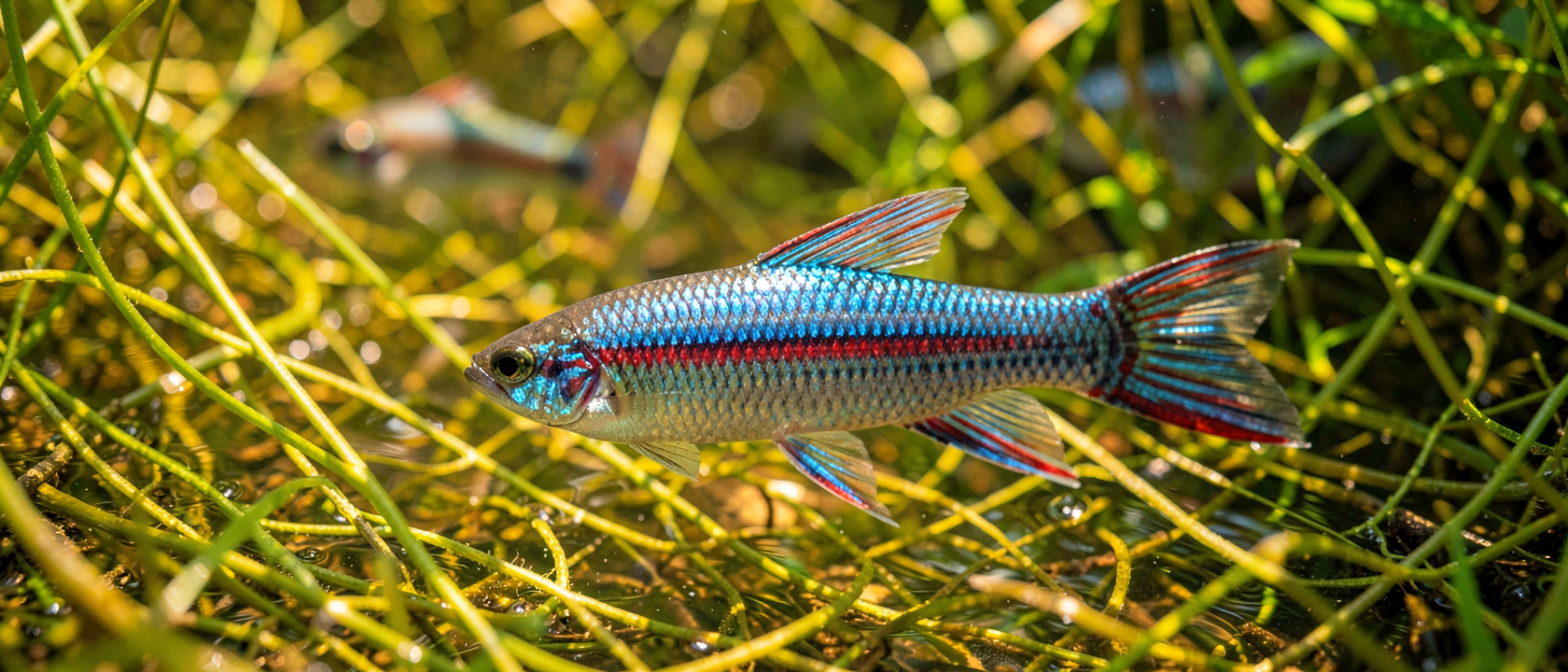
A paradise fish, dropped alone into an unfamiliar tank, maps the space faster and more confidently than a zebrafish given the identical empty tank and the identical isolation. That is the headline finding from Zoltán K. Varga and colleagues at Eötvös Loránd University (ELTE) and the HUN-REN Institute of Experimental Medicine, published in Communications Biology on July 29, 2025. Working with late-larval-stage fish of both species, the team ran paradise fish (Macropodus opercularis) and zebrafish (Danio rerio) through matched solo-exploration tests as part of a wider comparison of sociability, anxiety, and cognition. Zebrafish, the species every fish-cognition lab defaults to, explore new ground faster with company and noticeably slower without it. The paradise fish, a solitary, territorial native of streams, rice paddies, and marshes across East and Southeast Asia, needed no company at all, and often outperformed the social fish doing the same job by itself.
How to Explore Without a Map
The mechanism is a behavior called alternation. Rather than re-checking corners it already knows, the paradise fish kept steering toward the parts of the maze it hadn’t visited yet. In the study’s Y-maze, a three-armed layout that is the standard tool rodent researchers use to test whether an animal remembers where it’s already been, paradise fish exploration was dominated by exactly this pattern, arm after arm chosen for novelty, not habit. Pulling that off requires keeping a running tally of one’s own path, which is, functionally, working memory: holding a piece of information just long enough to use it, then releasing it. Alternation tasks have been a staple of rodent cognition labs for decades, run on rats and mice in T-mazes and Y-mazes. This is the study’s central behavioral finding: the same strategy, showing up unprompted in a fish’s exploration pattern.
Why One Fish Needs a Crowd and the Other Doesn’t
Zebrafish are a schooling species, and the study’s sociability tests show exactly why isolation costs them: exploration picks up around another zebrafish and drops when that fish is removed. For a zebrafish, exploring is partly a social behavior, so testing one alone quietly takes away part of its normal toolkit. Paradise fish showed no comparable social approach behavior at all. Being alone didn’t change how much they explored and didn’t raise their anxiety in the study’s anxiety tests, and across repeated trials their exploration and risk-avoidance patterns stayed more consistent than the zebrafish’s. The researchers frame this as a division of labor rather than a contest: zebrafish remain the better model for social behavior, paradise fish the better model for solitary memory and problem-solving. The lesson travels past the fish tank. An animal’s measured intelligence depends on whether the test matches how it actually lives, and asking a schooling species to think without its school measures what’s left of it, not its mind.
The Myth This Kills
Working memory expressed through alternation has mostly been documented in mammals, in rats, mice, primates, and people. That’s the assumption this paper overturns, and it’s worth being exact about what’s actually falling. Not “fish are as smart as mammals,” a claim too vague to test. Specifically: spatial working memory expressed through alternation is not a mammal-only trick. A paradise fish, running on a brain with nothing like a mammalian cortex, produced the same behavior.
The Fish ELTE Forgot
Decades before this paper, paradise fish were the house species in ELTE’s Department of Ethology, central to behavioral work under Professor Vilmos Csányi. Then zebrafish took over fish labs worldwide, for reasons that had nothing to do with the paradise fish’s abilities: zebrafish breed in bulk, their genetics are mapped in detail, and a live zebrafish larva is transparent enough for whole-brain imaging. Paradise fish got quietly shelved. Bringing them back for a study on solitary memory, precisely the kind of task where being alone is an advantage rather than a handicap, puts the old lab fish back at the center of the story it was dropped from.
What’s Still Dark
The paper reports the behavior, arm-by-arm alternation, without proposing what produces it inside the paradise fish’s brain; no neural circuit is identified, only the pattern on the maze floor. It also doesn’t say how long the fish’s memory of “already visited” lasts: seconds, one exploration session, or longer. And because the fish tested were at the late larval stage, whether the same alternation strategy holds in adult paradise fish is a question the study leaves open. All three stay unanswered for now.