
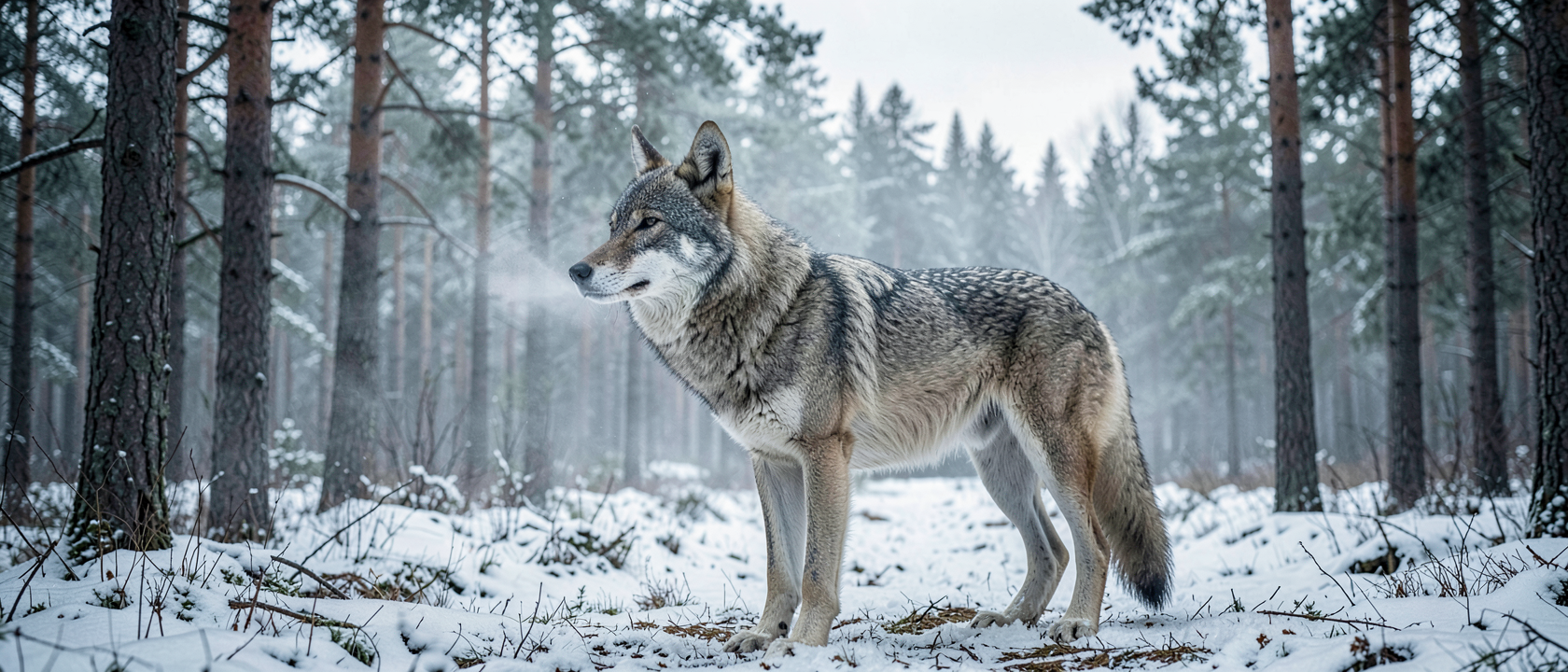
A wolf tooth from 120,000 years ago matches one alive in Poland right now
Picture two sets of fossil wolf teeth from Britain. One set is roughly 200,000 years old, worn smooth and simple, the kind of wear you get from slicing soft meat. The other is about 120,000 years old, pitted and crosshatched, the kind of wear you get from crunching bone. Now add a third set: teeth from gray wolves (Canis lupus) living in Poland today. They match the 120,000-year-old fossils, not the 200,000-year-old ones. A living wolf’s molar lines up with a fossil 120,000 years older than it, and nobody set out looking for that.
That three-way match is the finding behind a paper in Ecology Letters, led by Dr. Amanda Burtt at the University of Bristol, with Dr. Neil Adams, curator of fossil mammals at the Natural History Museum in London, among several co-authors from Bristol, the Natural History Museum, the University of Leicester, the University of Warsaw, and the British Geological Survey. Both fossil populations are British, pulled from two interglacials, the warm stretches between Ice Age glaciations, and the warmer of the two was mild enough that hippopotamuses lived in the River Thames.
What a tooth remembers: reading the scratches
Burtt, Adams, and their colleagues didn’t cut into the original fossils. They cast the tooth surfaces in resin, then scanned those casts at the University of Leicester under magnification fine enough to pick out individual pits and scratches, a method called dental microwear texture analysis. The logic comes from studies of living mammals: what an animal chewed in its last days or weeks leaves a readable signature on enamel. Soft flesh produces shallow, simple scratches. Bone and cartilage, ground between molars, leave deep pits and crosshatched scratches, a pattern called durophagy, literally “hard eating.”
Wolves from the colder of the two periods, around 200,000 years ago, when UK winter temperatures averaged between 32°F and 23°F (0°C to −5°C), carried the simpler kind of wear. Dr. Burtt’s explanation is about the prey, not the appetite: in cold, snowbound winters, deer and other prey are weaker and slower, struggling through ice and snow, so wolves hunt them down more easily and can afford to eat mostly meat. Warmer, snow-poor periods flip the equation. Prey are better fed, fitter, and harder to run down, so once a wolf finally makes a kill, it processes the whole thing, flesh, cartilage, and bone. That shows up on enamel as the complex, pitted wear.
An Ice Age pattern, happening again in Poland
The modern Polish wolves in the study, used as a stand-in for the wolves that once lived in Britain before they went extinct there, carry the complex, bone-heavy wear pattern, the one that belongs to the warmest wolves in the fossil record, not the cold ones. Poland was chosen specifically because its climate and landscape resemble what the UK looked like before people reshaped it, which makes the comparison a reasonable proxy for a population that no longer exists.
The research team’s own framing is direct: modern wolves “seem to be responding in the same way as their ancestors did in warmer periods, by fully eating carcasses.” That isn’t a forecast about a future warming scenario. It’s a pattern already sitting in the teeth of wolves alive now. The same strategy that carried wolves through the warmest stretches of the last 200,000 years, eat everything or go hungry, appears to be switching back on.
“Not listed as a threat”: the gap in the paperwork
Climate change is not currently counted as a threat to gray wolves. The species is listed as Least Concern by the IUCN (International Union for Conservation of Nature), and climate rarely makes the list of pressures it’s assumed to face. The reasoning is the usual one for wolves: they’re generalists, they adapt, they’ll eat almost anything.
The microwear data complicate that reasoning. Dr. Adams argues that leaving climate change off the threat list “is unlikely to be true, especially for remote populations.” Eating whole carcasses more often is itself a sign of a hunting strategy under strain, visible at the microscopic level in tooth enamel long before it would ever register as a drop in wolf numbers. The concern sharpens for wolves with no human-made safety net to fall back on when hunting gets harder: no livestock, no scraps, no roadkill. Wolves near farmland have options. Wolves in untouched, remote landscapes mostly don’t.
What the teeth haven’t told us yet
The paper doesn’t state how many fossil specimens from each period went into the comparison, so it’s unclear how much wear data this pattern actually rests on. It’s also unclear how far the Poland result travels. The team tested one modern wolf population, not wolves in other warming regions, so Poland’s wolves might be typical of what’s coming elsewhere, or they might simply be dealing with unusually fit, fast prey for reasons specific to that landscape.
The researchers flag the open ends themselves. They note that wolves in landscapes untouched by farming or roads will “likely need more targeted conservation support,” precisely because they lack the alternative food sources available to wolves closer to people. They also point out that the shift toward eating whole carcasses could drive wider changes in the ecosystem as prey numbers increase. Nobody has worked out what happens downstream if the eat-everything strategy becomes the default: what it does to the deer and other prey wolves lean on harder, to the scavengers that used to get the leftovers, or to wolves themselves across the generations that follow. The fossil record shows this has happened before. It doesn’t say how the story ends this time.