
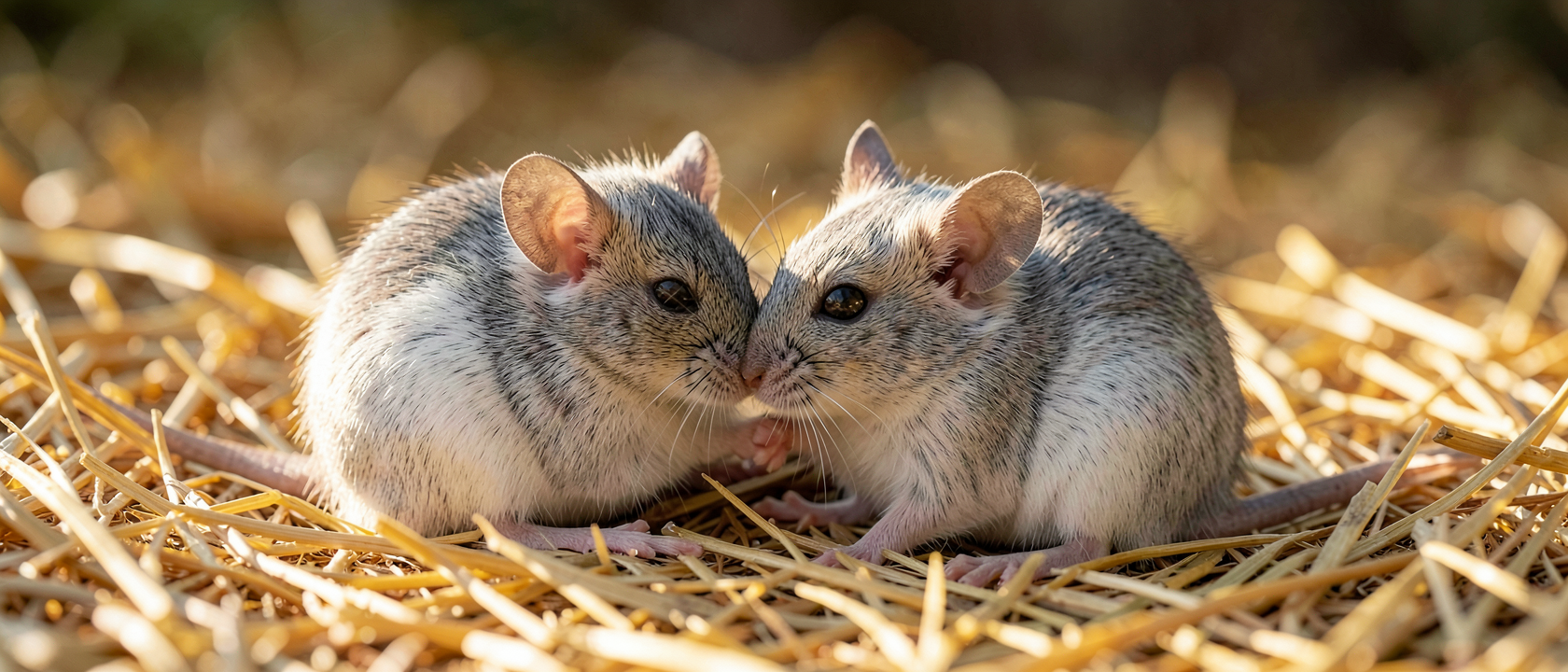
A mouse plays medic
More than half of the mice in a study from the University of Southern California bit at the mouth of an unconscious cage-mate and pulled on its tongue. Researchers led by Wenjian Sun published the findings on February 21, 2025, in the journal Science: across repeated trials, mice spent an average of 47% of a 13-minute observation window in physical contact with a knocked-out cage-mate, not one quick sniff and a retreat, but sustained, escalating attention.
That number is what the rest of the findings explain.
Sniff, lick, bite: in that order
The behavior runs through a fixed sequence. A mouse that finds an unresponsive cage-mate starts by sniffing it, moves on to licking its face, and only later escalates to biting at the mouth and tugging the tongue. The same sequence showed up with the lights off: mice performed it in total darkness, which rules out watching for stillness as the trigger and points instead toward scent or touch.
In one version of the test, Sun’s team placed a small plastic ball inside the mouth of the unconscious mouse. Cage-mates pulled it out in 80% of trials, a detail that looks a lot like clearing an airway.
A companion paper from UCLA researchers, published the same day in Science, traced the mechanism to a single hormone. Mice helping an unresponsive partner showed oxytocin release in the amygdala (a brain region tied to emotion and threat response) and the hypothalamus (a region that regulates hormones and basic drives). Blocking oxytocin receptors, or shutting down the neurons that produce it, cut the behavior down. The effort wasn’t just motion without result, either: mice that groomed and tongue-pulled more intensely had cage-mates that came back to consciousness faster than cage-mates left alone.
Why bother with a mouse that’s already out cold
The help wasn’t handed out evenly. Mice familiar with their cage-mate intervened more intensely than mice paired with a stranger, and every helper stopped the instant its partner woke up. Unresponsiveness switched the behavior on. Responsiveness switched it off, as cleanly as a reflex.
That pattern points at the same oxytocin circuitry known for building social bonds, repurposed for an emergency. The chemistry that lets a mouse recognize its own nest-mate appears to be the chemistry that pushes it to intervene when that nest-mate goes down. For an animal whose entire survival strategy depends on the group, a cage-mate that can walk, forage, and groom again is worth ten minutes of tongue-pulling.
This wasn’t supposed to need a big brain
Touching, nudging, and standing near an unresponsive group member has been documented before, in dolphins, elephants, and primates, and that list has quietly supported an assumption: caregiving like this needs a complicated brain, something close to self-awareness or theory of mind, the ability to model what another individual knows or wants. Active biting and pulling at another animal’s mouth to revive it, though, had never been recorded in any species before this study.
A house mouse (Mus musculus) weighing somewhere between 0.4 and 1.1 ounces (12 to 30 g), with a brain nowhere near the size of a dolphin’s or an elephant’s, did it in a laboratory cage. That gap challenges the assumption that such caregiving requires a complex brain.
Instinct, or something that looks like intent
Sun has said plainly that the study cannot tell whether a mouse has anything like an intention to revive its partner, or whether the whole sequence is hardwired instinct with no felt experience behind it at all. Oxytocin explains that the behavior happens, and roughly where it starts. It does not explain what tells a mouse’s brain that this particular cage-mate is unconscious and that action is needed now. That circuit hasn’t been mapped. The UCLA companion paper, printed in the same issue of Science, is working that question, and had not closed the gap as of publication.
The study itself started as an anecdote. USC neuroscientist Li Zhang had anesthetized many mice for his own research over the years, and he noticed, more than once, that cage-mates reacted strangely around a knocked-out partner, long before anyone ran it as a formal trial.