
580 Visits, and the Fat Bears Showed Up Just as Often
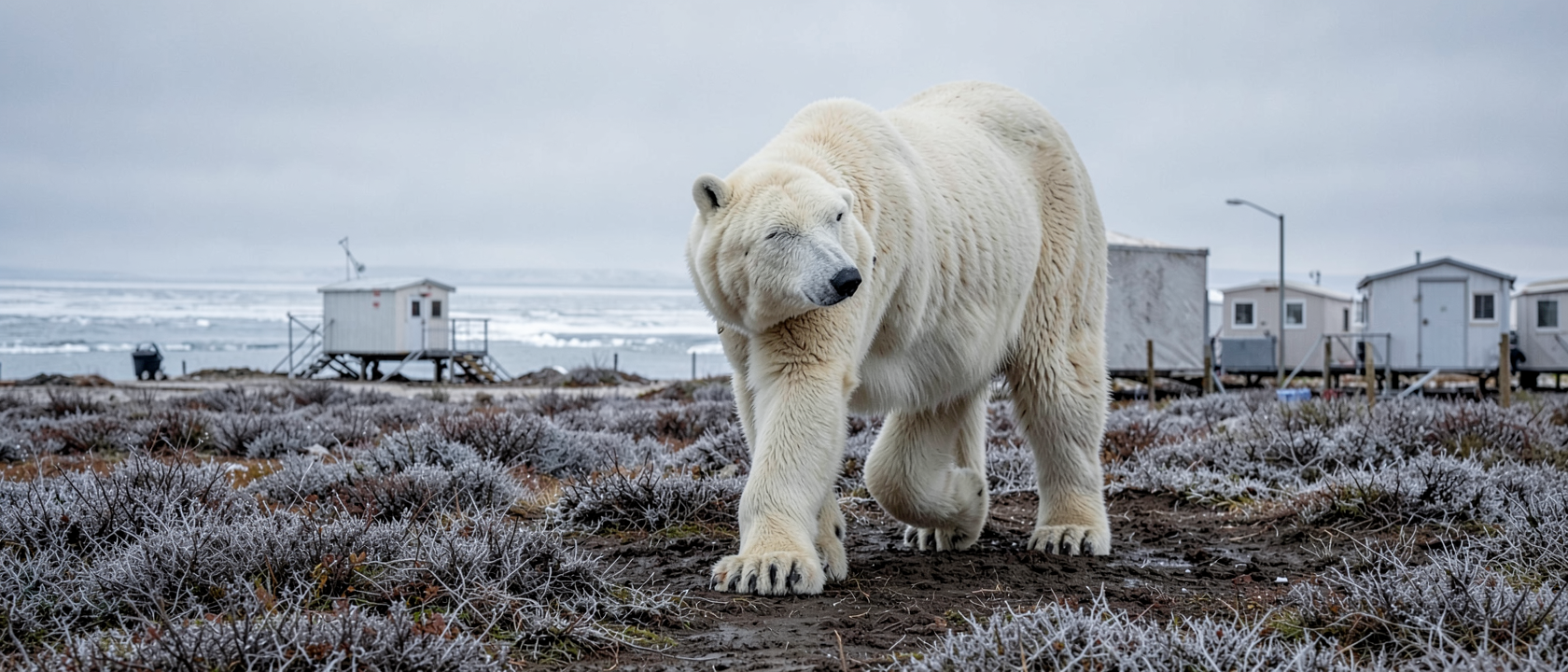
Between 2011 and 2021, trail cameras at three camps in Wapusk National Park and at the Churchill Northern Studies Centre recorded 580 polar bear visits along the west coast of Hudson Bay, Manitoba. The decade-long project, led by Dr. Douglas Clark at the University of Saskatchewan and published in Arctic Science, checked something nobody had actually tested: whether well-fed bears showed up at camps less often than thin ones. The answer was flat. In roughly 80 percent of the visits, the cameras caught enough of the animal to score its body condition using an established fatness index, a visual scale running from skinny to very fat, and bears across that whole range approached at essentially the same rate.
Stuck Ashore, Not Starving
Polar bears (Ursus maritimus) hunt seals from sea ice, not from land. Most of a polar bear’s fat sits right under the skin, which is why the same animal can look stocky in July and show ribs and hip bones by October, depending on how long it has gone without a kill. Western Hudson Bay’s sea ice has been breaking up earlier in spring and forming later in fall, and the study found that the length of that ice-free stretch, not a bear’s hunger, tracked how often bears turned up at the camps. There was no long-term trend across the eleven years, but the ice-free season swung a lot from one year to the next, and the longer it ran, the more bear visits the cameras logged. A bear that comes ashore fat in summer is still ashore in October. It has nowhere to hunt, so it walks, and camps sit in its path. More ice-free days simply means more bear-hours on land, whether or not any particular bear is hungry. Human activity at the sites didn’t change anything either: the study found no effect of people being present on how often bears showed up.
Showing Up Isn’t the Dangerous Part, What Happens Next Is
If body condition doesn’t predict who visits, the researchers propose it may still shape what a bear does once it’s there, though this part of their work is an interpretation, not something the camera data directly tested. A bear in good shape has less reason to take a risk near a camp; it can walk off and wait things out. A thin bear facing the same food source may have more to gain and less to lose, which the researchers suggest could make it more likely to push toward active food-seeking or outright aggression. That reframes the question. It stops being “why is this bear here” and becomes “what will this specific bear do now that it is.” For anyone reading a bear’s behavior on the ground, that second question is the one that actually carries risk.
It Was Never Just the Skinny Ones
The standing assumption was that hunger drives desperate, nutritionally stressed bears toward people, while well-fed bears stay safely out on the ice or tundra. The camera data contradicts that directly: visiting bears weren’t detectably thinner than the bears that stayed away, and as the ice-free season lengthened, bears of every condition showed up more, not just the ones running low on reserves. The researchers note that the bears weren’t hunting people so much as occupying ground that happened to have a building on it. None of this is news to the people who live there. Indigenous and local communities around Hudson Bay have said for years that camp visits were never just about starving animals, based on direct, sustained observation long before a trail camera was bolted to a wall. The study doesn’t discover this so much as catch up to it. That gap between what locals already knew and what a decade of camera data took to confirm is worth sitting with: sometimes the rigorous answer and the obvious one are the same answer, just arriving on different timelines.
Where Are the Young Loners?
Lone sub-adult polar bears, animals past weaning but not yet full grown, are usually flagged in other research as the riskiest age class: inexperienced, often hungry, more willing to take chances. They were rare in this footage. The researchers suspect this connects to a separately reported trend of longer ice-free seasons reducing juvenile survival in the western Hudson Bay subpopulation, meaning there may simply be fewer young loners around to show up anywhere. That link was not tested in this study. It’s a loose thread hanging off the data, worth naming and worth leaving alone until someone tests it properly.
They Built the Camps Inland on Purpose
Parks Canada sited its field camps at Broad River and Owl River away from the coast specifically to keep polar bears out of the picture, on the reasonable assumption that bears stick close to the ice edge and open water. The bears did not cooperate. Both camps started receiving more visits than anyone had planned for, which is the reason Parks Canada invited researchers to put up trail cameras in the first place. A decision meant to design the animal out of the picture is the reason there’s a decade of data on it at all.