
The Drum Section of the Family Tree
The Surprising Fact
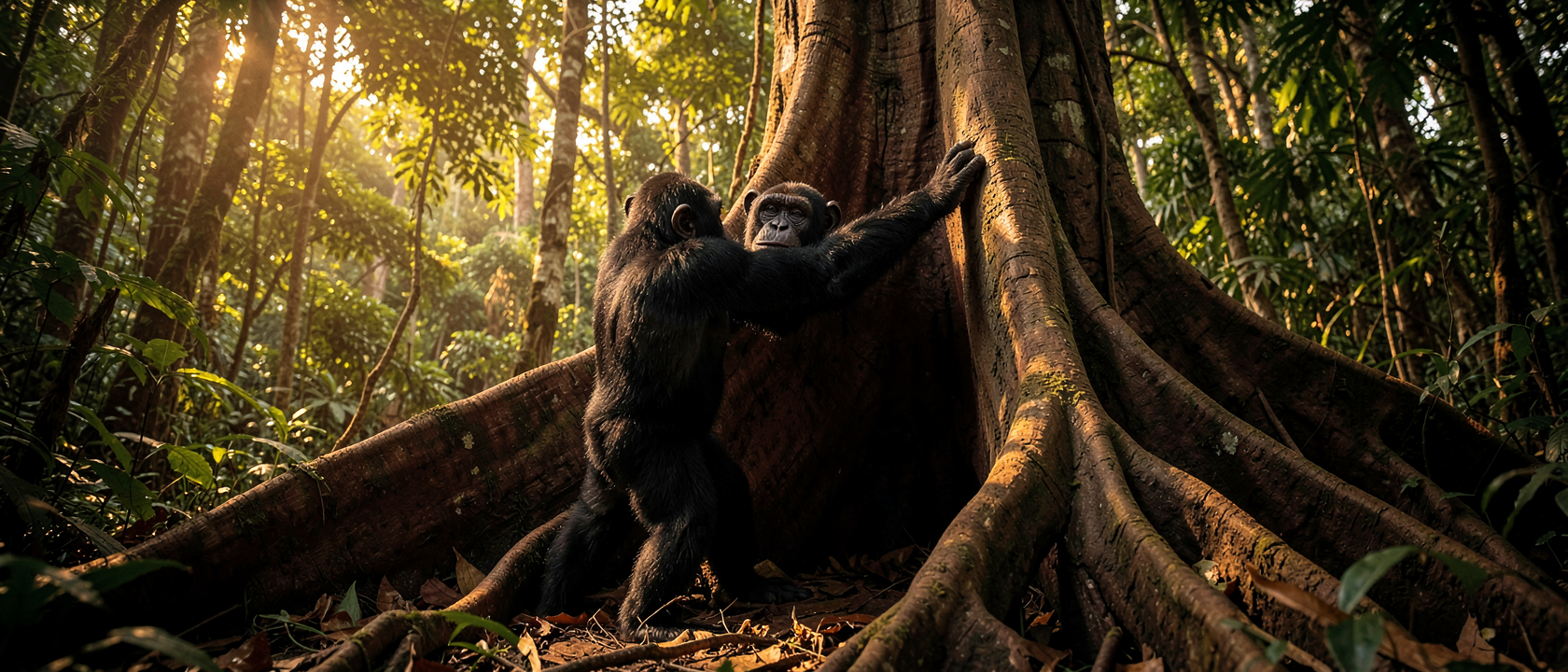
Chimpanzees (Pan troglodytes) hit the buttress roots of rainforest trees, the huge wooden flanges that fan out at the base of the biggest trunks, and they do not do it the way a toddler bangs a pot lid. A team led by Vesta Eleuteri at the University of Vienna, with senior authors Catherine Hobaiter at the University of St. Andrews and Andrea Ravignani at Sapienza University of Rome, analyzed 371 drumming bouts recorded across 11 chimpanzee communities, spanning six populations and both recognized subspecies. The results ran in Current Biology on May 9, 2025. The hits were not scattered at random. They landed with structured, often evenly spaced timing, the kind of regularity you would expect from something built for rhythm and not just for noise.
How the Drumming Actually Works
The low booming sound comes from slapping those above-ground buttress roots, which work like natural speaker cabinets and carry sound through forest that swallows up ordinary calls within a short distance. The study found the two subspecies do not drum the same way. Western chimpanzees (Pan troglodytes verus) drum isochronously, meaning the gaps between hits stay evenly spaced, and they also hit more often, drum at a faster tempo, and fold the drumming in earlier during their pant-hoot calls, the loud rising-and-falling vocalization chimpanzees use to announce themselves over distance. Eastern chimpanzees (Pan troglodytes schweinfurthii) do something else entirely: they alternate between short and long gaps, a different rhythmic signature. A statistical model comparison confirmed the tempo difference was real and not noise in the data (chi-squared equals 11.463, p equals 0.001). The researchers also checked whether local habitat differences between populations could explain the variation. They did not; the pattern tracked subspecies, not ecology.
The Second Why: Rhythm as a Check-In System
Earlier work by this same research line had already shown that each individual chimpanzee drums with a recognizable personal style, the way a particular person’s footsteps on a staircase tell you who is coming before you see them. Eleuteri’s team argues that the structured timing of drumming lets group members who are scattered through dense forest, often out of sight of each other for long stretches, track who is nearby and what they are doing without ever making eye contact. It is a social system built out of timing instead of vision: rhythm functioning as long-distance infrastructure for staying one group across kilometers of canopy, not as decoration layered on top of a call.
The Myth This Kills
The common assumption, repeated often enough to feel like settled science, is that structured, musical-sounding rhythm is something only humans do on purpose, that no other animal “keeps a beat” with intent. This study argues the opposite. The shared structural properties between chimpanzee root-drumming and human musical rhythm, the researchers write, point to an ancestral capacity for timed, patterned sound-making that was already present before humans existed as a species. Other reporting on the study places the split between the human and chimpanzee lineages at roughly 6 million years ago, which would put the raw material for rhythm on the family tree well before anyone was around to call it music. Musicality, by this reading, is not a human invention bolted onto an otherwise unmusical brain. It looks more like something we inherited.
What’s Still Unknown
Hobaiter has been direct about the limits of what this study shows: nobody knows how far back this capacity for rhythm actually stretches. The data confirm that the drumming is real, structured, and distinct by subspecies; they do not establish a timeline, or which branch of the evolutionary tree carried the trait forward, or whether other great apes carry pieces of it too. There is also an open question closer to home: whether the eastern and western drumming styles come from biological divergence between the subspecies or from something closer to local culture, chimpanzees picking up rhythmic habits from the other drummers in their own patch of forest. One researcher has floated the idea that chimpanzees may be learning their style from neighbors rather than being born with it, but that remains speculation, not a finding. Before the study, Eleuteri herself expected western chimpanzees to simply drum more and faster than eastern chimpanzees. She has said she was not expecting the rhythmic patterns, and their resemblance to human music, to come through as clearly as they did.