
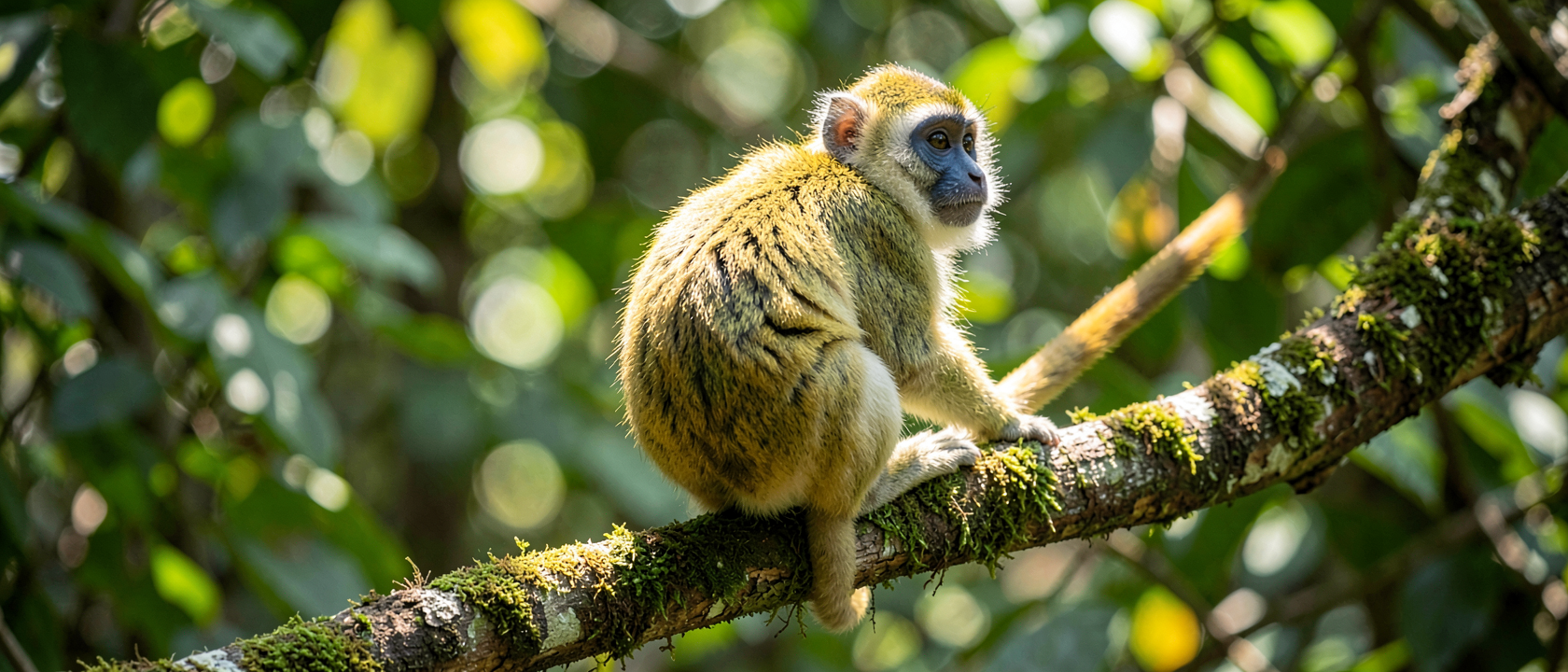
Five female African green monkeys (Chlorocebus sabaeus) at Yale University received a dozen injections of a synthetic, Alzheimer’s-linked protein, delivered through a port placed into their cerebrospinal fluid space: three doses a week, four weeks running. These are wild-derived research animals, not a breed, part of a colony descended from a feral African green monkey population on the island of St. Kitts. Three more female monkeys went through the identical schedule with a plain control solution instead. A year after the last dose, researchers sat all eight down for a memory test: show the monkey a shape, wait, then ask it to pick that same shape out of a lineup. The injected monkeys matched shapes exactly as well as the untouched ones did. Twelve doses of a protein built to injure neurons went in, a year went by, and the monkeys never missed a shape.
The study, led by Yale biochemist Bianca Brown and published in Communications Biology, reports that the treated monkeys never fell behind on the shape test, not during the month of dosing and not across the year that followed.
What the Spinal Fluid Was Hiding
Amyloid-beta oligomers are small, loose clumps of the protein that, over time, harden into the plaques associated with Alzheimer’s disease; researchers suspect the oligomers injure nerve cells more than the plaques they eventually become. When the team drew cerebrospinal fluid, the fluid that bathes the brain and spinal cord, from the monkeys twelve months after the final dose, the treated animals looked different from the controls at the molecular level. They carried higher amounts of C3, a protein involved in immune response; lower levels of several proteins tied to the connections between nerve cells; and shifted levels of proteins linked to blood vessels and clotting. A closer look at a particle-enriched slice of that fluid, containing extracellular vesicles, tiny membrane-wrapped packets cells use to ship proteins around, turned up still more differences the whole-fluid sample alone had missed. Tissue studies on the same animals found hyperphosphorylated tau, a chemically altered form of another Alzheimer’s-linked protein, and signs of neuroinflammation a year out, without the outright loss of neurons that marks full neurodegeneration. None of that showed up on the shape-matching test, which is exactly the point: a brain can be quietly rewriting its own chemistry while every test you’d think to give it comes back clean.
Why This Isn’t Just a Monkey Trivia Night
Researchers have long suspected that in humans, Alzheimer’s biology starts shifting years, sometimes decades, before anyone notices a symptom. That gap is nearly impossible to study directly: nobody biopsies a healthy person’s spinal fluid on a hunch. It’s also why African green monkeys are useful here at all. The popular assumption is that Alzheimer’s is a strictly human disease. It isn’t: aging African green monkeys naturally develop some of the same amyloid-beta plaques and tau tangles seen in human Alzheimer’s, something laboratory rodents don’t do on their own. The species also shares lifespan, neuroanatomy, vascular structure, and inflammatory responses with humans closely enough to make the comparison worth running, the researchers note. A monkey dosed and tracked on a known timeline is one of the only ways to watch that early, invisible window move inside a living brain instead of staying a hypothesis on paper.
The Myth This Kills
The quiet assumption most people carry is that a clean memory test means a clean brain: if you can still pick out the shape, nothing serious can be going on upstairs. Brown’s own description of these monkeys cuts against that directly: the nervous system can be “biologically altered” while behavior looks completely normal. These eight monkeys passed their test every time, for a year straight. Their cerebrospinal fluid did not pass anything so cleanly, carrying a different chemical signature than the control animals’, with echoes of immune activation, weakened neural connections, and vascular stress that no shape-matching task was ever built to catch.
What Nobody Knows Yet
Whether these monkeys go on to develop real memory problems is still unknown. A year of normal scores doesn’t mean the clock has stopped, and the animals were tracked with just one cognitive task, which could miss subtler trouble. It’s also unresolved whether the molecular changes in their spinal fluid reflect genuine early Alzheimer’s biology or something specific to this experimental model. Brown has cautioned against assuming that every molecular shift seen in the monkeys represents early Alzheimer’s disease in humans. On top of that, the sample sizes behind some of these findings are thin: the full cerebrospinal fluid comparison rested on just two treated monkeys against two controls, and the particle-enriched analysis on three animals per group, out of the eight originally enrolled. Next on the researchers’ list: lining this monkey fluid up against human samples to see whether the same chemical fingerprints show up there too.