
The Beak That Shouldn’t Exist
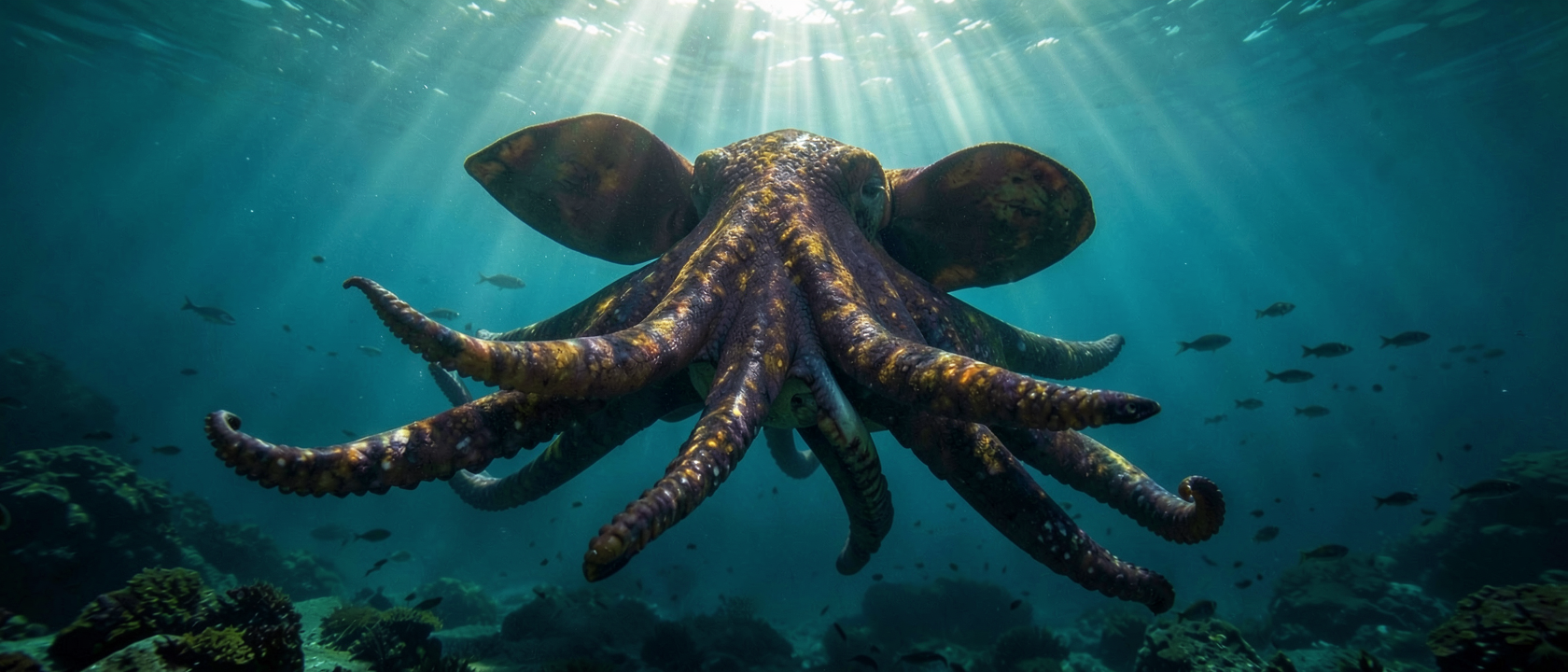
A single fossilized jaw, the kind that normally sits labeled and forgotten in a museum drawer, is the entire reason anyone can now talk about a 61-foot octopus. Paleontologists Shin Ikegami and Yasuhiro Iba, working out of Hokkaido University, analyzed 27 fossilized octopus beaks, 15 already held in museum collections, 12 recovered through a new scanning method. All 27 belong to two species of finned octopus from the Late Cretaceous, Nanaimoteuthis jeletzkyi and Nanaimoteuthis haggarti, found in marine rocks of the Pender Formation on Vancouver Island and in Cretaceous rocks of Japan, dated to between 100 and 72 million years ago. Their modeling put N. haggarti, the larger of the two, at 22 to 61 feet (6.6 to 18.6 meters) long, a range that would make it a candidate for the largest invertebrate ever described.
The study, published in Science in 2026, pushes the known fossil record of octopuses back by about 5 million years, and the record of finned octopuses, the cirrate group named for the paddle-shaped fins on their heads, back by about 15 million years.
Why a Beak Is All You Get
An octopus is almost entirely soft tissue: muscle and skin, no shell, no internal skeleton. That kind of body breaks down long before it can turn to stone. The one part built to last is the beak, made of chitin, tough enough to survive tens of millions of years after everything around it has rotted away. It is the same reason ancient sharks are known mostly from their teeth: the hard part is the only part that stays behind.
Turning a beak into a body length is the harder trick. Researchers reconstructing extinct sharks usually scale up from one living relative. Ikegami and Iba instead cross-referenced beak dimensions against 12 living octopus species, which is how they arrived at a range instead of a single guess. Twelve of the 27 fossils came from a method the team calls digital fossil-mining: grinding a rock sample down layer by layer, photographing each pass, and feeding the images into an AI-assisted process that reassembles them into a 3D model of a beak that was never visible on the surface. The beaks themselves show heavy, repeated wear on their edges and tips, the kind that matches an animal crushing the shells and hard bones of its prey.
The Favorite Tentacle
Some of the largest beaks, the ones belonging to N. haggarti, are worn down more on one side than the other. In living octopuses, that kind of lopsided handling of tools and prey tracks with lateralized brain function, a side preference linked to higher-order processing rather than reflex. The researchers put it plainly: asymmetric loss of the jaw edges suggests lateralized behavior, which has been linked to a highly developed brain and cognition. If that pattern holds for a Cretaceous animal, it implies something like a feeding “handedness,” a side an individual favored, tens of millions of years before any modern octopus lineage existed. Nobody is calling these animals smart. The finding is a wear pattern, read against what lateralization means in octopuses alive now.
The researchers tie the size itself to a wider pattern. Marine reptiles of the same era shed armor and scales to swim faster. Earlier cephalopod lineages lost or shrank their external shells for the same reason. Dropping rigid body parts, in both groups, opened the door to bigger, faster bodies. N. haggarti and N. jeletzkyi, already soft-bodied with no shell to lose, may simply have pushed that same trade further than anything before them.
Soft Bodies, Big Claims
The old assumption, that a soft body caps how large an animal can get, that only something with bones or a shell can truly scale up, does not survive this fossil. A boneless, shell-less animal reaching the length of a city bus rewrites that assumption by itself.
What the fossil doesn’t do is settle the exact number. The 22-to-61-foot range for N. haggarti is a model built from comparisons with living species, not a measurement off a complete body, no full Nanaimoteuthis specimen has ever been found, and some researchers, including a group in Zurich, have raised doubts about the upper end of that estimate. N. jeletzkyi, the smaller species, comes out to a more modest 9 to 25 feet (2.8 to 7.7 meters).
And before anyone stages the obvious matchup, and before anyone calls this animal a kraken: N. haggarti lived roughly 86 to 72 million years ago, tens of millions of years before the legend of the kraken was ever told, so there’s no real link between the two, mythical or otherwise. Megalodon’s run was 23 to 3.6 million years ago. The two miss each other by tens of millions of years in either direction. Any fight between them is a drawing, not a fossil.
A Kraken With a Favorite Hand
Picture one, somewhere in a Late Cretaceous sea, sizing up a shelled animal roughly its own body weight and reaching for it with the same arm it always leads with, the way anything with a dominant side does without noticing it does it. That’s a joke, not a finding: nobody measured which arm N. haggarti preferred, only which side of its beak wore down faster. The beak doesn’t explain the habit. It just refuses to let anyone pretend it wasn’t there.