
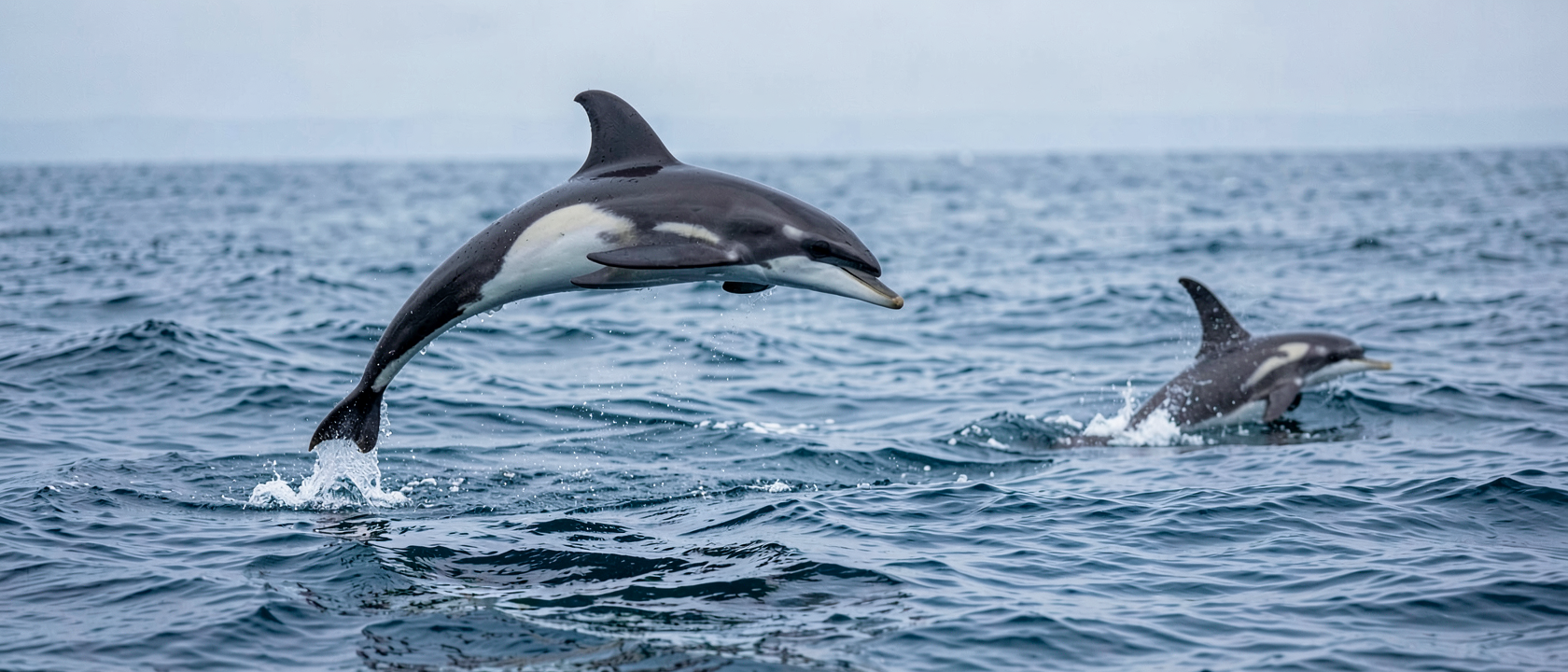
The seven years nobody counted
Pull a tooth from a stranded common dolphin (Delphinus delphis) and you can read its age the way you’d read a tree stump, ring by ring. Do that for enough animals and you get something aerial surveys never give you: an actual lifespan. In the Bay of Biscay, female common dolphins born in the late 1990s lived to an average of 24 years. Born closer to 2019, that number drops to 17. Seven years, gone, from a population everyone assumed was fine.
The finding comes from Etienne Rouby and his colleagues at the University of Colorado Boulder’s Institute of Arctic and Alpine Research, published in Conservation Letters. They worked from 759 stranded common dolphins collected along the French coast between 1997 and 2019. Twenty-two years of patient data collection turned up something far more unsettling than a slowdown: a generation of dolphins quietly disappearing from the record before their time.
Reading a dolphin like a tree stump
A dolphin’s teeth lay down growth layers year by year, the same way a tree lays down rings. Cut into a tooth from a stranded animal and you can read off its age at death down to the year, which is a far more precise instrument than a boat full of people trying to count dorsal fins from a distance.
That precision matters because stranded dolphins are a small slice of the picture. The Bay of Biscay holds roughly 180,000 common dolphins in winter, and stranded animals account for only about 10% of total deaths in that population. But each one washes up carrying its own private timeline, and 759 of those timelines, stacked across 22 years, add up to something no live headcount can give you: the actual age structure of a population, year by year, animal by animal.
What is actually killing them, and what it breaks
Run the longevity drop through the math of population growth and the number comes out at a 2.4 percentage-point decline, from an ideal of about 4% a year down to roughly 1.6% by 2019. Rouby has said the real figure is likely worse than that.
The biggest named driver is bycatch: dolphins killed incidentally by fishing gear. In 2021 alone, an estimated 6,900 common dolphins died this way in the Bay of Biscay, one of the busiest fishing grounds in Europe, out of a wintering population of 180,000. Fewer calves are being born too, which means survival and fertility are both sliding at the same time.
Common dolphins sit at the top of this food web. As Rouby put it, dolphins are the Bay of Biscay’s top predators, and without that pressure keeping fish numbers in check, those fish could multiply unchecked, strip out the plankton and vegetation below them, and drag the whole system toward collapse. Losing seven years off a dolphin’s lifespan isn’t just a sad statistic about one species. It’s an early warning for everything underneath it in the water, including a fishing industry that depends on that water staying balanced.
The surveys that said everything was fine
For years, aerial and boat surveys of the Bay of Biscay reported a stable common dolphin population. That reading wasn’t wrong because anyone miscounted. It was wrong because counting was the wrong tool for the job.
Common dolphins move constantly, range across huge stretches of open water, and reproduce slowly. A plane or boat passing overhead sees roughly the same number of animals whether the population underneath is thriving or quietly aging out from under itself. The tooth-layer data caught what two decades of sightings never could: a population that still looked stable from above while hollowing out underneath. Rouby’s team calls the Bay of Biscay a demographic sink, a place that looks fine in headcount while steadily losing ground in survival. That’s the gap this piece is really about: the difference between watching an animal and actually measuring it, between a nice sighting and a number that holds up.
The part no one has checked yet
Nobody has run this same tooth-layer analysis on harbor porpoises or bottlenose dolphins elsewhere in the North Atlantic, so whether they’re living through a similar invisible decline is an open question, not a confirmed one.
Even inside this study, bycatch doesn’t explain everything. The paper points to additional “environmental pressures” sitting alongside fishing deaths, without specifying what those pressures are or how much each one weighs. That phrase is doing real work in the research, and right now it’s unresolved. The number that started this, 24 years down to 17, is solid. What finishes the sentence after “because” isn’t written yet.