
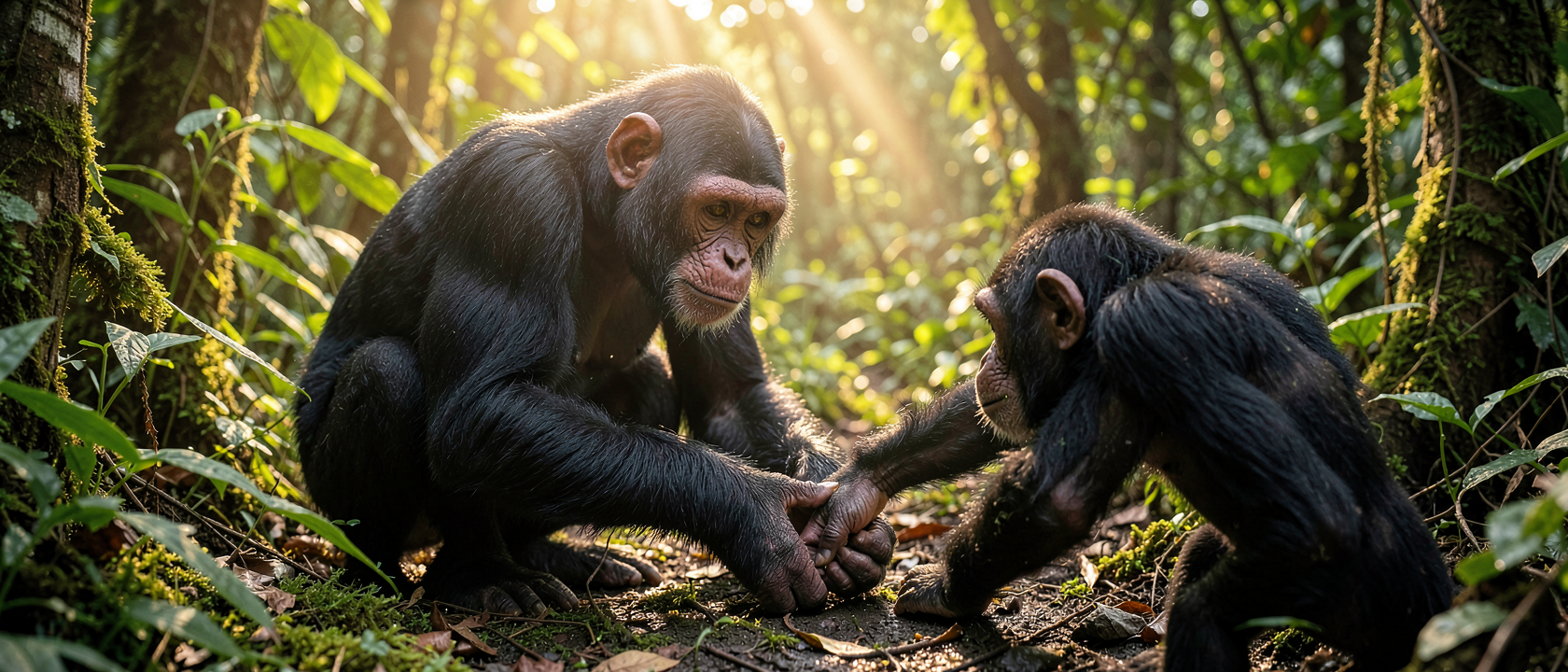
A chimpanzee mother in Gabon caught a flying insect out of the air, chewed it, and pressed it onto her son’s open wound. It is the first time any animal has been filmed treating another individual’s injury with an insect, and it turned into one of the stranger papers to come out of primatology in recent years.
The footage
In November 2019, Alessandra Mascaro, a volunteer with the Ozouga Chimpanzee Project, was filming in Loango National Park, Gabon, when she caught something on camera involving an adult female of the central chimpanzee subspecies, Pan troglodytes troglodytes, named Suzee. Suzee’s adolescent son, Sia, had an open wound on his foot. The footage shows her inspecting it, glancing up, snatching a flying insect out of the air, putting it in her mouth, and then pressing it, held between her lips, directly onto the cut on Sia’s foot, while her daughter, Sassandra, sat nearby and watched.
That is the whole event: one mother, one son, one insect, one camera. It says nothing yet about chimpanzees in general. It says one chimpanzee did this, once, on film.
What happened next
Mascaro showed the clip to the project’s lead researchers, Tobias Deschner and Simone Pika of Osnabrück University, who had been following this community for seven years without ever recording anything like it. They turned the anecdote into a question: was Suzee’s gesture a one-off, or something the group actually does?
For the next 15 months, the team watched the same community, known as Rekambo, roughly 47 chimpanzees ranging across 11.6 square miles (30 square kilometers) of forest along the Atlantic coastline. By the time they stopped counting, they had logged 76 separate instances of chimpanzees pressing insects onto open wounds, their own and other individuals’. Researcher Lara Southern filmed a later case herself: an adult male named Littlegrey, with a deep gash on his shin, being tended by another chimpanzee in the group. The results were published February 7, 2022, in the journal Current Biology, authored by Mascaro, Southern, Deschner, and Pika.
Why this isn’t just grooming
Chimpanzees groom each other constantly, picking through fur and occasionally licking a wound, and none of that is new. What sets this apart is the object and the sequence: catch a specific flying insect, put it in the mouth, chew it, then press it onto broken skin. That is a deliberate, multi-step act aimed at an injury, not routine hygiene.
The detail that matters most is buried in the count. Of the 76 recorded instances, only 19 involved a chimpanzee treating a wound of its own. The rest went to someone else’s injury. Self-medication itself isn’t new; animals ranging from elephants to bears to bees have been observed using plants or other substances to treat themselves. But treating another individual’s wound, not your own, is a different and far rarer category of behavior, and it’s the one this paper is actually about.
What it suggests about chimpanzee social life
Pressing an insect onto a group mate’s wound costs the actor something: time, the insect, and close contact with an open, possibly infected injury. The benefit lands entirely on the other chimpanzee. Pika and her co-authors describe this as prosocial behavior, acting to help another individual at a cost to oneself, and argue it points toward capacities for empathy and care usually assumed to be distinctively human.
There’s also a harder-edged reason a behavior like this might stick around over evolutionary time. Wound infection is a serious cause of death in wild great ape populations. A behavior that lowers infection risk in a group mate, particularly a relative, is a behavior that keeps that individual, and the genes it shares with the rest of the group, around longer.
The myth this kills
Pika has pointed out that the common assumption is simple: deliberate caregiving toward another animal’s injury, not just tolerating an injured group mate but actively doing something about the wound, is supposed to be a human trait, full stop. The Rekambo chimpanzees are a direct counterexample: wild, undomesticated animals performing a procedure that looks, step for step, like first aid.
What nobody knows yet
The team still hasn’t identified which insect species the chimpanzees are catching. That leaves the central chemical question wide open: whether these insects carry anything like the antibiotic, antiviral, anthelmintic, or pain-relieving compounds humans have pulled from insects for other uses, or whether the behavior does nothing chemically at all and any benefit is purely mechanical. Researchers also haven’t mapped out who treats whom across the community, whether it clusters around mothers and offspring, close associates, or spreads more indiscriminately through the group.
A separate study published in 2025 reported similar insect-on-wound behavior in East African chimpanzees, Pan troglodytes schweinfurthii, a different subspecies entirely, which suggests Rekambo wasn’t a local curiosity. What the behavior is actually doing, chemically, is still the question the next field season is built to answer.