
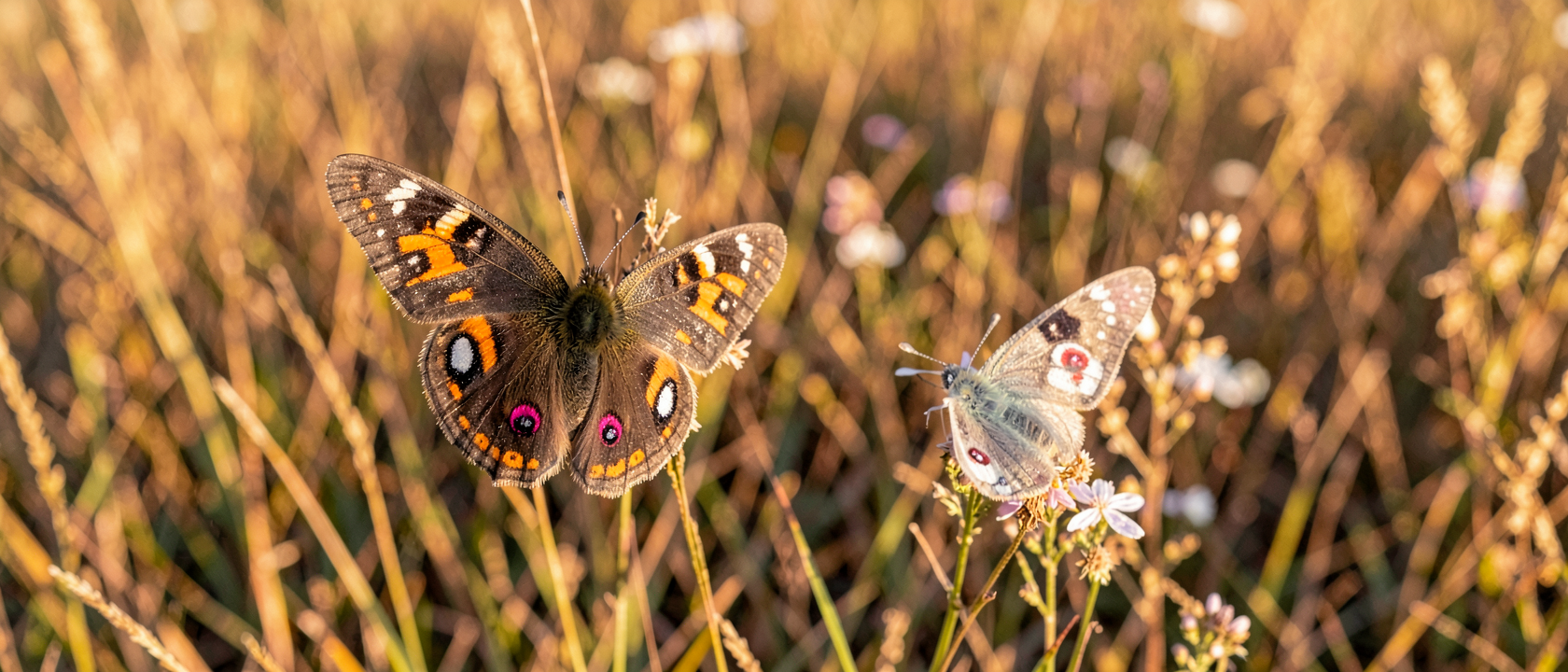
One Life, One Season, Two Different Eyes
A common buckeye butterfly (Junonia coenia) lives just 8 to 10 days as an adult, according to the team that studied it. In that short window the insect is born into either summer or fall and dies long before the season turns. It never meets the other one. No single buckeye ever compares June to October, because by October the June generation is long dead, and its descendants, several generations down the line, have never known anything but fall.
And yet a study published in Functional Ecology on November 6, 2025, led by Grace Hirzel and Erica Westerman at the University of Arkansas with collaborators at Cornell University, found that summer-emerging and fall-emerging buckeyes are not only different to look at. They are different in the eye tissue itself, in ways no individual butterfly could ever have learned or compared firsthand. The researchers sampled wild populations across three prairies in northwest Arkansas, Woolsey, Chesney, and Stump, from May to November between 2018 and 2021, and found widespread differences in gene expression between the two seasonal generations, with a striking share of those genes tied to vision and eye development. No buckeye experiences the shift firsthand. The change is written into its tissue before it ever emerges.
Why the Fall Ones Are Darker, and Why They Sunbathe
Start with what is visible. Buckeyes that emerge in September and October carry darker gray-brown wings than the ones that emerge earlier in the summer, a contrast naturalists have logged in the species for more than a hundred years. The new study confirmed the pattern again in wild Arkansas populations and added a behavioral piece: the darker fall butterflies spent more time basking in direct sunlight than their lighter summer counterparts.
The physics lines up neatly. Darker surfaces absorb more solar heat, and basking, perching in the open with wings spread toward the sun, is a well-documented way insects raise their body temperature in cooler weather. A fall buckeye is flying through conditions its summer relatives never experience, and both its wing color and its basking habit read like responses to that same cold.
The Wings Aren’t the Interesting Part: the Eyes Are
This is where the study stops being a story about wing color. The researchers argue that the darkening and the basking are only the visible edge of something larger: the caterpillar’s developmental environment appears to reshape how the adult’s entire visual system gets built, not just how dark its wings turn out. They frame this as sensory plasticity, one genome producing two differently wired versions of an eye depending on the season the animal grows up in, with no comparison, no learning, and no memory of the alternative involved anywhere in the process.
A fall-built eye, by this account, is not a slightly adjusted copy of a summer eye. It may be assembled as a different instrument altogether, tuned by cues only that caterpillar ever received, for an adult that will only ever need the fall version. Corresponding author Erica Westerman has long studied how plastic sensory systems can be, and chose buckeyes partly because their wing pattern was already known to shift with the seasons. First author Grace Hirzel has suggested that this kind of seasonal rewiring of the senses could turn out to be a broader survival strategy, used well past this one species, for living through a year that behaves less like one climate than several, stacked in sequence.
A related pattern has already shown up in lab studies of the tropical butterfly Bicyclus anynana, where seasonal shifts in color-sensitive opsin genes come bundled with changes in eye size, wing pattern, and breeding behavior. The buckeye findings put a second species, this time studied in the wild rather than a lab, into the same frame.
Different Eyes, Tuned to See What, Exactly?
Here is the part nobody gets to answer yet. Despite all those shifts in vision and eye-development genes, the study found no evidence that the butterflies’ actual color sensitivity changes between the two seasonal forms. The eye is being built differently. It does not, as far as this study can show, end up seeing different colors for the trouble. What the rewiring is functionally for, in terms of what the animal perceives, remains unresolved.
It is also not yet known which signal during the caterpillar’s development triggers any of this: temperature, the surrounding light or visual environment, or some cue the researchers have not identified. Because adult buckeyes live only 8 to 10 days and never cross into a second season, no one can test the same individual before and after a seasonal switch. For now, the question sits exactly where the data leave it: open, and worth watching.