
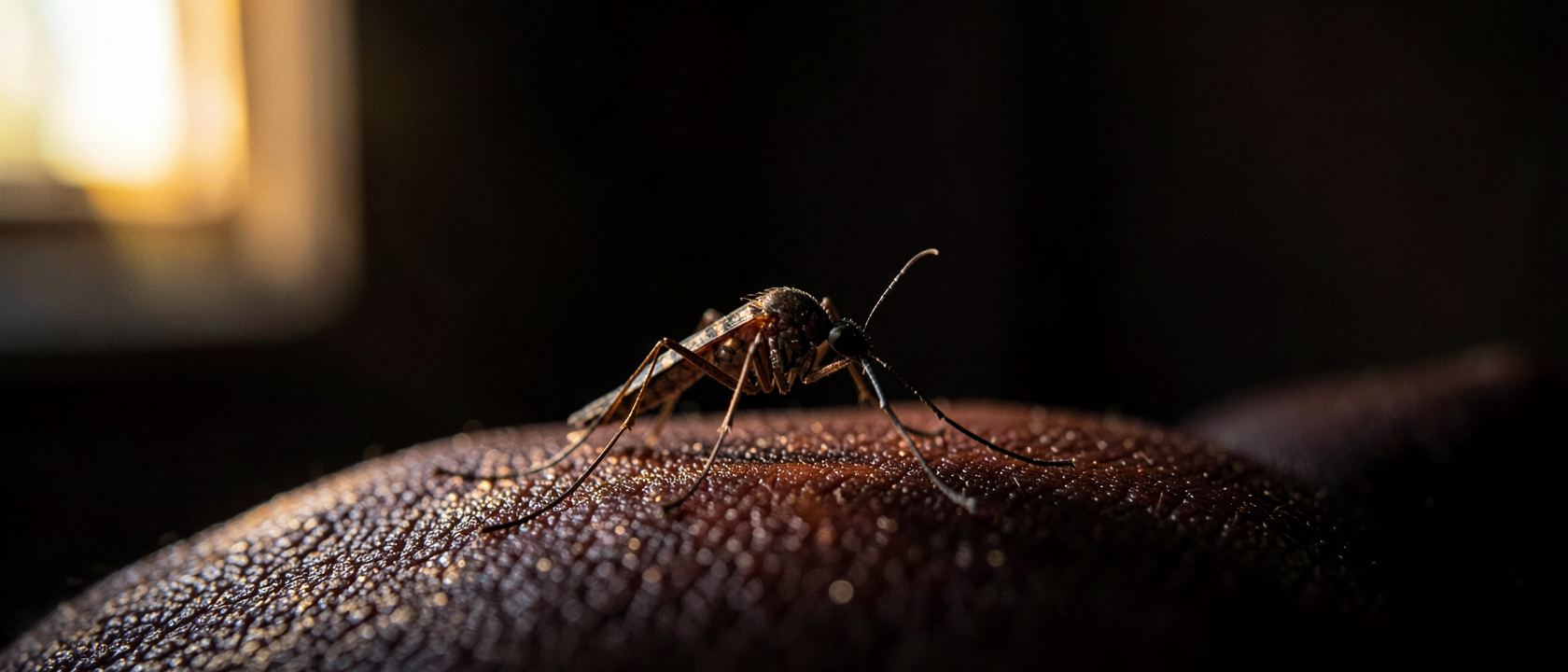
The mosquito that moved its dinner shift
Anopheles funestus has quietly rewritten its own schedule. A genomic study of 656 modern An. funestus mosquitoes, collected between 2014 and 2018 across 16 African countries, found populations of the species shifting away from the habit that made it so dangerous: biting people indoors, after dark, while they slept. In several areas it now bites outdoors, in daylight, instead. The study, led by Marilou Boddé of the Wellcome Sanger Institute with Mara Lawniczak as senior author, was published in Science on September 18, 2025.
An. funestus is Africa’s second-biggest malaria vector, an organism that carries and transmits the parasite between hosts, after the Anopheles gambiae group. In parts of the continent it has historically been the more lethal of the two, precisely because it specialized in finding sleeping humans indoors. That specialization is exactly what insecticide-treated bed nets were designed to exploit.
Why the net became a death sentence
A treated bed net doesn’t only block a mosquito’s path to skin. It’s coated in insecticide that kills on contact. An An. funestus female biting indoors at night, with a person asleep under a net, has to brush that net to reach the blood meal she needs to develop her eggs. Brush it, and she’s likely to die before she lays a single one.
Mosquitoes that happened to bite at a different hour, or outdoors, or both, never touched the net at all. They survived, bred, and passed on whatever quirk of timing kept them alive. Mosquito generations turn over in weeks, not years, so a selection pressure this strong can reshape a population’s habits inside a human lifetime, with no mosquito learning a thing. Nothing was taught. The ones that happened to dodge the net simply outlived and outbred the ones that didn’t.
A paper trail pinned in museum drawers
The researchers didn’t have to infer the timeline from statistics alone. They compared the modern genomes against 45 historic An. funestus specimens, collected between 1927 and 1967 and held at the Natural History Museum in London and the French Research Institute for Development (IRD). One insecticide-resistance mutation that is now widespread across the continent was already present in mosquitoes from the 1960s. Other resistance mutations are completely absent from those older specimens; they show up, and then spread, only after newer classes of insecticide came into use.
Resistance isn’t one trait the species picked up once and kept. It evolves mutation by mutation, matched to whatever chemical happens to be in use at the time, an arms race with a paper trail stretching back close to a century, dated now against a pin and a label instead of a model.
The vector everyone built their strategy around the wrong insect for
Malaria control across Africa has spent decades organized mostly around the Anopheles gambiae group: bed nets, indoor spraying, and the gene-drive research aimed at suppressing it. That’s the quiet myth behind the spending, that stopping An. gambiae is the same project as stopping malaria. Mara Lawniczak, the study’s senior author, states it plainly: even if the entire An. gambiae group disappeared, malaria transmission in Africa would not stop, because An. funestus would carry it on alone. The species is highly attracted to human blood and lives longer than other malaria-carrying mosquitoes, which makes it an efficient vector on its own terms. In 2023 the World Health Organization’s African Region recorded 569,000 malaria deaths, and a meaningful share of that toll belongs to a mosquito that research budgets have largely treated as the sidekick.
What nobody has tried yet
The study also found something useful hiding in the genome: a gene region already used as the target for an experimental gene-drive system, a genetic tool engineered to spread a trait through a wild population faster than ordinary inheritance would, built for An. gambiae around a gene called doublesex. That same region turns out to be highly similar in An. funestus. That’s encouraging for the idea of adapting the same tool to the second species. Whether such a system has actually been built or tested in An. funestus isn’t established here, only that the target looks promising on paper. There’s also no timeline, in this study, for how long it will take findings like these, the behavioral shift, the resistance mutations, the shared gene-drive target, to change what a control program actually does in the field. The genomes themselves now sit in the MalariaGEN Vector Observatory, available for the next study to pick up where this one left off.