
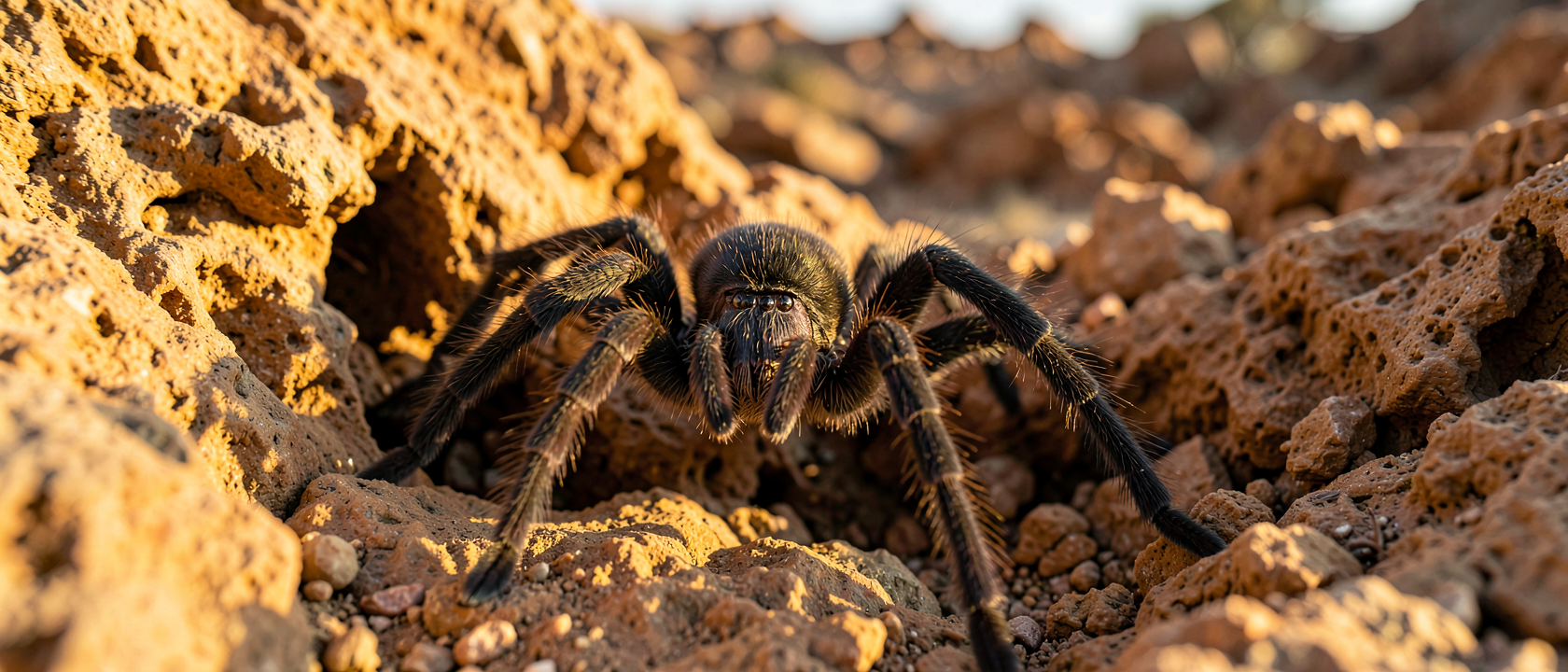
The spider with longer arms than it needs
A male Satyrex ferox grows palps, the short, leg-like feelers near a spider’s mouth, up to 2 inches (5 cm) long. On a spider with a legspan of 5.5 inches (14 centimeters), that is almost as long as a genuine walking leg, and nearly four times the length of its cephalothorax, the fused head-and-chest section at the front of its body. Male tarantulas in general already run long in this department: their palps typically measure about twice the length of the body. Satyrex ferox just takes the trend further than anyone had recorded before.
The measurement comes from the paper describing Satyrex, a new tarantula genus named by Alireza Zamani of the University of Turku, Finland, and colleagues, published in the journal ZooKeys on July 22, 2025. Five species make up the genus: four new to science, Satyrex ferox, Satyrex arabicus, Satyrex somalicus and Satyrex speciosus, and one old one. According to Zamani’s team, Satyrex longimanus, first named in 1903, had simply been filed under the wrong genus for more than a century until this paper sorted it out. The genus name itself splices Satyr, the oversexed, part-man, part-beast figure of Greek myth, with the Latin rex, king. Satyrex ferox, found in Yemen and Oman, is the largest and, true to its name (Latin for “fierce”), the most combative of the group. Its palps are the longest recorded in any tarantula.
That is an odd place to spend extra length. Legs are for walking. On a male tarantula, palps do something else entirely, and that something else is where the extra centimeters start to make sense.
What palps are actually for
Male tarantulas have no penis. Instead, a male spins a small web, deposits sperm onto it, then loads the fluid into bulbs at the tip of each palp, structures shaped like tiny boxing gloves. During mating he uses the bulbs like a pair of syringes, pressing them into the female’s genital opening to deliver the sperm.
That is a dangerous few seconds. In nearly all tarantulas, including Satyrex, males carry one built-in insurance policy: hooked spurs on their front legs that lock the female’s fangs shut while mating happens. Researchers describing Satyrex ferox suggest its unusually long palps work as a second layer of protection, letting a male keep more of his body out of range of those fangs while he finishes the transfer, on the idea that leg hooks alone may not be enough against a female this aggressive.
An arms race, not an accident
Chrissie Painting, an arachnologist at the University of Waikato who was not involved in the study, reads the long palps as a possible outcome of sexual conflict, an evolutionary tug-of-war in which the two sexes are, in effect, pulling in opposite directions. A female tarantula that eats more, including the occasional mate, can lay more eggs. Males eaten before mating leave none. Painting’s framing: females may be evolving toward more aggression to secure extra food, and males are evolving countermeasures just to survive long enough to pass on sperm.
Painting points to other spider species facing the same basic problem, a mate who might kill the male before he’s done, where males evolved in the opposite direction: instead of extra distance, extremely fast sperm transfer, in and out before the female can react. Two lineages, the same problem, two different solutions.
Still just a theory, and that’s the fun part
Painting is careful to call the palp-as-defense idea a hypothesis, not a result. Nobody has filmed Satyrex ferox mating to check whether males with longer palps survive the encounter more often, and nobody has compared mating outcomes across tarantula species with different palp lengths either. The idea is testable. It has not been tested.
The team describing the genus raised a second open question, this one about themselves. Satyrex ferox is large, aggressive, and loud enough to hiss at a disturbance, yet it went completely undescribed until the ZooKeys paper, in a spider family with well over 1,000 species already on record. A tarantula this conspicuous staying unidentified that long suggests the real number of undocumented species across the Arabian Peninsula and the Horn of Africa is still anyone’s guess.
Meet the spider that hisses at nothing
Satyrex ferox does not wait to be grabbed before it reacts. At the smallest disturbance, it rears up, raises its front legs, and rubs specialized hairs on them together to produce an audible hiss, a warning fired well before anything makes contact, according to the paper describing the species.
Knowing what mating looks like for this species, the hiss stops reading like drama and starts reading like good sense. A tarantula whose own partner might kill it over something as routine as sex has every reason to assume the worst about anything else that moves nearby.