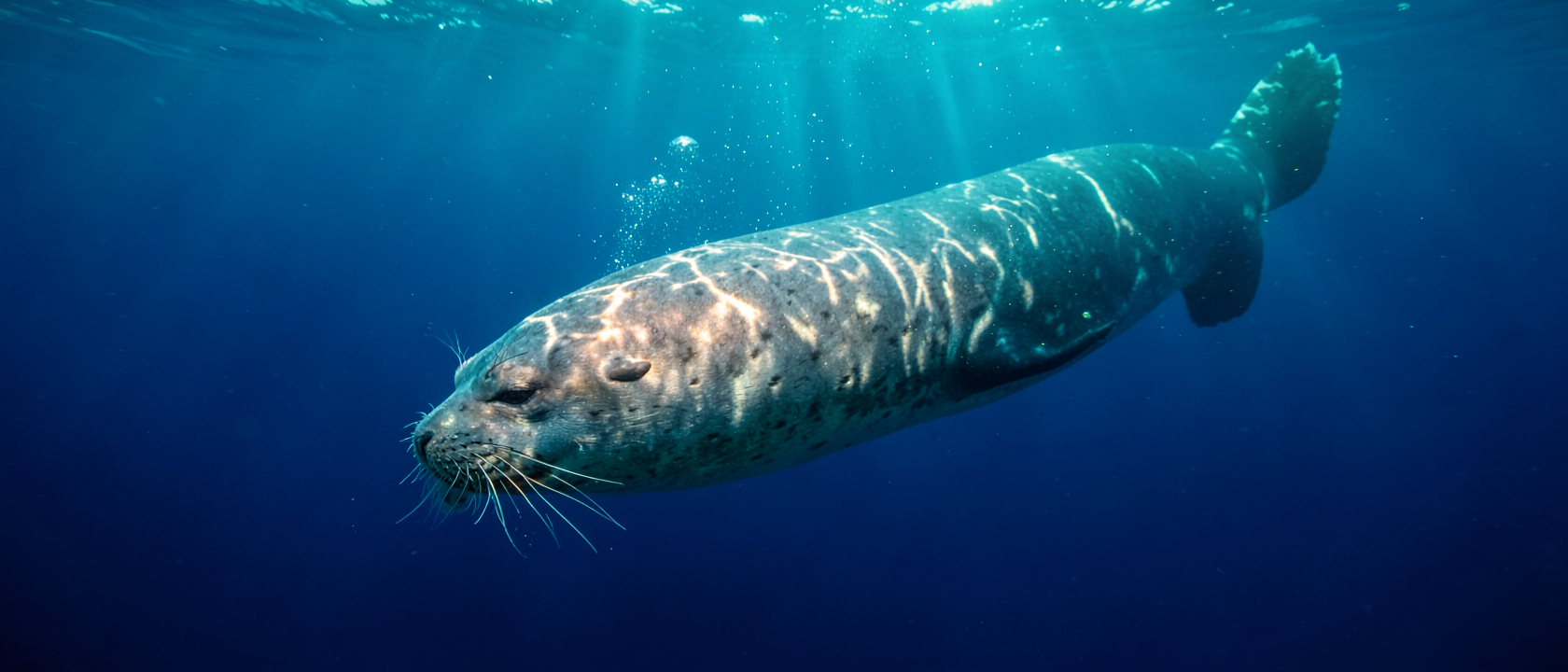
One Ear, Two Worlds
Seals hear equally well in air and underwater. Not “pretty good” in both, not “fine on land and passable at sea”: equally well, according to a study led by Dr. James Rule of the Natural History Museum in London and Monash University, with Dr. Natalie Cooper of the Natural History Museum, published in Proceedings of the Royal Society B on July 1, 2026.
So far, no other mammal has been documented pulling that off. A dog’s hearing falls apart the moment its head goes under. A dolphin’s hearing, built for the ocean, is nearly useless in open air. Every mammal ear anyone had studied was optimized for one medium and paid for it in the other. True seals, eared seals and walruses don’t pay that toll, and until this paper, nobody had actually shown why.
Your Own Blood as a Hearing Aid
On land, sound hits the eardrum, the eardrum vibrates, and that vibration drives the cochlea, the coiled, fluid-filled organ that converts motion into a nerve signal. Standard mammal build, yours included.
Underwater, that same eardrum becomes a liability. An air pocket sits behind it, and air and water are different enough in density that most incoming sound just bounces off that pocket and never reaches the cochlea. That’s the real reason your own hearing goes dull the second you duck your head under a pool.
Seals get around the mismatch with cavernous tissue, a spongy structure in the middle ear that fills with blood on command. Blood’s density is close enough to seawater’s that once the tissue is engorged, sound passes through it into the cochlea almost as well as it would through open water. The air pocket’s mismatch simply stops mattering, because the ear briefly stops relying on air as the middleman. And the tissue wasn’t recruited for this job alone: it swells during dives mainly to equalize pressure and protect the ear from the crushing changes that come with going deep, the same way blubber cushions the rest of the body. The hearing benefit rides along on a system built for something else entirely.
A 26.7-Million-Year-Old Retrofit
Here’s the part that makes this a finding and not just a party trick: the cavernous tissue was never built for hearing. Its original job, per the study, is protecting the ear from the pressure swings of diving.
The team reconstructed that history by micro-CT scanning 217 specimens across 119 species of living and fossil caniform carnivorans, the wider group that includes dogs, weasels, otters and raccoons alongside all 34 modern pinniped species. About 40% of those scans were done at the museum’s own Imaging and Analysis Centre.
The fossil record puts the origin of amphibious hearing at more than 26.7 million years ago, in a single event. Potamotherium and Puijila, otter-like relatives further back on the family tree, come out of the model as air-only hearers, with posterior probabilities of 99.61% and 85.64%. Enaliarctos, one of the earliest pinniped relatives, is where amphibious hearing most likely first shows up, around the time ancestors of seals moved into marine life. Every living seal inherited the trait from that one shift.
It didn’t stay uniform after that. Devinophoca, an early true seal, tuned the system toward sharper hearing underwater. The earliest eared seals tuned it the other way, toward air. The two branches still solve the same underlying problem differently today: true seals lean on an enlarged oval window, the membrane just past the eardrum leading into the cochlea, while eared seals lean on a smaller tympanic membrane, the eardrum itself. One accidental retrofit, two different follow-up jobs, depending on how each lineage actually lived.
What Nobody Knows Yet
Dr. Cooper flags a practical stake in this: ocean noise is rising, and hearing is how seals find mates and stay in contact with each other. A system that runs on blood-filled tissue instead of a plain air-to-cochlea path is still a system that can be damaged, and damage there threatens the same things it would in any animal that depends on hearing its own kind.
What the study doesn’t say is how that damage would actually happen. Nobody yet knows whether chronic noise exposure hits the cavernous tissue, the cochlea behind it, or some other point in the chain, and whether the resulting injury looks anything like noise damage in a standard single-medium mammal ear. That’s an open question, not a finding, and the paper leaves it there.
What a Seal Sounds Like
As an aside, Dr. Rule describes seal calls as “eerie,” the kind of noise you’d expect from a science-fiction soundtrack rather than a beach at low tide. He also mentions, as color rather than as data from this particular study, that seals can keep a beat and have been recorded mimicking elements of human speech. None of that comes with a sample size attached. It’s a researcher’s aside about an animal that has apparently been running two different sound systems inside one skull for at least 26.7 million years.