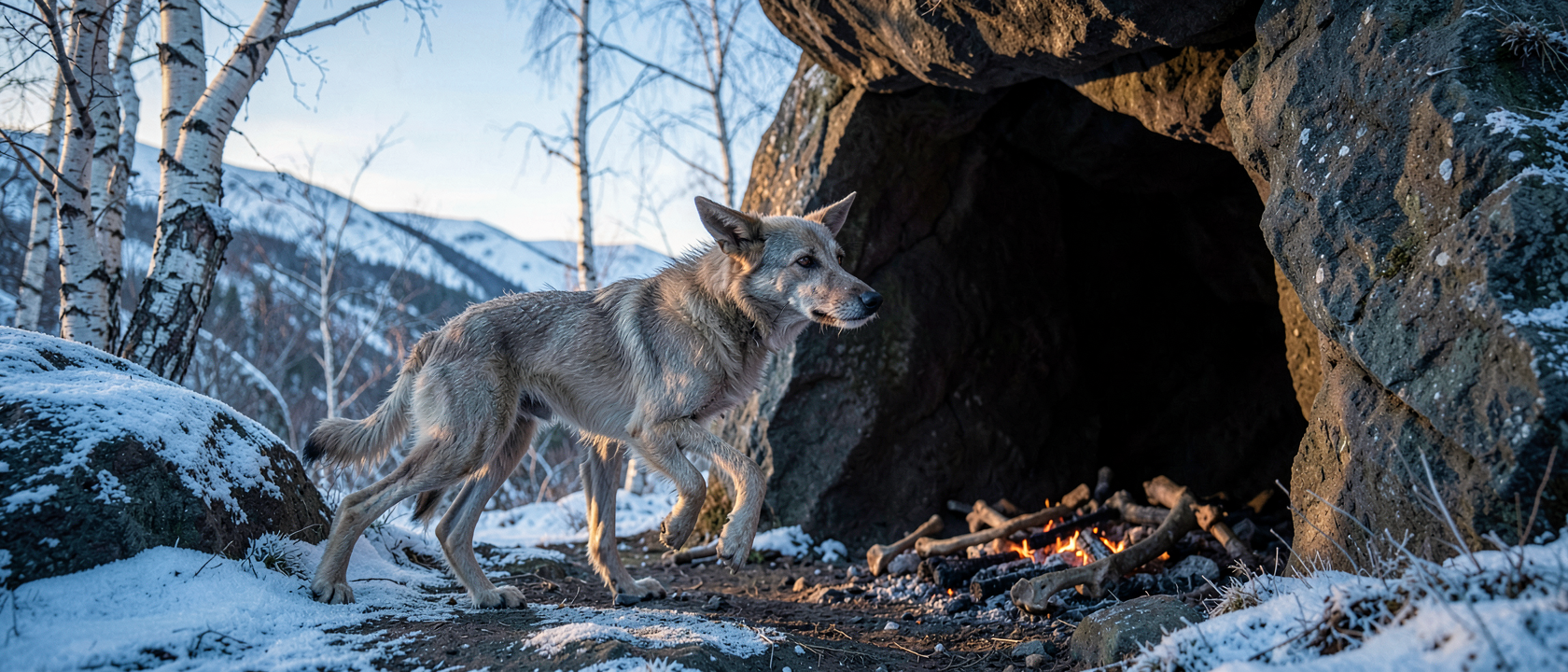
A Jawbone Older Than Anyone Was Ready to Prove
A dog jawbone pulled out of Gough’s Cave in Somerset, England, sometime between 1927 and 1931 belonged to an animal alive roughly 14,300 years ago. A second jawbone, from Pınarbaşı in Türkiye, is older still: about 15,800 years ago. Both have now had their whole genomes sequenced, not fragments, not just measured against a chart of skull shapes, and both come back the same verdict: domestic dog, Canis familiaris, not wolf. The work is published in Nature, led by Dr. William Marsh of the Natural History Museum and Dr. Lachie Scarsbrook of LMU Munich, with more than a dozen other institutions attached. Zoologist Simon Parfitt first flagged the Gough’s Cave bones decades ago for being oddly small next to the huge wolves that shared that landscape. It took a full genome to prove he was right about what that smallness meant.
The previous genetically confirmed record for the earliest dog sat at about 10,900 years ago. This study moves that line back more than 5,000 years, into the last Ice Age.
Why Nobody Could Prove This Before
A wolf and an early-stage dog looked like the same animal in this window: comparable size, comparable skull proportions. Older studies had two tools for telling them apart, short fragments of ancient DNA and bone-shape comparisons, and both run out of resolution exactly where the question gets interesting. A companion paper, “Genomic History of Early Dogs in Europe,” tested how bad that problem really is: it sequenced 216 canid genomes from 14,000 to 1,000 years ago and managed a confident species call for only 141 of them. One case makes the point on its own: a 13,700-year-old canid from Belgium had long been filed as a probable dog because it was small and showed signs of human handling. Its genome came back wolf.
The new study skips shape entirely, building full genomes from the Gough’s Cave and Pınarbaşı remains and checking them against a reference panel of more than 1,000 modern and ancient dog and wolf genomes gathered from around the world. That density of comparison is what finally lets someone write “dog, not wolf” at 15,800 years and have it hold.
What These Dogs Were Already Doing With Their Family Tree
Genetically, the Gough’s Cave and Pınarbaşı dogs sit closer to the ancestors of today’s European and Middle Eastern breeds, boxers and salukis among them, than to Arctic lines like the Siberian husky. That means the split between those two major dog lineages had already happened before the Ice Age ended. Related dogs have since turned up at sites in Germany, Italy and Switzerland, part of a genetically similar population that the University of Oxford dates as expanding across the region between 18,500 and 14,000 years ago.
What were these animals actually for? Nobody has proof, but two of the study’s senior authors have named their guesses. Prof. Laurent Frantz points to something like an alarm system, useful currency between distinct hunter-gatherer groups long before anyone had a fence. Prof. Ian Barnes suggests help with hunting or fishing, dogs woven into culturally and genetically separate human societies across very different landscapes. Both are informed speculation, attached to real names, not settled findings. Isotope analysis, which reads an animal’s past diet from the chemistry left in its bones, gives one hard data point at Pınarbaşı: the dogs there ate a diet heavy in fish that tracked the local human diet closely, and they were unlikely to be catching much of it themselves. Someone was feeding them. At Gough’s Cave, some jawbones show deliberate human modification, including perforations, which Parfitt reads as a sign these dogs mattered even after death.
The Bone-Shape Theory That Finally Got Confirmed
Years before this genome study, Dr. Selina Brace argued from bone shape alone that dogs were already living in Europe around 15,000 years ago. At the time, that rested on morphology, the exact kind of evidence the Belgium wolf case shows can mislead at this age. The whole-genome data now arrives at almost the same number by a completely different route, backing her independently.
The myth here was never that dogs weren’t ancient. It’s that “genetically confirmed” and “shape-based guess” got treated as roughly equal for years, when they weren’t. One of those two finally had the evidence to back it up.
What Nobody Can Say Yet
This pushes back when dogs are confirmed to have existed. It doesn’t prove when domestication itself began. Dr. Scarsbrook has raised the possibility that domestication happened during the last Ice Age, but that’s a proposal, not a proof. The genomes show these animals were already genetically distinct from wolves by 15,800 years ago, they don’t show when the split that made them dogs actually started. That gap between “already a dog” and “when did this begin” is real, and the researchers are leaving it open rather than filling it in.
A Marquess, a Cave, and a Century-Old Donation
The Gough’s Cave jawbone was donated to the Natural History Museum in 1928 by Thomas Thynne, the 5th Marquess of Bath, not long after it came out of the ground. His descendant, Ceawlin Thynn, the 8th Marquess of Bath, whose family estate includes Cheddar Gorge and Caves, has said the donation now carries new weight given what the bone turned out to be. It’s one family’s story attached to one object, not a claim about dogs in general, just a single jawbone’s very long trip from a Somerset cave to a genome sequencer, nearly a century after it left the ground.