The Fish Finger Has a Death That Lasts Longer Than Your Commute
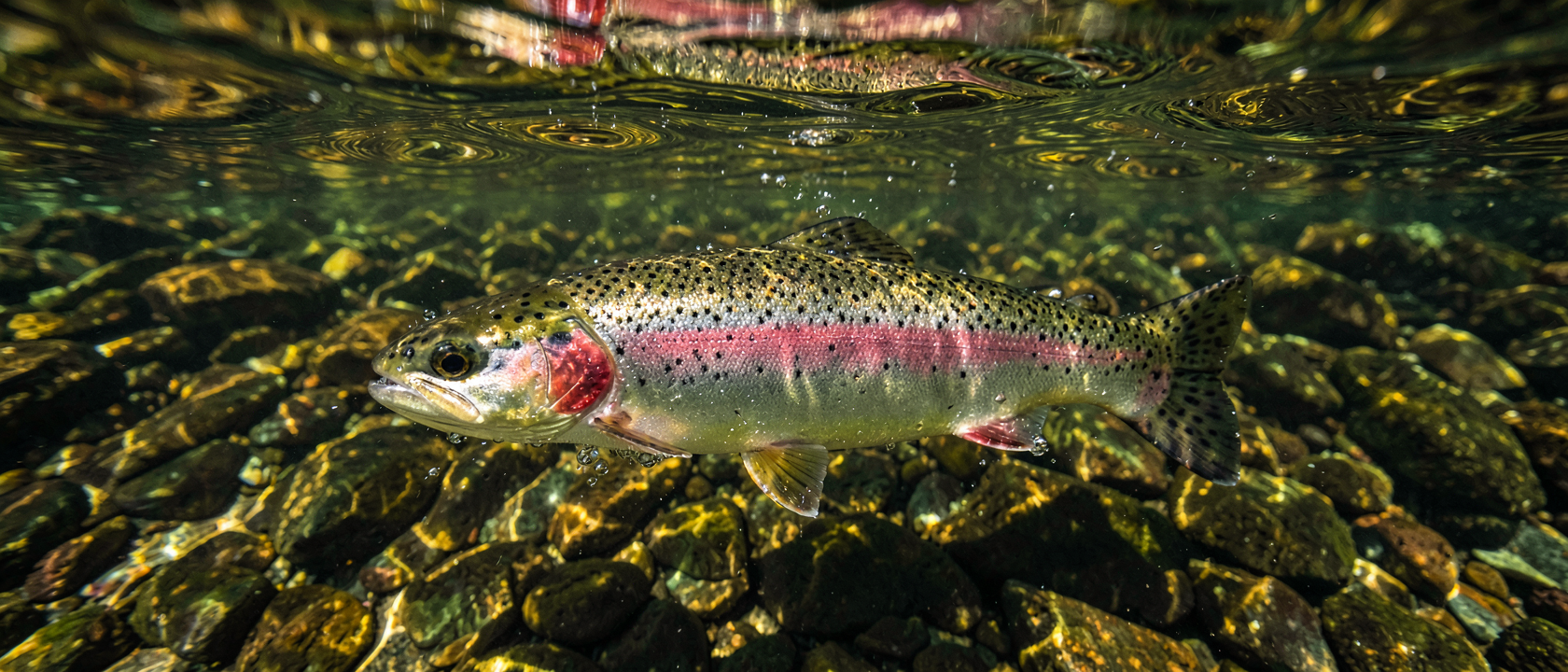
A rainbow trout (Oncorhynchus mykiss) killed by standard asphyxiation, the ordinary method of pulling it out of water and leaving it to suffocate, suffers an average of 10 minutes of moderate to intense pain, and can suffer as much as 22 minutes, before it finally loses consciousness. The figure comes from a 2025 study in Scientific Reports, led by Cynthia Schuck-Paim of the Welfare Footprint Institute with an international team of biologists, built from a review of the physiological evidence on how fish respond to air exposure.
Scaled to how fish actually reach a plate, the same team put the average at 24 minutes of pain per kilogram (2.2 pounds) of trout produced, with some farm conditions pushing moderate-to-extreme pain well past an hour per kilogram. This is not some exotic species from a nature documentary. It is the rainbow trout sitting in the supermarket freezer case, farmed on every continent except Antarctica, and the arithmetic runs backward from what you would expect: the more efficiently a farm processes its fish, the more pain-minutes get compressed into each kilogram of dinner.
What Actually Happens When a Gill Hits Air
A trout’s gills are built to filter water, not air. Underwater, the thin filaments inside them stay spread apart, giving blood maximum contact with dissolved oxygen. Pull the fish out, and those filaments collapse against each other within seconds, sealing off gas exchange almost completely.
According to the researchers’ synthesis of the existing physiology, the fish does not go quiet at that point. It gets worse first. Within seconds of air exposure, a stress response begins: the trout twists and gasps as carbon dioxide, a normal byproduct of its own cells that is usually exhaled through the gills, starts building up in its blood. That buildup, more than the drop in oxygen itself, is what the researchers link to nociception, the nervous system’s pain-signaling pathway. On this account, unconsciousness only arrives once the blood and cerebrospinal fluid, the fluid that cushions the brain and spinal cord, turn acidic enough to shut the brain down. That chemical threshold, rather than the moment air replaces water, is what would stretch the ordeal into minutes instead of seconds.
There is a related, separate strand of research worth knowing here: work on rainbow trout has found that brief air exposure after exhaustive exercise makes physiological damage worse, with more acid buildup, higher blood lactate, and disrupted blood gas levels. In those experiments, only 62% of exercised trout survived a 30-second air exposure after 12 hours, and just 28% survived a 60-second exposure, against 88% survival for exercised fish kept in water and 10% for unexercised controls. It is a different measurement than the pain-minutes estimate, but it points the same direction: air is not a gentle exit for a trout, whatever state it is in when it leaves the water.
Why Anyone Bothered to Time a Fish’s Pain
Schuck-Paim’s team built this estimate using the Welfare Footprint Framework, a method designed to turn an animal’s internal, invisible suffering into something comparable: how much time, at what intensity, an animal spends in a negative state. The same approach let the researchers calculate that electrical stunning, proposed as a more humane alternative, could theoretically avert between 60 and 1,200 minutes of moderate-to-extreme pain per US dollar spent on stunning equipment, with an upper estimate around 20 hours per dollar.
That is the actual point of building it. With as many as 171 billion farmed fish and up to 2.2 trillion wild fish killed for food every year, “humane slaughter” has never had a shared unit of account the way emissions or calories do. A regulator or a producer could call one method “better” than another, but nobody could say how much better, or whether switching was worth the cost. Pain-minutes per kilogram give them a number to argue over instead of a hunch.
‘At Least It’s Quick’ Was Never Measured Before
The common assumption that pulling a trout out of water and letting it suffocate is a fast, low-suffering death is a myth nobody actually tested before this study. It became the industry default because it seemed obviously true, not because anyone timed it.
Schuck-Paim and her coauthors contradict it directly: an average of about 10 minutes of moderate-to-intense pain per trout during air asphyxiation, ranging up to 22 minutes depending on the fish’s size and the water temperature, and an average of 24 minutes of pain per kilogram (2.2 pounds) of fish produced, with some conditions running well past an hour of moderate-to-extreme pain per kilogram. That is not a moral argument stapled onto the study. It is what happens once a process judged for decades by “seems quick enough” finally gets measured in minutes instead.
The ‘Fix’ Nobody’s Finished Checking
Electrical stunning is the leading alternative in the same study, and on paper it looks decisive: up to around 20 hours of pain averted per dollar of equipment cost. But that number assumes the stun works exactly as intended, every time, and the brain scans cited in the research say it does not. A stun is supposed to knock a trout out immediately and completely; in practice, its effectiveness varies, and some fish may stay partly aware after a stun that looked, from the outside, like it worked.
The paper also notes that a stun’s real welfare payoff depends on everything that happened to the fish before it reached the electrodes, including handling and transport stress the framework has not fully quantified yet. So the theoretical savings hold up only if the equipment performs as designed on every fish, and that part remains unconfirmed. The framework can now measure the ordeal precisely. Whether the fix is as clean as the spreadsheet says is still an open question, and knowing the difference between a measured number and a comforting assumption is exactly what separates someone who watches these videos from someone who actually understands what they’re watching.