Shorty
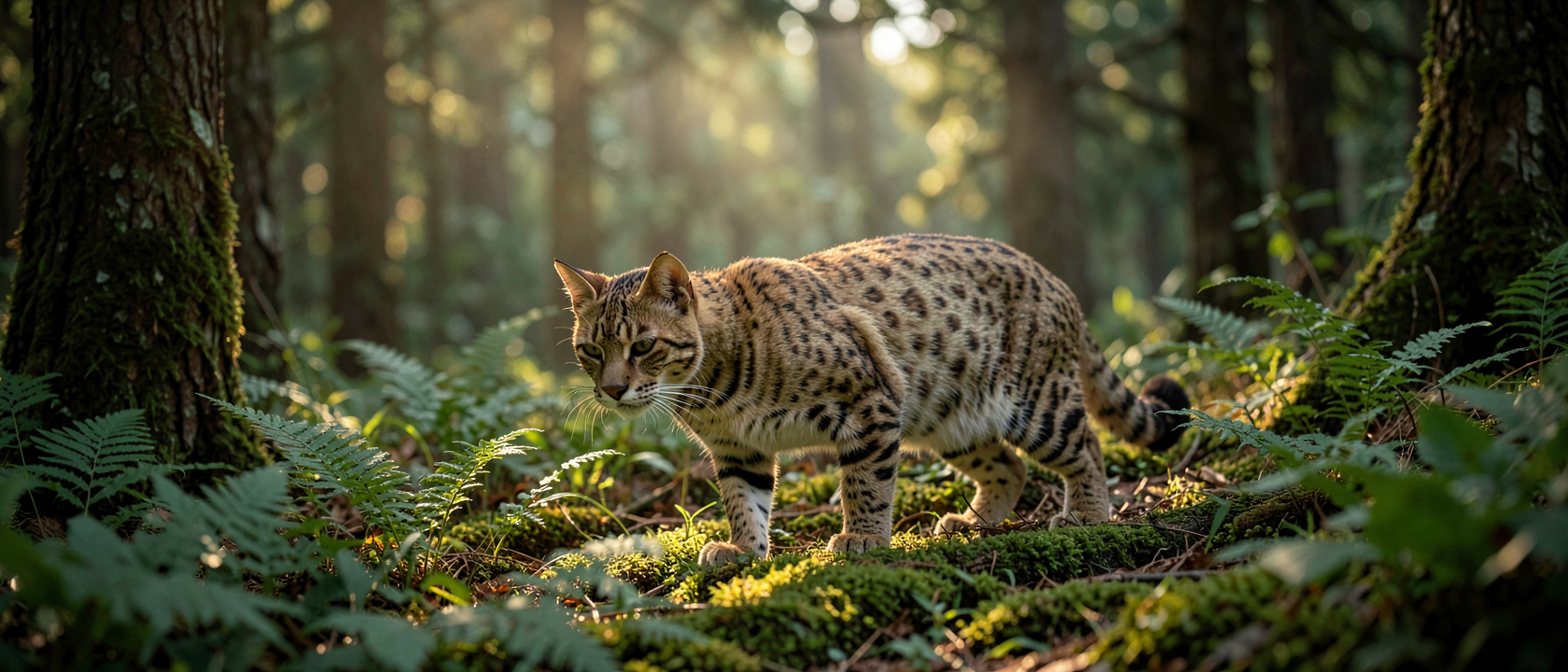
Between 2024 and 2025, field surveys on Tsushima Island turned up three Tsushima leopard cats (Prionailurus bengalensis euptilurus) with tails cut to roughly half the species’ normal length. Nobody had ever recorded this before, not in this subspecies and not in any leopard cat population studied anywhere. One of the three cats was caught, examined, and sampled, and researchers gave him a plain working name: Shorty.
The study behind the discovery, led by Yuki Matsumoto at Azabu University and published in Global Ecology and Conservation, treats the short tail as exactly what it is: an anomaly that needed an explanation, not a curiosity to admire and move past.
Why Tsushima Matters
The Tsushima leopard cat lives nowhere else on Earth. The most recent survey puts the population at roughly 90 to 100 animals on Kamijima, the island’s northern landmass, with at least 17 more confirmed on the southern island of Shimojima; other government surveys have cited a rounder figure closer to 150. Either way, this is one of the smallest wild cat populations anywhere, and it is listed as Critically Endangered on Japan’s Ministry of the Environment Red List.
That smallness cuts both ways. It means researchers can plausibly sequence a meaningful slice of the entire population. It also means a new physical trait showing up in three animals at once is not background noise: it’s a signal worth chasing down properly.
What They Actually Tested
Shorty’s tail measured 4.1 inches (104 mm), against a typical male tail length of 9.6 ± 0.8 inches (245.0 ± 20.14 mm) recorded in the population. Researchers sequenced Shorty’s whole genome and compared it against 15 normal-tailed Tsushima leopard cats, 4 continental Asian leopard cats, and 5 local domestic cats, three of which were themselves naturally short-tailed, in the manner of Manx or Japanese Bobtail-type cats.
They went looking specifically for two genes already known to cause short tails in domestic cats, genes with a documented mechanism in that species. If Shorty carried a domestic-cat tail gene, or if his genome showed a domestic-cat mitochondrial signature, that would be the tell of recent interbreeding.
The Myth That Died
A short tail on a wild cat looks, to most people, like an easy call: short tails are common and genetically well understood in domestic cats, so a short-tailed wild leopard cat must carry some housecat in its family tree. It’s the exact assumption Yuki Matsumoto flagged when the study came out, saying the team wanted to know what the genome actually showed before drawing conclusions from appearance alone.
The genome disagreed with the easy call. Shorty’s estimated domestic-cat ancestry, measured through a supervised admixture analysis (a method that estimates what fraction of an individual’s genome traces to each reference population), came out at less than 0.01 percent. His mitochondrial DNA matched every other Tsushima leopard cat sampled and sat in a group entirely separate from the domestic cats. Neither of the two known domestic short-tail genes turned up in his genome. The obvious suspect had an alibi.
The Second Suspect, Also Cleared
With roughly 100 cats on the island, inbreeding was the next candidate, and it’s not a hypothetical worry: when the Florida panther population dropped to just 30 animals in the 1990s, tail kinks and other skeletal abnormalities became common, and researchers traced that pattern to lost genetic diversity.
Shorty’s genome didn’t fit that pattern. His inbreeding coefficient, a measure called FROH that tracks long stretches of genome inherited identically from both parents, came out at 0.587, almost exactly the population average and well inside the normal range of 0.544 to 0.636 measured across the other Tsushima leopard cats sampled. A radiograph did show that his distal caudal vertebrae, the tail bones farthest from the body, were not clearly defined, with signs of possible damage near the ninth or tenth vertebra, but nothing established how or when that damage occurred.
What Nobody Knows
Two of the three short-tailed cats were only ever caught on camera trap footage by the Tsushima Wildlife Conservation Center’s monitoring team; neither was physically examined or sampled. So there is no way yet to say whether all three share one cause, whether the trait is heritable at all, whether it is a rare developmental accident, an injury nobody witnessed, or the trace of some ancient, low-level crossbreeding event too old and too diluted for current genetic methods to catch.
The paper is candid about this: settling the question will take more short-tailed individuals, caught, examined, and sequenced the way Shorty was. Until then, the cause stays officially unknown. The authors do note one first, regardless: this is the first clinical and genomic look at a short tail anywhere in the genus Prionailurus.
What This Says About You
Seeing a short tail and jumping straight to “there’s a housecat in there somewhere” is the same reflex as watching a dog tilt its head and deciding you know exactly what it’s thinking. Here, someone actually checked, and the genome ruled out the tidy story twice: no hybridization, no inbreeding, just an honest open question. Spotting the gap between the obvious answer and the correct one is what separates finding a cat cute from actually understanding it.