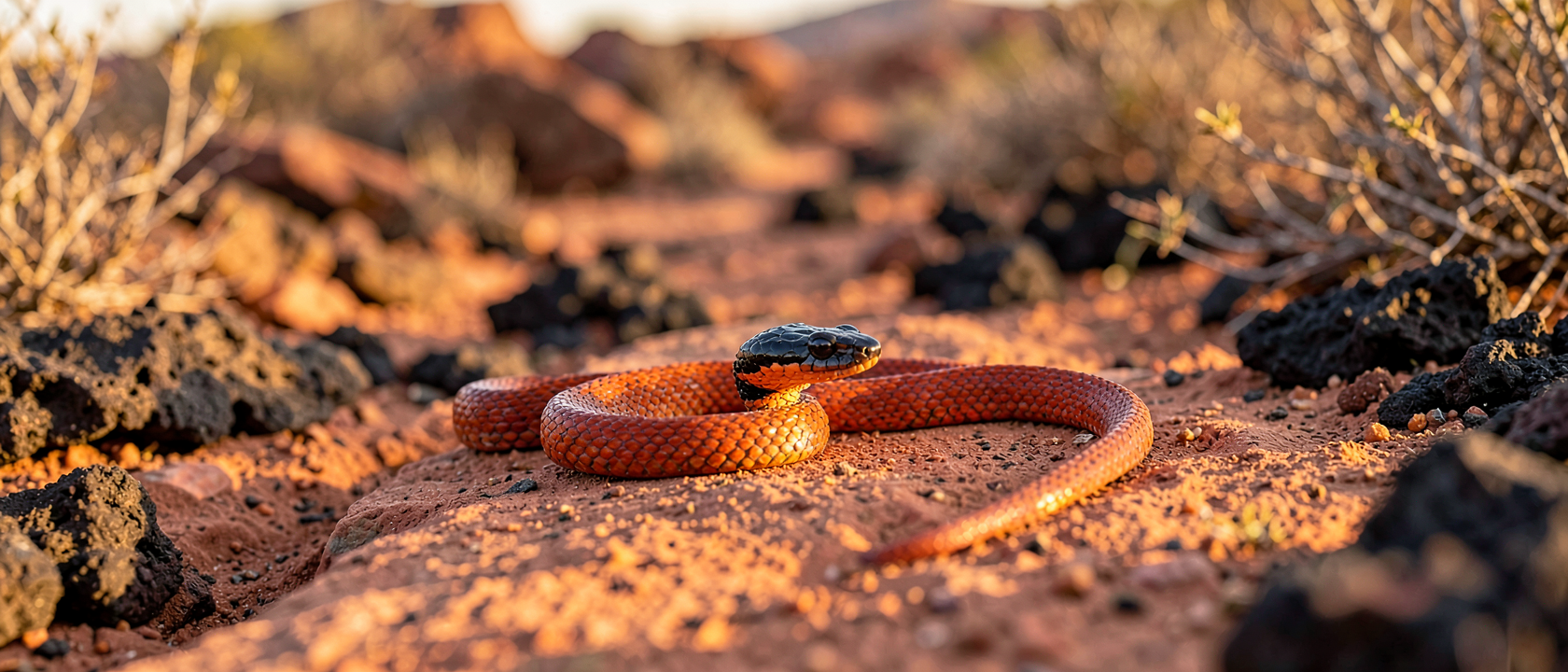
One Snake, Two Costumes
Two snakes pulled from the sandy wadis around AlUla, in Saudi Arabia’s Hejaz region, look nothing alike. One is brick-red with a solid black collar wrapped just behind its eyes, as if its head had been dipped in black paint before the rest of the body was left its natural reddish color. The other is black from snout to tail tip, no collar, no red, nothing. They are the same species.
That species now has a name: Rhynchocalamus hejazicus, described in 2024 in the journal Zoosystematics and Evolution by a team led by researchers at CIBIO in Portugal and Charles University in the Czech Republic, with fieldwork backed by the Royal Commission for AlUla. It is a small colubrid snake, part of the family that includes most of the world’s snake species, and adults run roughly 10 to 16 inches (25 to 40 cm) long. The description draws on specimens collected across several seasons, in Hail Province, the Prince Mohammad bin Salman Royal Reserve, Tabuk Province, and AlUla County.
The team did not just eyeball the two color forms and call it a day. They ran genetic analysis across mitochondrial genes (12S, 16S, cytb) and nuclear genes (cmos, MC1R, NT3, RAG1), and both the red-collared animals and the all-black ones landed in the same lineage. One species, wearing two coats.
Why Wear Two Coats
Nobody has tested why R. hejazicus comes in these two forms. That is the honest answer, and the paper does not pretend otherwise; it documents the two morphs, it does not explain them.
There is a plausible direction, borrowed from what is known more broadly in nocturnal reptiles: full-body dark coloring, called melanism, can affect how fast an animal absorbs heat after sundown, and different color patterns can make an animal harder to spot against different backgrounds, whether that is pale sand, dark basalt, or the scrubby, disturbed ground near a settlement. That is general reptile biology, not a finding about this snake specifically. Whether the black form of R. hejazicus actually warms differently, or blends into a different patch of ground than its red-collared relatives, is an open question the description paper does not answer.
A Night Shift Snake
Every single R. hejazicus individual the researchers recorded in the field was out and active after dark. That is not a guess about the species’ habits; it is what the survey data showed, snake after snake, only ever active at night.
It also lives somewhere people already are. The species turns up on sandy and stony ground with patchy vegetation, in stony wadis cutting through old lava fields, and in areas altered by human activity, meaning it can share space with a town like AlUla without anyone noticing. Laszlo Patko of the Royal Commission for AlUla, who worked on the survey, described the snake’s nightly routine simply: it comes out to hunt invertebrates and small insects. It carries tiny fangs for gripping prey, but no venom.
Patko has also called it “a very cool snake,” adding that it’s “a small snake about 20-30 centimeters long, easy to handle.” AlUla is home to fewer than 20 known snake species, by his count closer to 18, and this one had apparently been going about its business there, after the sun went down, the entire time.
The Missing Piece of the Map
The genus Rhynchocalamus holds five species of secretive snakes, scattered from Egypt eastward to Iran and across the Arabian Peninsula. Two of its members, in particular, have puzzled researchers for years: R. dayanae, restricted to southern Israel, and R. arabicus, found along the coasts of Yemen and Oman. Between them lay a wide, unexplained gap running straight through the Arabian interior, a stretch of the map where the genus was simply not known to exist.
R. hejazicus turns out to be widely distributed across central-western Saudi Arabia, sitting almost exactly inside that gap. Genetic data confirm it is the closer relative of both R. dayanae and R. arabicus. A single new species, described from one region, fills in a distributional hole that had sat open in the genus for decades. As the paper’s authors put it, finding a widespread new snake species in Saudi Arabia’s central-western regions raises the hope that more undescribed species are still out there.
Not Threatened? Too Soon to Say
Because R. hejazicus tolerates sandy, stony, and even human-disturbed ground, and because its known range is already wide, the description team suggests it may not meet the criteria the International Union for Conservation of Nature uses to classify a species as threatened.
That reading comes with a hard caveat, stated plainly in the same paper: almost nothing is known yet about this snake’s broader natural history and behavior. Its full range has not been mapped, its population size has not been estimated, and the researchers call for further monitoring before any real conservation status can be assigned. A wide range on a survey map is not the same as a counted population, and currently, nobody has counted one.