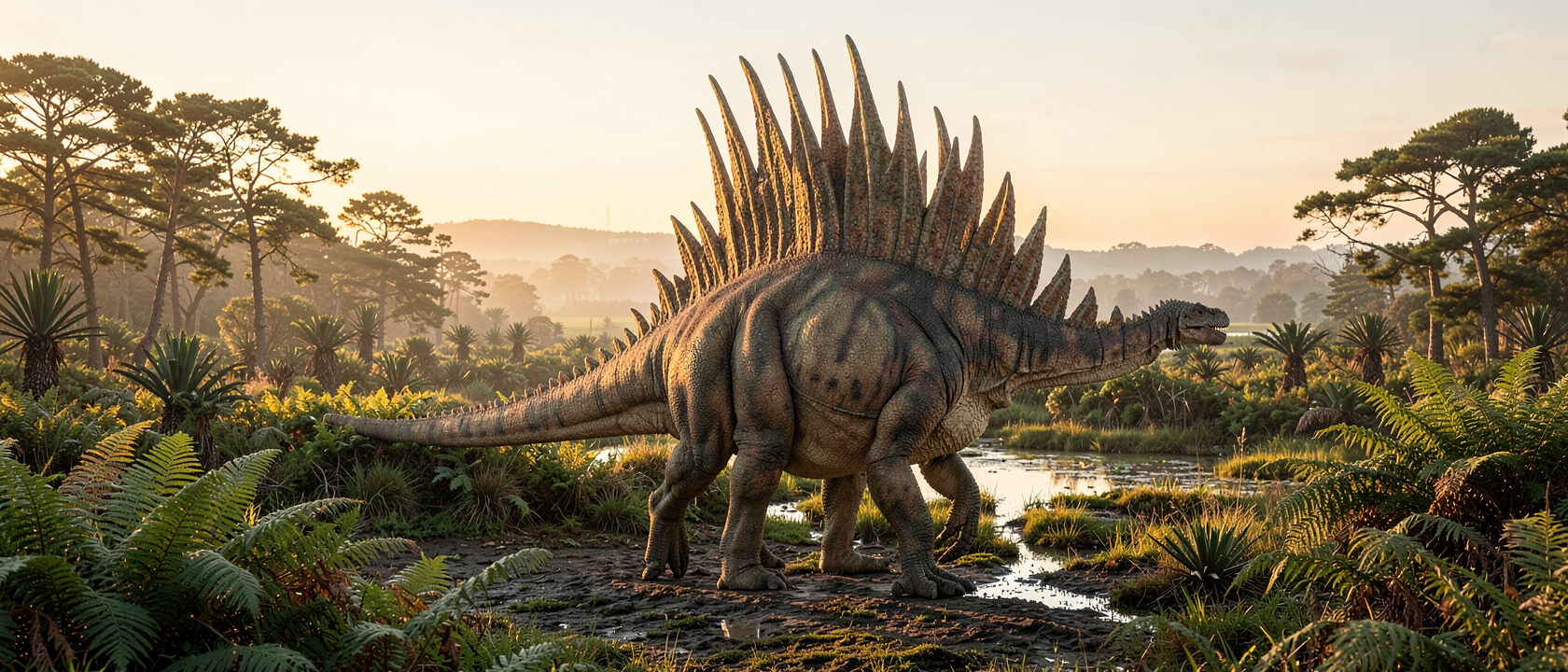
The One-Tonne Dinosaur With a Sail on Its Back
In 2025, in the journal Papers in Palaeontology, Dr. Jeremy Lockwood and his colleagues named a new dinosaur: Istiorachis macarthurae, an iguanodontian, a member of the plant-eating dinosaur group that includes Iguanodon. It comes from Early Cretaceous rock on England’s Isle of Wight, laid down more than 120 million years ago. The animal weighed as much as 2,200 pounds (1,000 kg), about the mass of an American bison, stood roughly 6.6 feet tall (2 m), and walked on four legs for at least part of its life. What made this skeleton stand out in the Dinosaur Isle museum’s collection was a row of unusually tall bony spines running down its back, tall enough to form a sail-like silhouette. The genus name says so directly: Istiorachis comes from the Greek for “sail” and “spine.”
The species name, macarthurae, honors Dame Ellen MacArthur, an Isle of Wight sailor who set the record for the fastest solo non-stop voyage around the world in 2005. Asked about it in a press statement, she said it was far from an everyday thing, to be asked whether a newly discovered dinosaur could carry her name.
What a Dinosaur’s Spine Was Actually Built For
The sail is not skin stretched over ribs, the way it works in Spinosaurus. It is built from neural spines, bony extensions rising straight up from the top of each vertebra. Lockwood’s team surveyed the fossil record of iguanodontian dinosaurs and found a pattern: as these animals got larger and shifted from small, two-legged runners toward bigger, more four-legged builds, their neural spines tended to grow taller too. Earlier research had already traced elongated spines appearing in some iguanodontians during the Late Jurassic and becoming far more common by the Early Cretaceous. Read one way, tall spines are simply scaffolding. A heavier back and neck need bigger anchor points for the muscles holding them up. Bigger body, bigger struts.
The Spines Were Taller Than They Needed to Be
Then the team plotted Istiorachis against that same size-to-spine-height trend, and it did not fit. Its spines were taller than its body size would predict, well past what muscle support alone requires. The explanation the paper proposes is a display structure: a visual signal, likely used to attract mates or to be recognized within a herd, functioning the way an oversized, energetically costly tail functions on a peacock. That flips the story. The sail stops being a side effect of a heavy skeleton and becomes, in this reading, a leading candidate for why natural selection kept the trait around. Presumably, other Istiorachis would have taken notice of it, though that part of the argument is interpretation, not something the fossils can confirm outright. The authors present it as their leading hypothesis rather than a proof.
Not a Radiator: Why Sails Weren’t for Cooling Off
A sail is usually assumed to be a radiator, a wide surface for dumping or absorbing heat, the explanation people reach for with Spinosaurus or Dimetrodon. Lockwood and colleagues argue against that here. A sail carries a heavy blood supply, and running one exposed along an animal’s back, with no fat or armor over it, would have made it dangerously easy to injure and bleed from in a fall or a fight. That is a poor place to keep a climate-control system. The paper also lists other possibilities worth ruling out, fat storage, predator deterrence, herd recognition, but treats sexual signaling as the best fit for the data.
The same paper quietly kills a second assumption. Isle of Wight iguanodontian fossils had long been sorted into just two species, Mantellisaurus atherfieldensis and Iguanodon bernissartensis. Istiorachis is the third new iguanodontian named from the island in recent years, following Comptonatus chasei in 2024 and Brighstoneus simmondsi in 2021. Two species was never the real number.
The Bones That Vanished From a Cliff Over 50 Years Ago
The first Istiorachis bones were dug up by fossil hunter Nick Chase in the 1970s. More material came out of the same site afterward, and some of it was poached during collection and never recovered, leaving an unknown chunk of the skeleton permanently missing. Lockwood, a retired physician who found the species while re-examining museum drawers for his Ph.D. at the University of Portsmouth and the Natural History Museum, London, put it plainly: “While the skeleton wasn’t as complete as some of the others that have been found, no one had really taken a close look at these bones before.”
Whatever was in those stolen bones is still out there somewhere, or gone for good, and with it any extra vertebrae that might have settled how tall the display really got, or how it moved. A 2025 paper on a species that lived more than 120 million years ago is still, in places, working from a hand someone else dealt short decades ago.