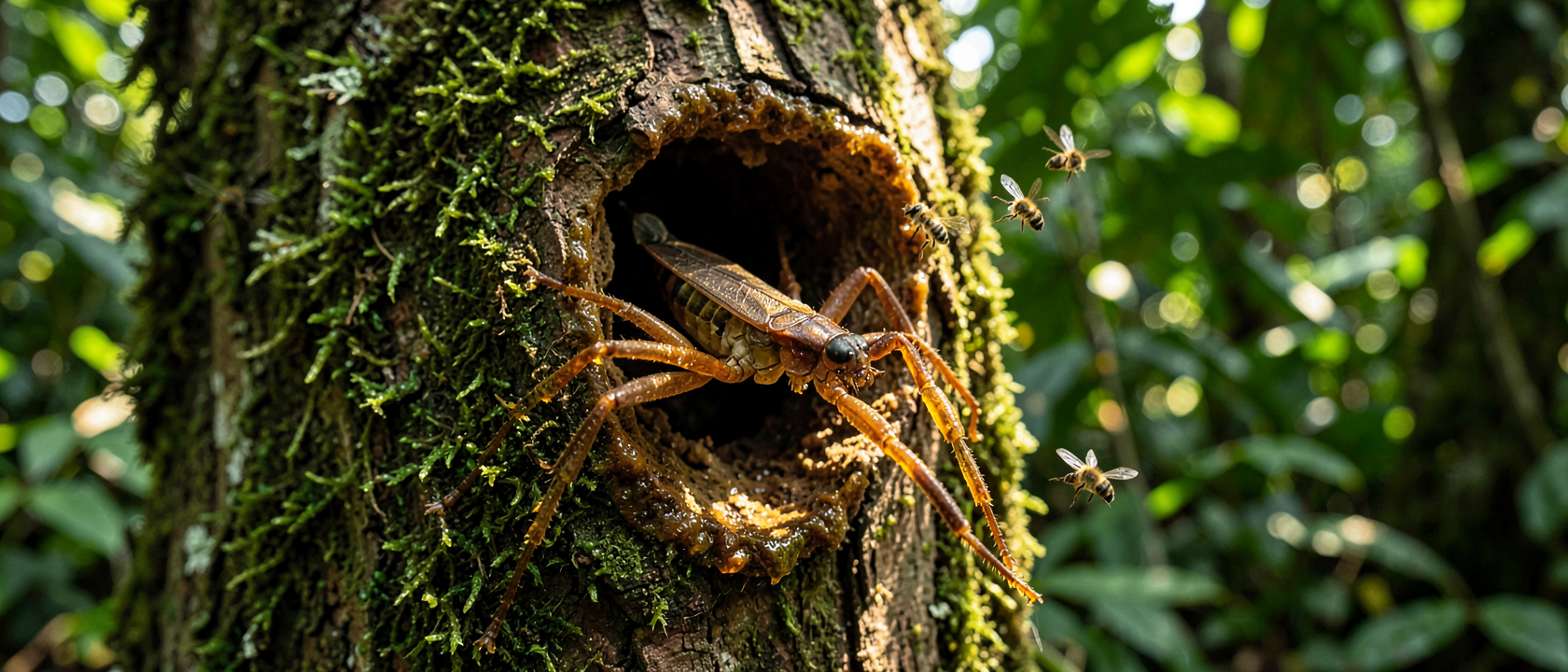
The Ambush
An assassin bug that lives near the hives of stingless bees in Thailand and China doesn’t wait around empty-handed. Pahabengkakia piliceps, a true bug in the family Reduviidae (the assassin bugs, named for the raptorial front legs they use to grab and hold prey), sits at the hive entrance, dips its front and middle legs in resin the bees themselves left there, and waits. The guards come to it.
Entomologists Zhaoyang Chen and Li Tian of China Agricultural University, working with colleagues at the Xishuangbanna Tropical Botanical Garden and the Institute of Zoology of the Chinese Academy of Sciences, described the behavior in a paper published in PNAS on May 12, 2025. In the field, the team watched the bug hunt six species of stingless bee; it’s known specifically as a predator of Tetrigona sp. and Trigona collina. The bug isn’t hiding in the resin for the stick of it. It’s using the hive’s own material to call its dinner over.
Why the Bees Fall for It
The trap already exists before the bug arrives. Many stingless bee species defend their nests by dabbing droplets of resin, sticky and acrid, around the entrance. It works as a built-in alarm: an intruder that gets stuck triggers the guards, who rush out biting, dashing, and chasing (stingless bees have stingers that have lost most of their function, so mobbing is the main defense, not venom). P. piliceps invents none of this. It steals the resin, works it into its own legs, and stations itself exactly where the guards are trained to look.
Chemical analysis by the same research team found the mechanism behind the theft. Resin that has been smeared and handled releases volatile compounds at a much higher rate than resin left undisturbed on the bug’s legs. Smearing spreads the resin’s volatile compounds faster, cranking up a smell the hive already treats as an emergency, and the guards follow it straight to the ambush.
The Case for Tool Use
The obvious explanation is that sticky legs simply grip better. The field trials rule that out. Bugs with resin coated on their front and middle legs, the ones used to grab prey, succeeded in ambushing guard bees 75% of the time. Bugs carrying no resin at all succeeded less than 30% of the time. On its own, that’s the number you’d expect from a better glue.
Then the researchers ran the test that breaks the simple story. They smeared resin on the bug’s abdomen instead, a body part with nothing to do with grabbing anything, and hunting success still rose compared with bugs carrying no resin at all. If stickiness on the hunting legs were the whole explanation, resin on the abdomen should do nothing. It didn’t do nothing.
That gap is the basis for calling this genuine tool use rather than a useful accident. The researchers applied three standard criteria: does the animal control an external object toward a goal, does it deliberately alter that object’s properties, and does it use the object to manipulate another animal’s behavior. P. piliceps clears all three. It collects the resin on purpose, smears it to raise the scent it releases, and uses that scent to steer a guard bee’s decision to approach. The guard bee responds to what its own alarm system tells it, it just doesn’t know the alarm was staged by a bug.
Not All Assassin Bugs Do This
There’s an easy assumption sitting under all of this: that resin use among assassin bugs is basically one trick, wherever you find it. It isn’t. A 2023 study in Biology Letters by Fernando Soley and Marie Herberstein looked at assassin bugs in the genus Gorareduvius in Western Australia, which coat their legs with resin from spinifex grass. There, the resin does the job most people would assume: it makes the legs stickier, which helps the bug hold on to prey it has already caught. No scent-based lure was part of that picture.
Soley has described first coming across the behavior years before that study existed, on a walk through the Western Australian savanna, when he picked up an unfamiliar insect, noticed how sticky it was, and recognized a smell he already knew from the grass nearby. That’s one researcher’s personal account of a different species, not P. piliceps, and it belongs in a different column: the Australian bug’s resin use is glue. The Thai and Chinese species’ resin use is a signal that recruits its own prey. Same raw material, two different jobs.
What Nobody Knows Yet
Why would two assassin bugs, both smearing resin from a food source onto their own legs, end up with such different tools: one a better grip, the other a stronger smell? The researchers behind the P. piliceps paper point to prey specialization as one candidate. This species hunts stingless bees almost exclusively, while the Australian Gorareduvius species is not limited to a single kind of prey. Narrowing down to one target may be what let a scent-based lure evolve, since it means relying on one very specific alarm system instead of many different ones.
That’s a hypothesis, not a finding. The study’s authors say the real answer needs comparative work across many assassin bug species, built on a phylogenetic framework (a family tree based on evolutionary relationships) that could show whether resin-as-scent and resin-as-glue evolved separately, and how many times. Until that comparison exists, there are two data points and an open branch between them.