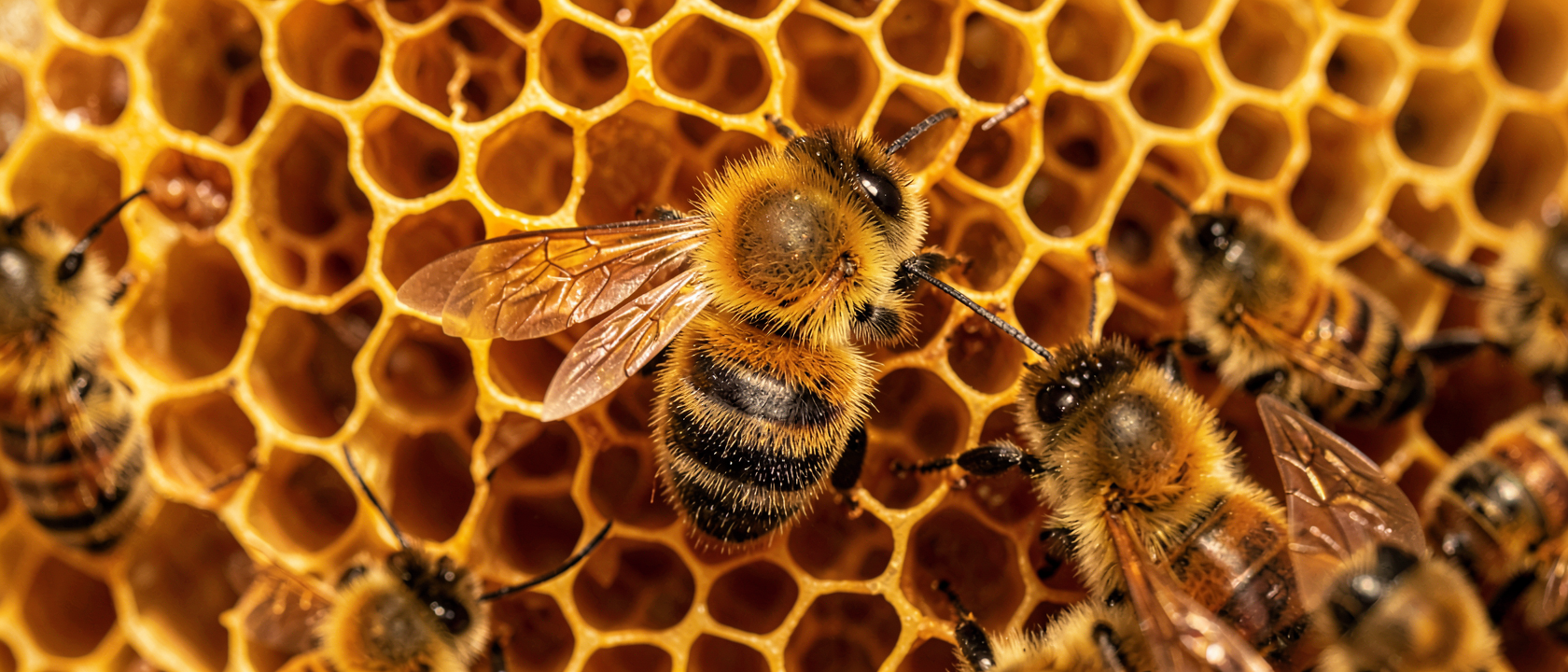
Bees Dance Worse to a Bored Room
The waggle dance of the Western honey bee (Apis mellifera) has always been sold as fixed code: a forager returns to the hive, runs a tight figure eight on the vertical comb, and hands out the same coordinates to whoever happens to be standing nearby. A study published March 23, 2026 in the Proceedings of the National Academy of Sciences, led by Ken Tan of the Chinese Academy of Sciences with James Nieh of UC San Diego and Lars Chittka of Queen Mary University of London, found that isn’t what happens. When the crowd of watching bees on the dance floor thins out, the dance gets sloppier. Not a different message, a worse delivery of the same one.
“Precision” here means something specific: how tightly the dancer repeats the same waggle angle relative to the sun, which encodes direction, and the same run duration, which encodes distance, from one waggle to the next. A precise dancer repeats her runs almost like a metronome. An imprecise one drifts, run to run, in the very numbers her nestmates are supposed to read as flight instructions.
A Dancer Working the Room
The researchers ran two experiments. In the first, they simply changed how many bees were present on the dance floor. In the second, they held the total number of bees constant but swapped in young worker bees, insects too early in their working life to have any interest in following a dance. Both changes produced the same result: less precision.
The cause traces back to the dancer’s own movement. With fewer real followers around, she doesn’t just perform fewer repetitions and quit. She wanders. Between waggle runs she covers more ground across the comb, searching for bees willing to trail her, and that searching eats into the tight, fast rhythm the dance depends on. Mean run duration and distance stayed about the same, but both became markedly more variable when followers were scarce, the wobble of a performer whose attention is split between the routine and finding somebody to perform it to.
How She Even Knows Who’s Listening
None of this works unless the dancer can sense her audience, and the researchers watched how she does it: constant antennal and body contact from the bees standing around her. Every brush of an antenna or bump of a body appears to carry a small packet of information, telling her roughly how many bees are near and, apparently, what kind. An experienced forager seems to register as a different kind of contact than a young bee with no intention of following anyone anywhere.
She isn’t broadcasting into a void and hoping. She’s getting touched, or not getting touched, and adjusting to which one it is.
A Dance That Costs Something
None of this would be worth keeping if a waggle dance were free, and it isn’t. A precise dance takes energy, and it takes a forager’s time, time she could spend flying back to the same food source herself instead of advertising it to a room. Performing full precision for an empty floor, or for a floor full of young bees who were never going to leave the hive anyway, is effort with no return.
Scaling precision to the audience that’s actually there, and actually able to act on the message, is a colony managing its own attention budget. The dance isn’t just information leaving a forager’s body. It’s an investment the colony only makes when the investment can pay off.
Not a Memo, a Conversation
MYTH: the waggle dance is a one-way transmission, a fixed signal decoded the same way regardless of who’s watching, the insect equivalent of a memo pinned to a board. FACT: the 2026 PNAS study shows precision is built live, shaped by feedback from whoever happens to be on the dance floor at that moment. The same forager, advertising the same food source, dances more precisely to a packed floor of experienced foragers than to three bees and a wall of uninterested juveniles.
What’s Still Unknown
The paper stops at the level of behavior. Touch clearly carries information, and precision clearly responds to it, but nothing in the study explains how a brush of antennae on the dancer’s body gets translated, physiologically or neurologically, into a steadier angle and a more consistent run length. That link is unspecified. Nor does the paper draw a line for how small an audience has to get before precision starts to slip, or put a number on how much sloppier the dance actually becomes. Touch equals information, precision equals response, and the wiring in between is still an open question.