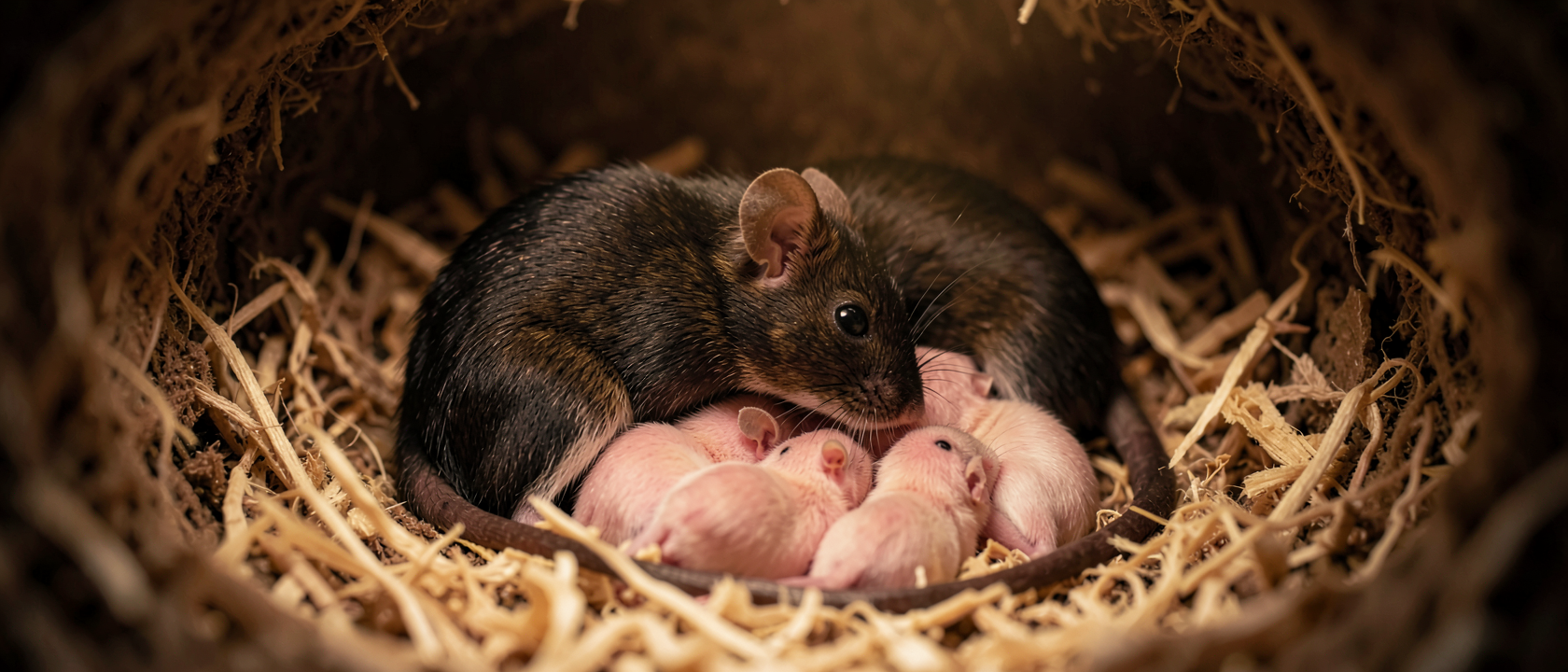
The mother ate badly. The pup paid permanently.
A C57BL/6 laboratory mouse pup whose mother ate a low-fiber diet while nursing it nearly doubled in weight by weaning. The researchers then put it on a healthy, fiber-balanced diet for nine weeks. The Proteobacteria kept blooming in its gut. The weight kept climbing. The mother’s three-week diet during nursing had already settled something that no subsequent correction could reopen.
That is the central result of a paper published December 8, 2022, in Cell Host & Microbe, by Jun Zou, Vu L. Ngo, Yanling Wang, Yadong Wang, and senior author Andrew T. Gewirtz, a microbiologist at Georgia State University. Gewirtz later recalled that the weight-gain data were so striking he did not believe them until many replications had confirmed it.
What fiber deprivation actually does inside a gut
The mechanism reported by Zou et al. runs in two stages. A standard grain-based laboratory diet sustains a diverse bacterial community by feeding fiber-fermenting species that produce short-chain fatty acids and keep microbial populations in balance. Remove the fiber and those bacteria starve. Proteobacteria, a large bacterial phylum with no fiber requirement, fill the opening because the competition that would normally limit them has gone.
The second stage is the cost of that bloom. Proteobacteria carry lipopolysaccharides on their cell surfaces, molecular structures that the innate immune system reads as a threat signal. A gut dense with Proteobacteria is a gut in persistent, low-grade inflammatory activation. Simultaneously, the paper reports that the altered bacterial community remodels the intestinal lining in ways that increase lipid absorption. The result is two parallel effects from the same disrupted ecology: an immune system running hot and a gut extracting more fat per meal.
The nursing window is the only window that matters
For a Mus musculus pup, the approximately three-week nursing period is the founding event of its entire microbial life. The species that colonize first shape the local immune environment, and the immune environment determines which subsequent species can gain any foothold at all. A Proteobacteria bloom with three weeks to establish dominance before the pup ever touched solid food was not going to be dislodged by nine weeks of correct eating afterward.
The dietary-challenge data made the durability concrete. After those nine post-weaning weeks on the standard grain-based diet, the researchers transferred twelve-week-old offspring to a low-fiber, high-fat diet for four weeks. Pups from low-fiber-nursed mothers gained significantly more weight, accumulated more fat mass, and showed indicators of elevated blood cholesterol and insulin resistance, compared to pups from standard-diet mothers. The maternal fiber deficit had not only altered the starting microbiome; it had made the gut more susceptible to the next disruption it encountered.
The myth this kills
The default assumption about obesity is that it is essentially a record of what the individual eats. The Zou et al. data contradicts that directly: pups that ate correctly for nine consecutive weeks after weaning still nearly doubled in weight and still harbored abnormal bacterial communities. The disruption was set before those animals made a single independent food choice.
The paper’s authors observe that energy-dense foods have been available for decades, yet obesity rates continued to climb across that same period, a gap that calorie arithmetic alone cannot bridge. What the study proposes is that early-life microbiome composition, shaped by the mother’s diet rather than the offspring’s, represents a susceptibility factor established before any individual eating behavior begins.
The team also tested an inulin-enriched maternal diet as a partial correction. At twelve weeks of age, pups from inulin-enriched mothers still had microbiomes that clustered distinctly from those of pups raised on the standard grain-based diet, with the gap only slightly smaller than in the full low-fiber group. Enriching the maternal diet with inulin helped. It did not repair the damage.
Three questions the study cannot answer
The paper does not resolve how the altered microbiome travels from mother to pup. Breast milk composition, direct bacterial transfer during nursing contact, and fecal-oral exposure in the shared cage environment are all plausible routes. Zou et al. do not disentangle them.
Whether any of this applies beyond C57BL/6 Mus musculus is untested by this work. The strain is the standard laboratory model for diet-induced obesity research, partly because C57BL/6 mice are particularly prone to weight gain and insulin resistance on high-fat diets. That suitability does not indicate what happens in other species, and the paper makes no such claim.
Gewirtz noted in December 2022 that introducing missing microbial species at a young age might reverse the damage from maternal fiber deprivation, but described that as requiring further investigation. Whether any intervention could genuinely restore a healthy microbiome, what form it would need to take, and how early it would need to arrive are all unestablished. The nine-week dietary correction tested here was not sufficient. Whether the problem is the length of the window, the type of intervention, or both is precisely what the study leaves open.