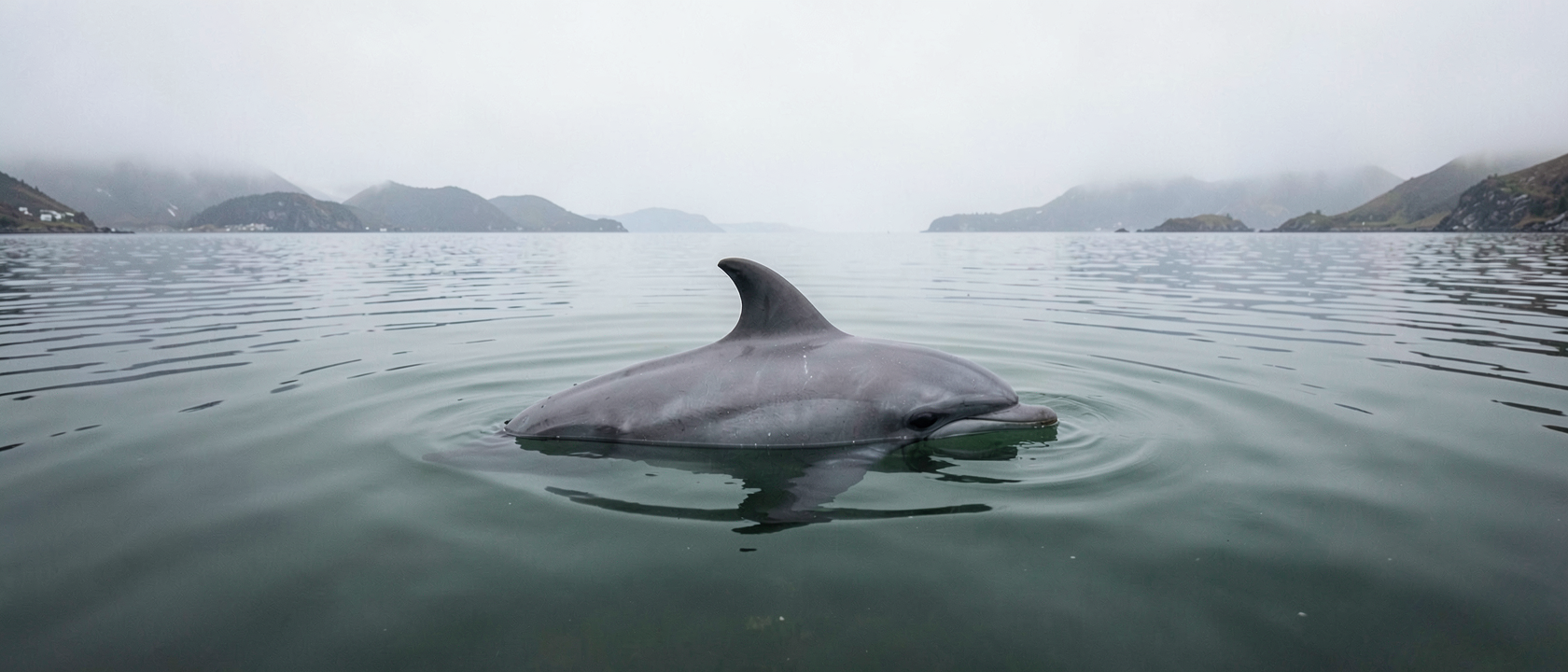
Ten Thousand Sounds, Zero Audience
A bottlenose dolphin (Tursiops truncatus) living completely alone in a Danish channel was recorded making 10,833 separate sounds over 69 days, between December 8, 2022, and February 14, 2023. The count comes from a study led by cetacean biologist Olga Filatova of the University of Southern Denmark, published in the journal Bioacoustics on October 31, 2024. The breakdown: 2,291 whistles, 2,288 burst-pulses, 5,487 low-frequency tonal sounds, and 767 percussive sounds. There was no other dolphin within earshot. He produced a full acoustic repertoire anyway.
Locals call him Delle. He has lived in the Svendborgsund channel, between the islands of Funen and Tåsinge, since September 2019, well outside the typical range for this species. He is actually catalogued as individual #1022, nicknamed Yoda, in the Moray Firth photo-identification catalogue in Scotland, a male born in 2007, identifiable by a set of notches on his dorsal fin. He crossed a lot of water to end up producing that sound library alone in a Danish harbor.
What Whistles and Burst-Pulses Are Supposed to Require
Bottlenose dolphins carry something close to a name: a signature whistle, a whistle contour unique enough to each animal that other dolphins use it to identify who is “speaking.” Burst-pulses, rapid strings of clicks, tend to show up in friction: aggression, competition, tension between two animals. In every prior recording of wild dolphins, both categories were produced during an exchange with somebody else. They are, by definition, addressed sounds.
The recordings came from a Soundtrap ST-500, an autonomous underwater recorder dropped into Svendborg harbor to study something else entirely, how Delle’s presence was affecting the local harbor porpoises (Phocoena phocoena), a smaller, differently shaped cetacean he shares the channel with. Filatova has said she added the recorder mostly out of curiosity, expecting a handful of distant whistles. What came back included three distinct signature whistles. Had the researchers not already known there was only one dolphin in that water, the recordings would have read like a conversation among at least three.
Three Explanations, None Confirmed
Filatova offers three possibilities, and stands behind none of them as settled. The first: Delle is talking to himself, replaying or rehearsing exchanges he remembers from before he arrived in Denmark. The second: the sounds are not addressed to anyone at all, an involuntary release the way a person might laugh out loud at a joke with no one else in the room. The third: he is calling out, hoping something answers. Filatova considers this the least likely of the three. Delle has had years in the channel to learn that nothing does.
Thea Taylor of the Sussex Dolphin Project, who was not involved in the study, has pointed out that dolphins rely on sound constantly, for hunting, for reading their surroundings, for communicating over distance, so a solitary dolphin staying vocal is not shocking on its own. What remains genuinely open, by her own account, is why dolphins produce the range of sounds they do at all, and what that range might reveal about what they are experiencing when no other dolphin is there to hear it.
The Myth This Kills
Solitary, or “outcast,” dolphins have historically been treated by researchers as a dead end: no group, no exchange, nothing to record. Filatova’s framing names that assumption directly, and Delle’s own data contradicts it. Whistles and burst-pulses were expected to need at least two dolphins in a room. One produced them for 69 straight days with nobody else present. If a solitary animal was assumed to have nothing worth recording, the field was quietly deciding in advance what counted as data, and skipping a category of behavior before anyone checked whether it existed.
The Paddleboarder Theory, and Why It Died Fast
Before the researchers had to reach for anything strange, they checked the obvious answer first. A paddleboarder was known to pass through the channel regularly, and it seemed reasonable that Delle’s vocalizing might simply be directed at him. The recorder ran at night too, with no human anywhere in the water. The sounds kept coming. The mundane explanation closed in one line of data, leaving the stranger one standing.
Delle stayed in Svendborgsund for more than three years before leaving on April 8, 2023, when he turned up in Nyborg, about 18.6 miles (30 km) north. By April 23 he was in Travemünde, Germany, where he stayed roughly three weeks before drifting to other spots along the German Baltic coast. He left the recorders behind in Denmark, and whatever he was doing with all those sounds went with him, unresolved.