The Oldest Ant Ever Found Was Already a Monster
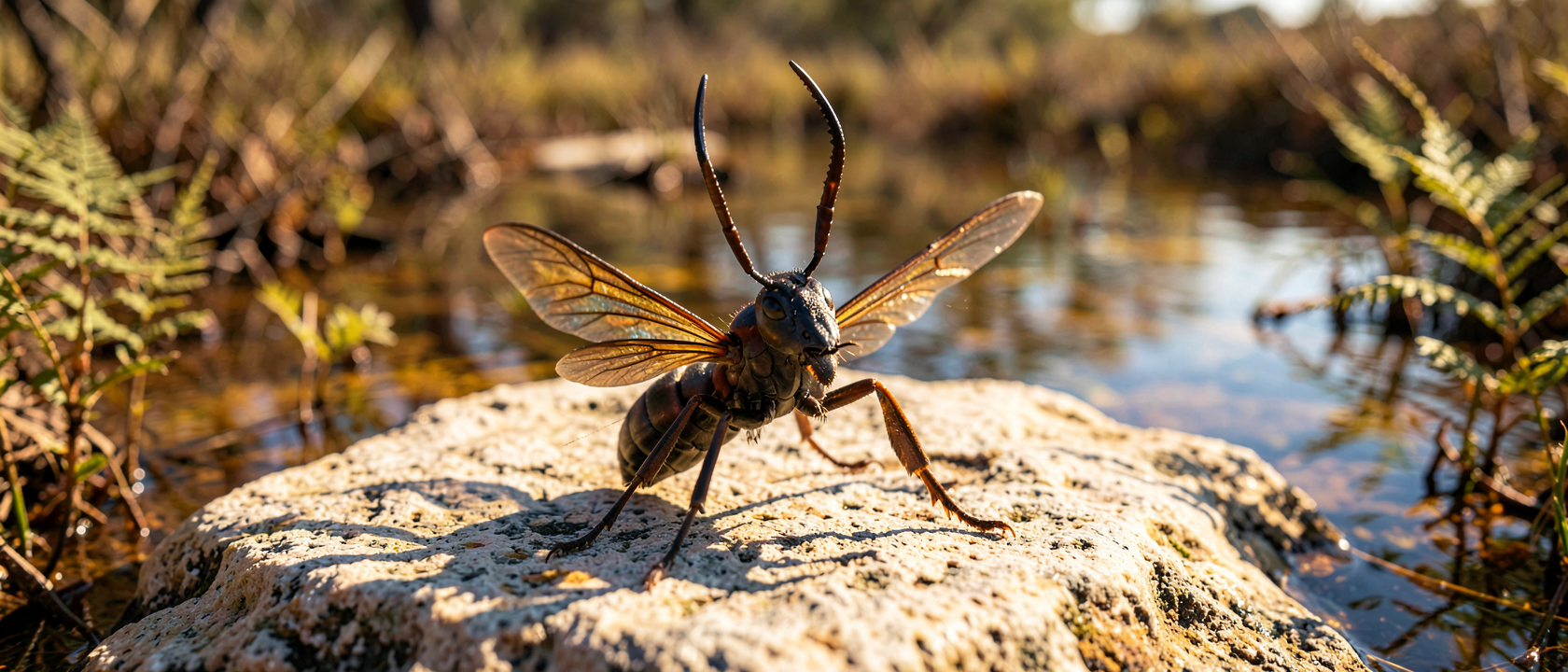
113 million years ago, in what is now northeastern Brazil, an ant died with its jaws already built like scythes. Its name is Vulcanidris cratensis. A team led by Anderson Lepeco at the Zoological Museum of the University of São Paulo confirmed it as the oldest ant on record, in a paper published in Current Biology on April 24, 2025. That beats the previous record holders, hell ants trapped in amber from Myanmar, France, and Canada, by more than 13 million years; those amber fossils date to around 100 million years old. This one was never in amber. It turned up in limestone, in the Crato Konservat-Lagerstätte, a Brazilian fossil deposit known for preserving Cretaceous life in fine-grained rock instead of tree resin. At about half an inch (1.35 cm) long, winged, with a stinger like a wasp’s, it looks nothing like a modern ant. It is one, and it is currently the oldest confirmed ant on record.
Jaws That Open Upward, Not Sideways
Lepeco’s team scanned the fossil with micro-computed tomography, essentially a CT scan sized for something the length of a grain of rice, revealing structures no magnifying glass could show. Its mandibles don’t swing side to side, the way every living ant’s jaws do. They swing upward and scissor shut against the clypeus, the plate at the front of the head, the two tips meeting to form a small cavity between them. That upward hinge defines Haidomyrmecinae, the extinct hell ant subfamily. Its likely function, read from the shape of that joint and the head around it, was seizing or impaling prey, possibly pinning it against a horn-like projection the way other hell ants are built to do. Nobody watched this ant hunt; the claim comes from what the hinge can and cannot do, not from a strike caught on film.
Ants Came Out of the Gate Already Armed
Molecular estimates put the split between ants and their wasp-like ancestors somewhere between 120 million and 168 million years ago. At the older end of that range, hell ants’ most extreme jaw was already fully formed within about 55 million years of ants existing at all; at the younger end, it took as little as a few million. Either way, the jaw was not sharpened slowly over ant history, it locked in near the start. Micro-CT comparison also placed Vulcanidris cratensis close to Aquilomyrmex huangi, a hell ant from 100-million-year-old Myanmar amber, making this fossil the first haidomyrmecine ever recovered from the western half of the ancient supercontinent Gondwana. Lepeco’s team proposes hell ants as the oldest major ant lineage to spread across the globe, with South America as a likely starting point, a reasonable read that still rests on one specimen from one place, so “ants were already worldwide” remains an inference, not a fact pinned down by a fossil somewhere in between.
Two Things Everyone Assumed, Both Wrong
Myth one: the earliest ants survive only in amber, since almost every hell ant before this one turned up that way. Vulcanidris cratensis sat in ordinary limestone, the first hell ant ever recovered as a compression fossil, flattened into rock, rather than trapped in resin. Myth two: the earliest ants were simple, generalized insects that only specialized later. Wrong again, by the same fossil: at 113 million years old, this ant already carried one of the most extreme jaw designs any ant has ever had. There was no plain, unspecialized ant to point to first.
It Was Already in a Drawer
Nobody found this ant on a field expedition. It was excavated from the Crato formation in Ceará decades earlier, probably in the 1980s or 1990s, and spent years afterward in the private collection of Maria Aparecida Vulcano. After her death in 2018, her family donated the collection to the University of São Paulo’s museum, around 2020. It sat there unidentified until Lepeco went looking through the collection for something else entirely: wasps. He has said he was startled to realize what he was actually holding, a close relative of a hell ant already known from Burmese amber. The discovery happened in a museum drawer, not a jungle.
What Nobody Can Say Yet
One specimen can’t say how common Vulcanidris cratensis was, whether its males or other castes looked anything like this winged female, or exactly what it killed with that upward jaw. There are no gut contents and no strike caught mid-motion, the way a separate 99-million-year-old amber hell ant was famously found frozen while grabbing prey. It’s also unresolved how directly this species connects to the amber hell ants of Myanmar, France, and Canada, versus a separate early branch that reached a similar jaw on its own. Nearby, another Crato fossil called Cariridris has been proposed as an early ant for years, but its holotype, the single specimen a species is formally defined by, has been inaccessible for decades, so even that claim stays unsettled. The record for oldest ant currently rests on one insect in a drawer in São Paulo.