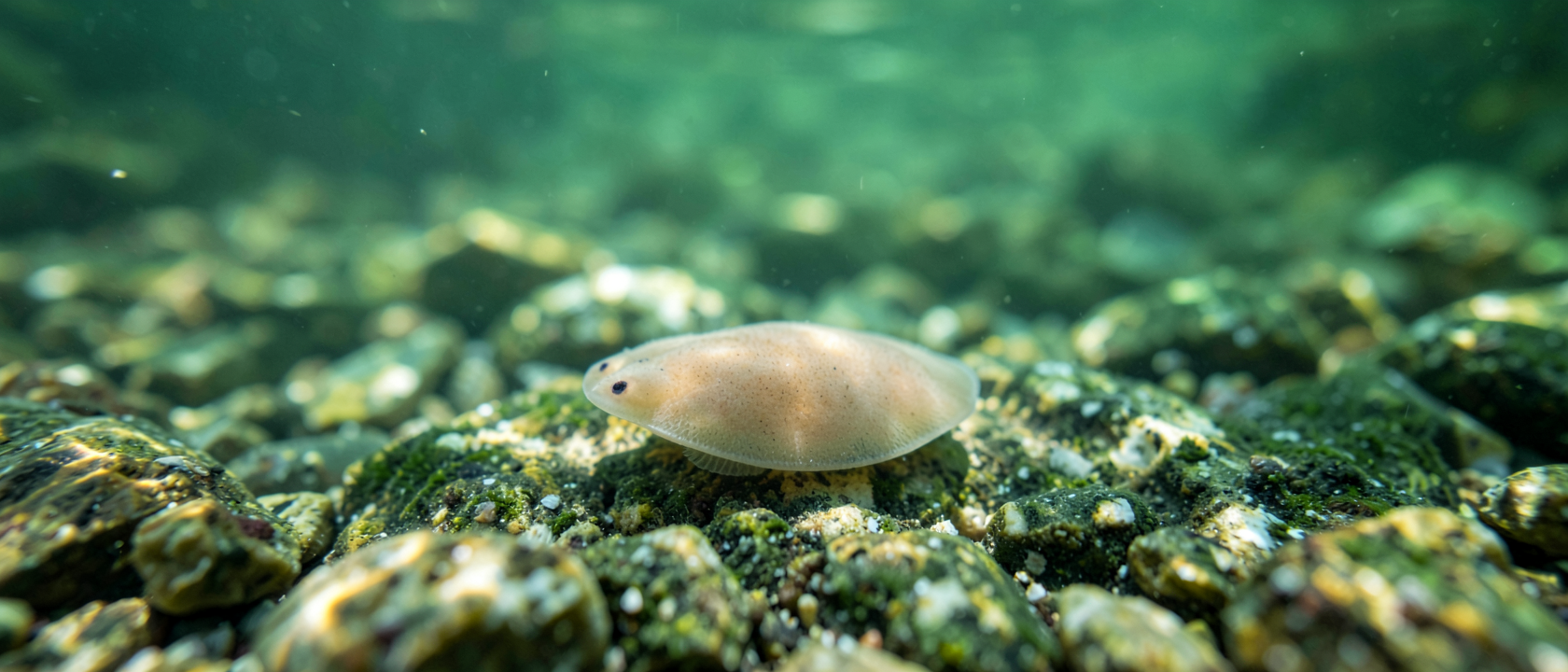
An estimated 15% of the body of Schmidtea mediterranea, a freshwater planarian, is made of pluripotent stem cells, meaning cells that haven’t committed to being any particular tissue yet and can still become almost anything the animal needs, though some estimates put that share as high as 20 to 30%. In a human body, the equivalent category of cell makes up under 1%. Slice one of these flat, pancake-shaped worms in half, or take just the head, and the stem cells left behind will rebuild the missing half from scratch: a new brain, new eyespots, a new gut, in days. The worm-splits-in-two video has been floating around the internet for years. The number behind it rarely comes along for the ride.
The Cells Everyone Suspected
When a planarian is wounded, its stem cells don’t sit still. They multiply fast and stream toward the injury like traffic converging on an accident. Researchers led by postdoctoral researcher Frederick G. Mann Jr., working in the lab of Alejandro Sánchez Alvarado at the Stowers Institute for Medical Research, mapped the tissue around those stem cells using spatial transcriptomics, a technique that records which genes are switched on in a cell and exactly where that cell sits in the tissue. The study was published in Cell Reports on October 15, 2025.
They found large, many-armed cells physically wrapped around the stem cells at the wound. The team named them hecatonoblasts, after Hecatoncheires, a many-armed monster from Greek mythology, which is a fitting name once you see one of these cells reaching around a stem cell like it’s holding a steering wheel. The obvious read was that these wraparound neighbors were the ones giving orders, the same way a foreman stands right next to the crew he’s directing. When the researchers checked the hecatonoblasts’ gene activity, that read fell apart. Genetically, the hecatonoblasts weren’t running anything. Removing them didn’t stop regeneration. Proximity, in this case, was a coincidence, not a chain of command.
Orders From Across the Body
The actual instructions, the study found, come from intestinal cells, cells that have no physical relationship with the stem cells at all. No touching, no shared membrane, no local neighborhood the way a “niche” usually works in biology. Electron microscopy backed this up: the researchers found a near-total absence of the junctions, the structural links that normally connect touching cells, between the stem cells and the differentiated tissue around them. And yet these distant gut cells were regulating where the stem cells moved and what they turned into during regeneration. That’s the finding: control without contact. The organ giving orders and the cells receiving them are nowhere near each other.
The Niche Myth, Dead
Most stem cell biology runs on the “niche” model: a stem cell behaves the way it does because of the specific physical neighborhood it sits in, the way human blood stem cells take their cues from the bone marrow cells right next to them. Swap the neighborhood, and you swap the behavior. That’s the textbook rule, and it’s the rule most science-adjacent readers already carry around without ever naming it. The Stowers team’s finding breaks it. The cells sitting closest to the planarian’s stem cells, the hecatonoblasts, turned out to be dispensable. The cells actually in charge were somewhere else in the body entirely, never touching. If proximity equaled control, this animal wouldn’t work the way it does.
What Nobody Knows Yet
How intestinal cells manage to steer stem cell behavior from a distance, with no physical link between them, is not explained by this study. The researchers describe it, not how it happens; the molecular signal that crosses that gap is left for future work. Sánchez Alvarado frames why the answer matters beyond one flatworm: most human tumors begin when stem cells stop following the rules that keep them in their lane. Figuring out what keeps a stem cell obedient, and what makes it go rogue, is the same question in a planarian gut and in a cancer clinic. He also points to a longer-term hope, that understanding this kind of control could eventually inform human regenerative medicine. That translation hasn’t happened. It’s a stated goal, not a result.
Which is the part worth sitting with longer than the worm-splitting clip ever asks you to. The viral version of this animal ends at “it grew back.” The real version ends at “we don’t yet know how it’s told to.”