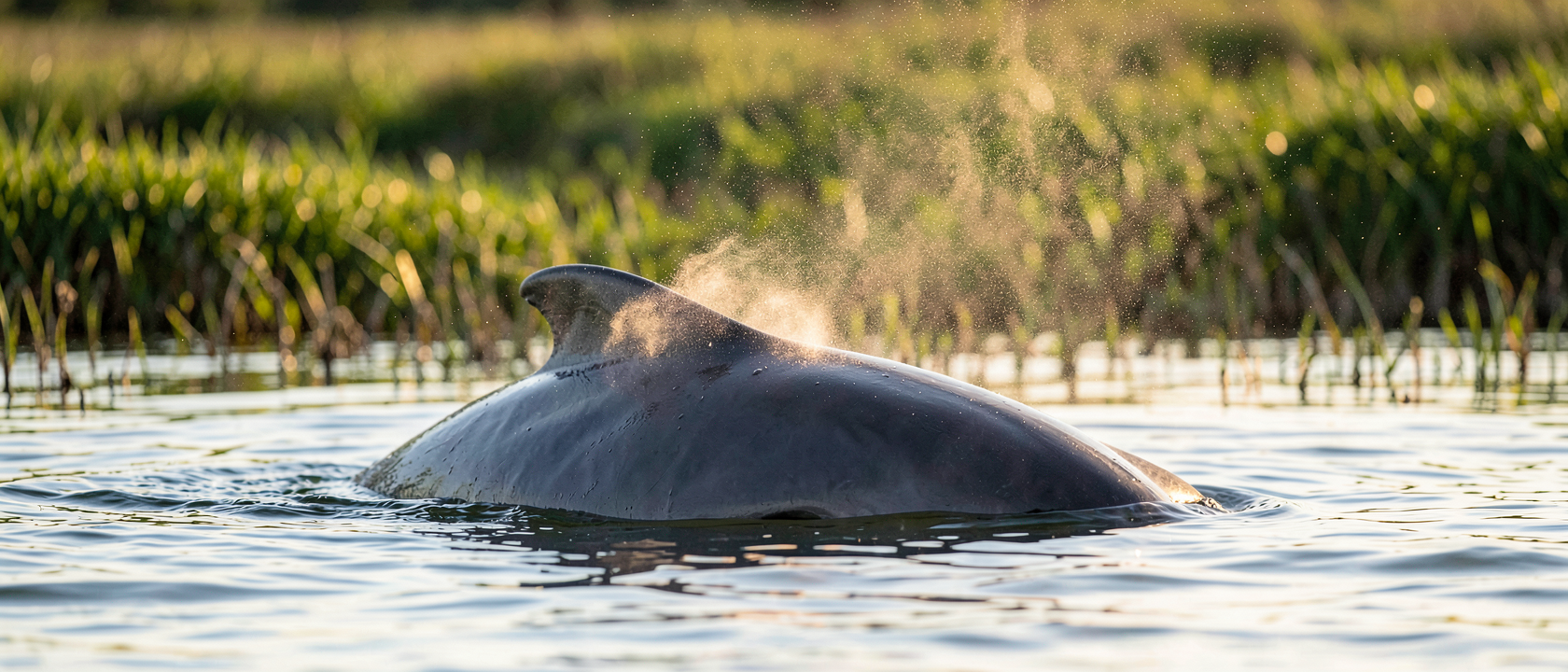
A dolphin can exhale plastic
Eleven wild bottlenose dolphins (Tursiops truncatus) had their breath tested, and eleven came back positive for microplastics. Every animal, five living in Sarasota Bay, Florida, and six in Barataria Bay, Louisiana, exhaled at least one plastic particle from its blowhole. Miranda Dziobak of the Sarasota Dolphin Research Program led the study, published in the journal PLOS ONE on October 16, 2024. The particles ranged from fibers to fragments to films. Of a subset of 17 particles whose exact polymer the team identified, more than half were polyethylene, the plastic behind shopping bags and bottles, and about a quarter were polyester, the fiber behind a lot of modern clothing. Dolphins do not only swallow plastic. They breathe it, in and out.
How you catch a breath without touching the dolphin
You cannot hand a wild dolphin a breathalyzer. Dziobak’s team worked during routine catch-and-release health checks, the brief exams researchers already run on these animals in the water. First, they cleaned the blowhole and the skin around it, wiping away anything sitting on the surface that had nothing to do with the animal’s own airway. Then, as each dolphin exhaled, a researcher held a sterile petri dish, or in some cases a customized spirometer, a device that measures the volume and flow of a breath, directly over the blowhole. Air around the boat was sampled too, as a control, to rule out particles drifting in from the breeze rather than from the dolphin. Every captured particle was checked under a microscope, tested against a heated soldering needle to see how it melted, and confirmed with Raman spectroscopy, a laser technique that reads a material’s chemical fingerprint. One recovered microfiber measured nearly 14 times smaller than a strand of human hair, small enough that it only shows up under a microscope. The method points to two likely origins: microplastic drifting off nearby land and out over the water, and microplastic already in the water, thrown airborne by waves and sea spray. Which of those two an individual dolphin actually breathes in, the study cannot say.
Why a dolphin’s lungs make this worse, not better
Bottlenose dolphins have unusually large lungs for their body size and take deep breaths between long stretches underwater, a rhythm built for an animal that surfaces on its own schedule rather than constantly. The Dziobak team flags that same trait as a reason for concern: if the air over an estuary, or the sea spray coming off it, carries microplastic, a dolphin’s deep breath could in theory pull in more of it than a shallower human breath would. That is a concern raised from what is already known about dolphin lung capacity, not a number anyone has actually measured. What it raises, without confirming, is the possibility of airway or lung irritation building up over years of ordinary breathing.
Everyone assumed it was all coming from dinner
Dziobak has said her team has been studying plastic pollution in dolphins for almost 10 years, and until this study, the story was always about the stomach. Her earlier work had already found microplastics and plastic-related chemical additives in dolphin stomach contents and in the fish these dolphins eat. That built a tidy assumption: dolphins get exposed to plastic because they eat contaminated prey. The blowhole study breaks that assumption open. Inhalation is a second, separate exposure route that nobody had measured, running alongside the one everyone already knew about. Plastic is not only arriving on the menu. It is in the air a dolphin surfaces to breathe.
Eleven dolphins, one open question
The study cannot say whether inhaled microplastic is making any dolphin sick. What it documents is exposure, not harm. It also cannot say where a given particle came from: the method that catches a microplastic in a dolphin’s breath has no way to tell whether that particle blew off a parking lot or bounced off a wave. And the sample is small, 11 animals across two estuaries, one urban and one rural. The researchers behind the study are calling for larger studies, covering more individual dolphins and other marine mammal species, before anyone turns this into a statement about actual risk.
Even the porpoise nobody has heard of wasn’t safe
Richard Sabin, Principal Curator of Mammals at the Natural History Museum in London, was not involved in the study, but he keeps his own case on file. In 2017, a spectacled porpoise, a species found only in the remote, rarely visited waters of the southern hemisphere, was brought to the museum and found to have plastic in its gastrointestinal tract. One porpoise, one specimen, not a trend. Sabin has also said he would expect large baleen whales to show similar results if anyone tested them. Sabin is speculating from experience, not reporting a test result, and nobody has yet run that test. But it points at the same widening frame the blowhole study opens: if a porpoise almost nobody encounters was still carrying plastic, there may be no ocean left where an animal gets to breathe clean air. Which raises an odd little question for the rest of us: if you have ever watched dolphin footage and felt nothing but delight, this is the part of the story that was always swimming just underneath it.