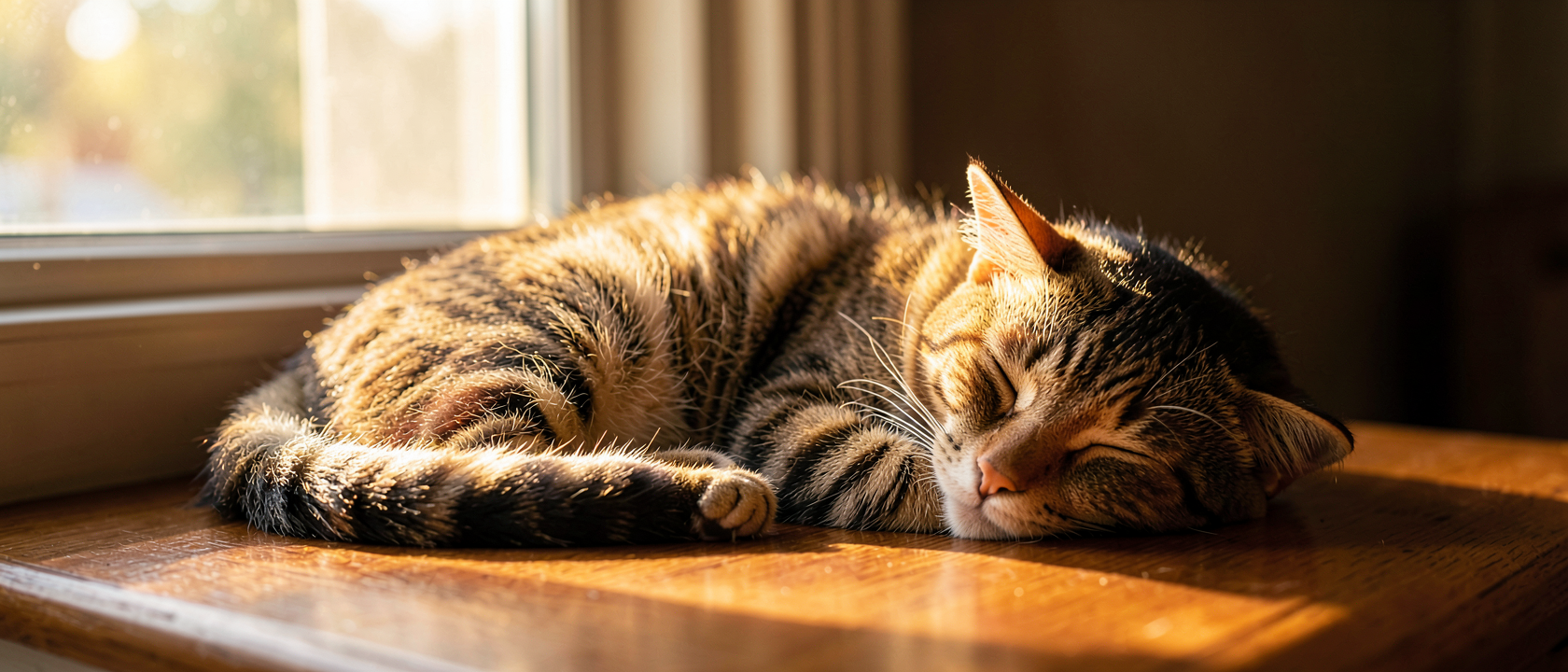
Two in Three Cats Have a Side
Of 408 YouTube videos showing cats asleep or resting, roughly two out of three cats came down on their left side. That is not a coin flip. Behavioral neuroscientist Onur Güntürkün of Ruhr University Bochum, working with researchers from the University of Bari Aldo Moro, Medical School Hamburg, and collaborators in Canada, Switzerland, and Turkey, ran the numbers and published them in Current Biology on June 23, 2025. Nobody wired a single cat to an EEG machine for this. The team just watched ordinary footage, cats sleeping in front of a phone camera, and logged which side each one favored. The leftward pattern was strong enough to fail a basic test of pure chance (chi-square = 22.9, p < 0.001, the kind of statistic that rules out coincidence). If you have noticed your own cat always flops onto the same flank, you were tracking something real. You just didn’t have the mechanism yet.
Sleeping With One Hemisphere on Duty
A cat lying on its left side keeps its left eye, and with it its left visual field, aimed out at the room. That field is wired to the brain’s right hemisphere, the side that specializes in spatial awareness, threat detection, and organizing a fast getaway. The left-side lean, in other words, isn’t about which cushion feels softer. It’s positioning. The half of the brain built to notice danger first gets first look at whatever crosses the room. “Asymmetries in behavior can have advantages,” Güntürkün has said, “because both hemispheres of the brain specialize in different tasks.” Sleep doesn’t switch that specialization off. It just runs it from a horizontal position.
Vigilance Was Already the Whole Plan
Domestic cats sleep 12 to 16 hours a day, and the study’s authors note they spend roughly 60 to 65 percent of their lives in that half-conscious, defenseless state. They already burn part of that time picking exposed, elevated ground, a cat tree, a windowsill, the top of a stacked suitcase pile, for the sightline it gives them while unconscious. The researchers propose the leftward bias as the same logic, applied one level finer: not just where a cat sleeps, but which side it lands on once it’s there. Wake up hunting or fleeing, and the eye that was already facing the room feeds straight into the hemisphere built to react first. It’s the same strategy showing up in body angle instead of address.
What 408 Videos Can’t Tell You
Güntürkün’s team is direct about the limits of a video archive. A YouTube clip doesn’t reveal a cat’s sex or whether it was pregnant, two variables the authors say they could not rule out as contributors to the pattern. The clips weren’t sorted by breed, age, or what the room looked like, either. And nobody has actually clocked reaction times: no one has timed how fast a left-sleeping cat startles awake compared with a right-sleeping one. The faster-escape idea rests on where the visual field points and which hemisphere receives it, a mechanism that makes sense on paper, not a stopwatch result. In their own words, the authors say additional factors cannot be excluded.
Off Duty, Never Off Duty
Picture it from the cat’s side: flat out in a sunbeam, eyes shut, looking for all the world like it has clocked out completely. One whole hemisphere is still on shift the entire time, watching the doorway like a night guard who never quite lets himself drift off.