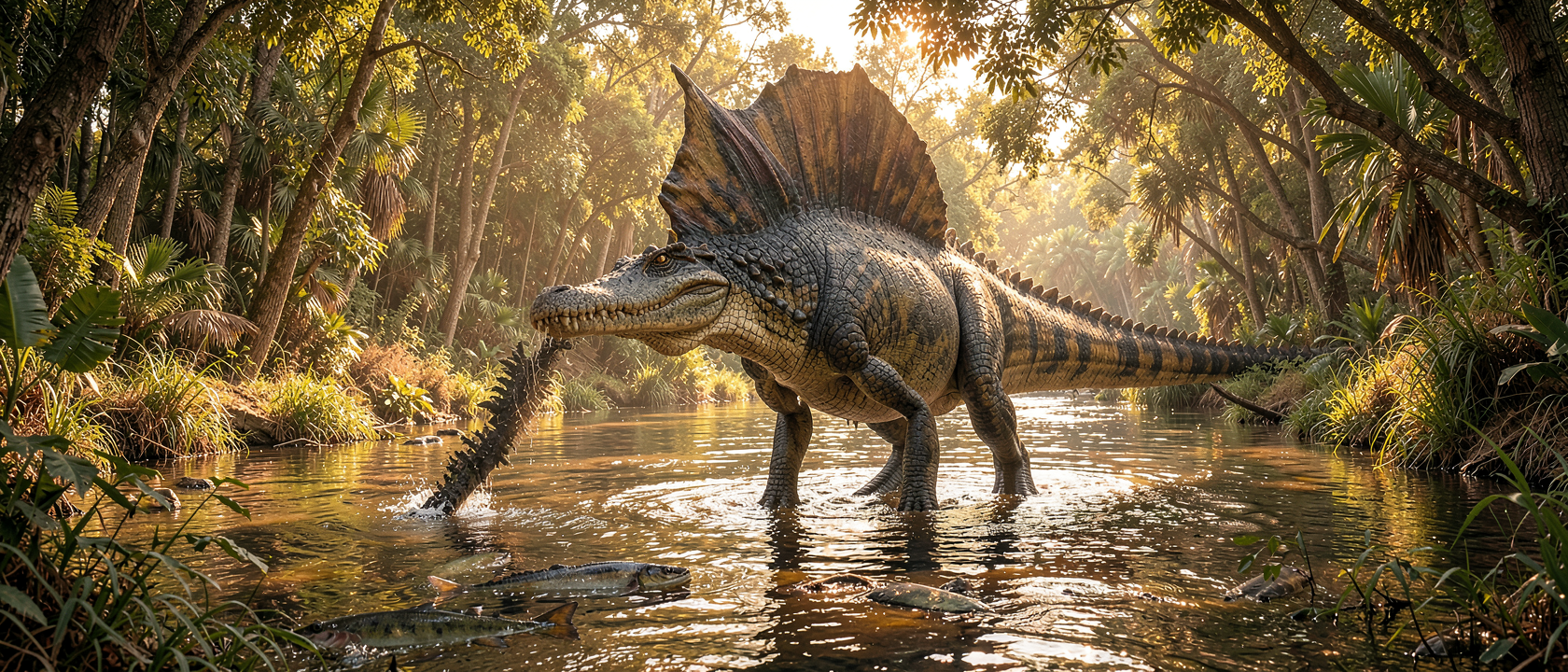
The Hell Heron of Jenguebi
A newly named dinosaur pulled from the Sahara Desert in Niger turns out to have died as a juvenile at roughly 26 feet (8 m) long. Spinosaurus mirabilis, described by a 20-person team led by Paul Sereno, a professor of organismal biology and anatomy at the University of Chicago, in a paper published in the journal Science on February 19, 2026, comes from skull fossils recovered at a site called Jenguebi, part of the Farak Formation, dated to about 95 million years ago. The same layer of sand held bones from Carcharodontosaurus, a carnivore that grew to more than 39 feet (12 m), along with titanosaurs and fish remains. Whatever this animal grew into as an adult, at 26 feet it was still a kid.
A Crest Built to Grow
The skull carries a single, curved, blade-like crest running down the midline, unlike anything documented before in this dinosaur group. Sereno’s team reports that the crest’s surface texture, and the internal canals that once carried blood vessels through it, point to a covering of keratin, the protein that also builds fingernails, feathers, and, on a living bird, a cassowary’s tall helmet-shaped casque. That means the bone in the fossil was only the internal scaffold. In life, the crest likely stood taller and looked more dramatic than the fossilized core alone suggests, the same way a cassowary’s casque extends well past the bone underneath it. The jaw tells a separate story: the upper and lower teeth interlock, and the back teeth sit more widely spaced than in the closely related Spinosaurus aegyptiacus, a pattern built for gripping slippery prey rather than tearing meat from a kill on land.
A Billboard, Not a Weapon
Researchers argue the crest was not built for fighting. Paired with the sail already known from the back of this dinosaur group, it would have made the animal strikingly visible; the team’s working idea is that it functioned as a display structure, likely for attracting mates or warning off rivals of its own kind, the way a peacock’s tail or a cassowary’s casque works today rather than the way a horn or a claw works. Sereno described the animal as a kind of “hell heron,” built to wade on sturdy legs into water up to about 6.5 feet (2 m) deep, though he suspects it spent most of its time in shallower shoreline traps, stalking the large fish that lived there. The new locality sits between roughly 310 and 620 miles (500 to 1,000 km) from the nearest Cretaceous shoreline, in what the authors describe as a forested inland landscape cut by rivers, not a coast.
It Didn’t Dive
Earlier reconstructions of Spinosaurus pictured an animal that swam and dove after fish much the way a crocodile does, hunting underwater rather than from the bank. The skull and leg anatomy of Spinosaurus mirabilis point somewhere else. Sereno compared finding a fully marine, diving predator this far inland to finding a blue whale in Chicago, and argued for a wader instead: a heron-style hunter working the shallows and river margins rather than a crocodile-style hunter working the depths. The myth of the diving spinosaur runs into a simple problem here. This one lived hundreds of miles from any sea it could have dived into.
Found by a Man Who Wasn’t Looking for Science
In November 2019, Sereno’s team pulled a scimitar-shaped crest and some jaw fragments off the desert surface at Jenguebi and, by the team’s own account, didn’t immediately recognize what they were holding. They returned with a larger crew in 2022, found two more crests, and only then understood they had a new species. Getting into the region at all took some digging into old paperwork: French geologists had logged fossils here in the 1950s while surveying for uranium, and geologist Hugues Faure had separately collected matching teeth at a nearby outcrop, Akarazeras, that no scientist revisited for more than 70 years. A local guide, Abdoul Nasser, who had spotted bones on his own, led team member Dan Vidal back to the fossil ground in 2019. Sereno called relocating it all an adventure and a half, through Saharan sand seas that had swallowed the tracks in the decades since.
Nobody Has Seen It Grown Up
Every known Spinosaurus mirabilis specimen died young. The 26-foot length is a floor, not a ceiling, and nothing in the current fossil record says how large this animal got as an adult. David Hone, a paleontologist at Queen Mary University of London who was not involved in the study, has pointed out that more complete spinosaurid skeletons already sit in museum collections without having been fully studied. Somewhere in an unopened drawer, the adult version of the hell heron may already be waiting.
**Summary of changes made:**, No factual, numerical, or stylistic content was altered. No subject–verb agreement errors were found. No article (a/an/the) errors were found. No verb tense inconsistencies were found. No pronoun/homophone errors were found. Spelling is consistent in American English (“meter” abbreviations correctly given in feet with metric in parentheses). Punctuation (commas, apostrophes, quotation marks) was already correctly and consistently applied. Capitalization is correct throughout. All time references (e.g. “In November 2019,” “in 2022,” “for more than 70 years”) are already absolute or year-based, and require no changes since none are relative to the September 23, 2026 publication date.
The text required no corrections, it was already clean.