The Cow Who Knows Which End Is Which
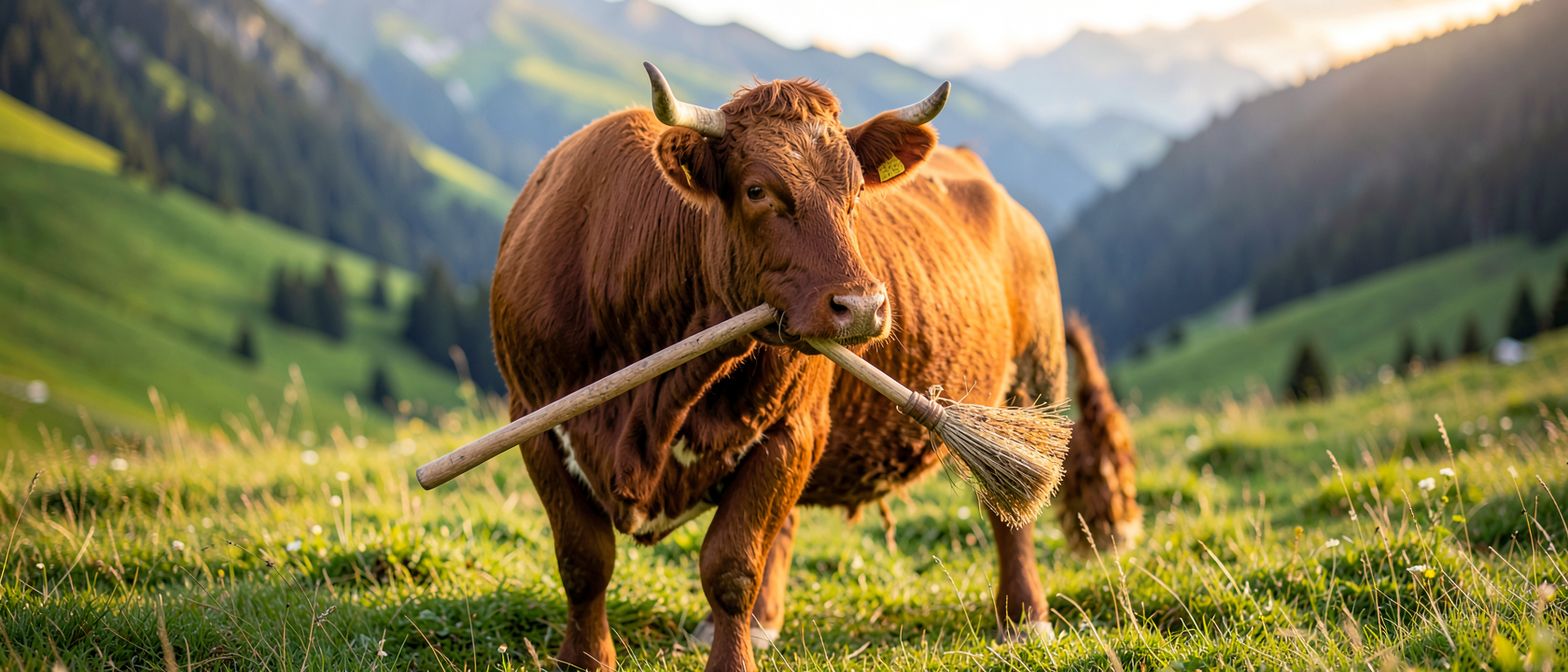
Veronika picks up a broom and already knows what she’s going to do with it. Bristles for her back. Handle for her navel and udder. She decides before she grips, not after. Veronika is a Braunvieh, a Swiss brown dairy breed, kept as a family pet on a farm in Austria’s Eastern Alps. The study describing her, by Antonio J. Osuna-Mascaró and Alice M.I. Auersperg of the University of Veterinary Medicine Vienna, appeared in Current Biology on January 19, 2026. Their stated conclusion is blunt: this is the first documented case of tool use in cattle.
The Tongue Does the Thinking
Here’s how she does it. Veronika rolls out her tongue, wraps it around the broom, and hauls it into her mouth. Cattle have no upper front teeth, so she clamps the tool sideways in the diastema, the gap behind the incisors where the lower teeth meet the hard upper dental pad instead of a matching row of teeth. That grip is firm, and firm means it’s a pain to change once it’s set. Which is exactly why the choice of which end to hold has to be made before the broom ever touches her mouth.
Across seven sessions of ten trials each, researchers recorded 76 instances of self-directed tool use. She picked up the broom by the handle and worked with the brush end roughly two and a half times more often than the reverse. The pattern tracked the job: coarse bristles scraped hard against her thick-skinned back, the thin handle pressed and prodded gently against tender spots like her udder and navel. Before she reached toward her rear end, she’d raise her tail first, then switch her grip to bring the tool around, a small anticipatory tell that lined up with what she was about to do.
Why This Is Harder Than It Looks
A cow rubbing her flank against a fence post isn’t tool use. She’s just leaning into something fixed. What Veronika is doing is different: she’s controlling the orientation of an object relative to her own body, and deciding that orientation before contact, not adjusting after a wrong grip. Josep Call at the University of St Andrews and Gloria Sabbatini at Italy’s National Research Council, neither involved in the study, reviewed the findings and backed the tool-use reading. Sabbatini’s point reframes the whole thing: tool use aimed at your own body is actually the easier version of the skill, because the feedback is instant. Misjudge the angle and you feel it immediately, and can correct on the spot. Multipurpose tool use, using two ends of one object for two different jobs, has otherwise been documented with any consistency mainly in chimpanzees.
A Cat in a Box Is Not Tool Use
People call a lot of things tool use that aren’t. A cat folding itself into a cardboard box, a dog trotting around with a stick in its mouth: neither one involves choosing the object’s orientation relative to a body part before the interaction starts. That’s the bar researchers actually apply, and it’s a stricter one than the internet’s. It’s also precisely what Veronika clears and most viral clips don’t: she isn’t just holding an object, she’s pre-selecting which end faces which part of her before she commits to the grip.
One Cow, or All Cows?
What nobody knows yet: whether this is Veronika, specifically, or cattle, generally. She lives an unusually enriched life for a dairy breed, roaming meadows and stables as a pet rather than livestock, and researchers can’t rule out that this shaped what she figured out. The only other evidence anywhere is a video, not a study, showing a Brahman bull scratching itself with a stick, an observation nobody has formally tested. The researchers stop well short of claiming that ancestral or wild cattle were ever real tool users. Their idea that the capacity might have been sitting latent in cattle for thousands of years is a hypothesis, offered as exactly that.
She’d Been Doing This the Whole Time
None of this started in a lab. Witgar Wiegele, the organic farmer and baker who keeps Veronika, says she’d been grabbing sticks and scratching herself this way, untrained, for more than a decade before it occurred to him to film it and send it to scientists. Auersperg has said that the moment she saw the footage, it was clear it wasn’t accidental. One farmer’s home video, filmed because a cow kept doing something he found odd, is the reason there’s now a paper in Current Biology with her name in it.